

Homemade steam engine ready to rumble as Prince’s Grant doctor completes seven-year project
Dr Tinus Deysel said he had set a personal goal for himself with the project, attempting to make as much as he could himself by hand, sometimes even modifying equipment he had in the workshop rather than buying specific tools.
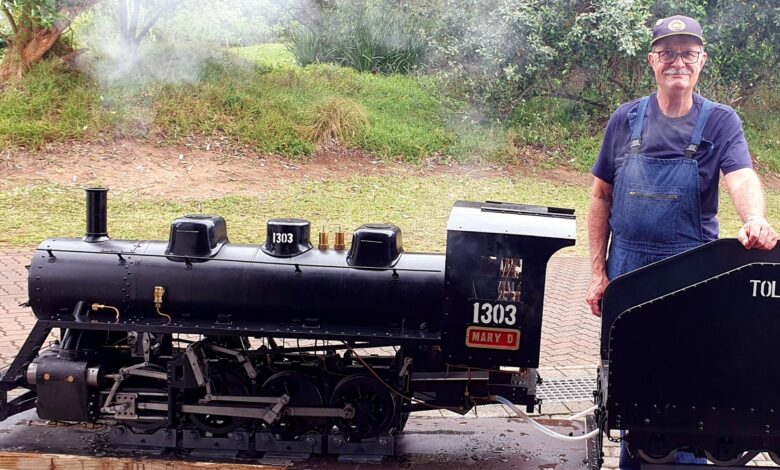
A seven-year project has come to an epic end for Prince’s Grant Golf Estate resident Dr Tinus Deysel, who celebrated the completion of a mini shunting locomotive which he built from only a photo.
The desire to build the locomotive has come a long way and was sparked by a browsing session at Durban’s Adams Bookshop way back in the 80s.
The semi-retired North Coast general practitioner moved here in 1982 after completing his national service in Oshakati in Namibia and finishing his studies at the University of Pretoria in 1979.
An avid reader, Deysel would frequent bookshops whenever he went to Durban back in the day, leaving his wife to do the shopping while browsing the Adams Bookshop shelves in search of interesting reads.
“We always parked in Pine Parkade as the central business district of Durban was the place to shop, eat and drink. Adams had several floors packed with books,” Deysel recounted with fondness.
One day one book in particular caught his attention – ‘How to build a model steam locomotive’.
It was at that moment that his interest was piqued, and he wanted to attempt building his own locomotive.
“Needless to say, I was frowned upon for wanting to attempt this project, being a medical doctor and not an engineer,” he said, but that did not deter him in the slightest.
It took Deysel three years to build a smaller 1/12 scale steam locomotive, completed in 1992.
It was at that time that he joined the Durban Society of Model Engineers, but he abandoned aspirations of starting work on another locomotive, instead turning to knifemaking and bookbinding, among other hobbies.
Years would go by before he again began thinking of tackling another locomotive.
“The spark was rekindled seven years ago while searching the internet and discovering a photo of an American and Canadian shunting locomotive, which I decided would be the locomotive to build,” he said.
After his daughter helped him source a book from America, he got to work.
Deysel made the parts himself, even the patterns for the wheel and cylinder castings for which he used Jacaranda wood.
“These were then cast for me by a foundry in Isithebe,” he said, noting the only parts bought were cap screws, nuts and a few bolts, as well as the pressure gauge.
“The actual locomotive was built using lengths of flat steel bar, round steel bar, round cast iron bar, bronze and brass. I did the welding of the boiler myself as well,” he said.
Deysel said he had set a personal goal for himself with the project, attempting to make as much as he could himself by hand, sometimes even modifying tools he had in the workshop rather than buying specific tools.
“There was much hacksawing and filling done in my workshop,” he laughed.
With the project now completed, Deysel will in early November celebrate the inaugural run of Mary D, named after wife Marié-Daleen, at the Pietermaritzburg Model Engineering Society where a suitable track could be found.
“I saw this as a fun and challenging project. The challenge consisted mostly of problem solving as I did not have any detailed plans for the locomotive.
“The fun part was solving these problems. The locomotive will now be used to run at our club as a special kind of big boy toy. As with many things in life, the journey was more important than the destination.”
Follow The North Coast Courier on Facebook, Twitter, Instagram & YouTube for breaking news
Telegram Broadcast Service: https://t.me/joinchat/yJULuN8NaCs5OGM0

Stay in the loop with The North Coast Courier on Facebook, X, Instagram & YouTube for the latest news.
Mobile users can join our WhatsApp Broadcast Service here, or if you’re on desktop, scan the QR code below.