

Rare duckbill ray rescued from tidal pool at Thompson’s Bay
The species is critically endangered, making rescues all the more important.
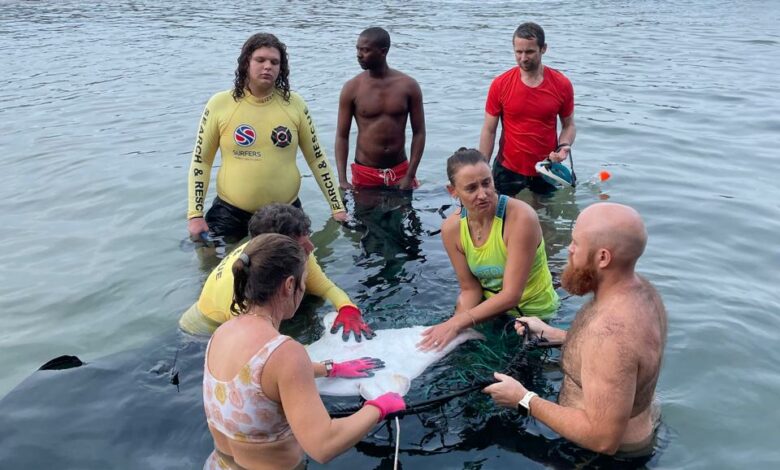
Beachgoers at Thompson’s Bay witnessed an unusual scene last Tuesday as scientists, lifeguards and volunteers worked to rescue a rare duckbill ray trapped inside Charlie’s Pool.
Marine conservationists responded after the critically endangered animal was spotted swimming in the popular tidal pool, prompting a co-ordinated rescue and release operation.
The ray was identified as Aetomylaeus bovinus, also known as the bull ray or duckbill eagle ray – a large stingray species found along the coasts of Europe and Africa.
Video clips courtesy of Tessa Duane of the Dolphin Coast Conservancy.
In KwaZulu-Natal, the species is typically seen during summer months when it moves closer to shore to feed on crabs, mussels, squid and fish.
In February, two spotted eagle rays were seen in a rock pool at Ballito’s Clarke Bay, although no rescue was required.
Last week’s operation was led by South African Association for Marine Biological Research (SAAMBR) scientist Dr Chantel Elston, who manages the Oceanographic Research Institute’s (ORI) Co-operative Fish Tagging Project.

She was joined by SAAMBR’s lead scientist for linefish and marine protected areas, Dr Ryan Daly, and Quentin Power, commander of Ballito’s Specialised Rescue Unit. They were assisted by Alicia McArthur and Tessa Duane of the Dolphin Coast Conservancy, KwaDukuza lifeguards and members of the public.
It is unclear how the ray became trapped in the tidal pool, but researchers suspect it may have been caught and released there by fishermen. Daly said similar incidents have occurred before.
“The ray showed signs of exhaustion and was very lethargic. It had scuff and scratch marks on its back, with chafing on its wing edges, likely from trying to escape,” he said.
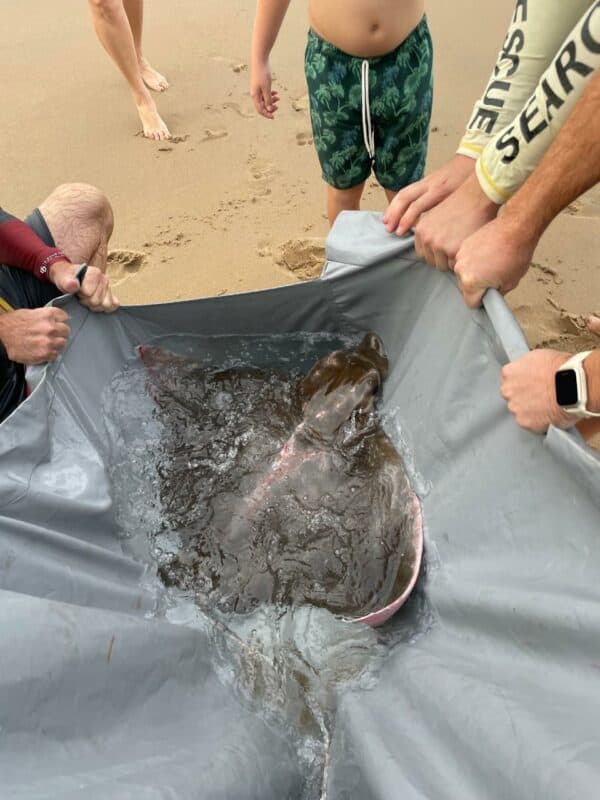
“Fishermen have, over the years, placed sharks and rays in rock pools for unknown reasons – possibly for entertainment or to avoid catching them again.”
The ray measured 99cm in disc width and is believed to be sexually mature. Daly said such encounters are rare in KZN.
“By tagging the ray, ORI can track its movements and better understand the species along our coastline,” he added.
Stay in the loop with The North Coast Courier on Facebook, X, Instagram & YouTube for the latest news.
Mobile users can join our WhatsApp Broadcast Service here, or if you’re on desktop, scan the QR code below.