

Stranded lesser flamingo rescued from Ballito beach [Watch]
Flamingos are no strangers to South Africa, but spotting them on Ballito’s beaches is a rare sight.
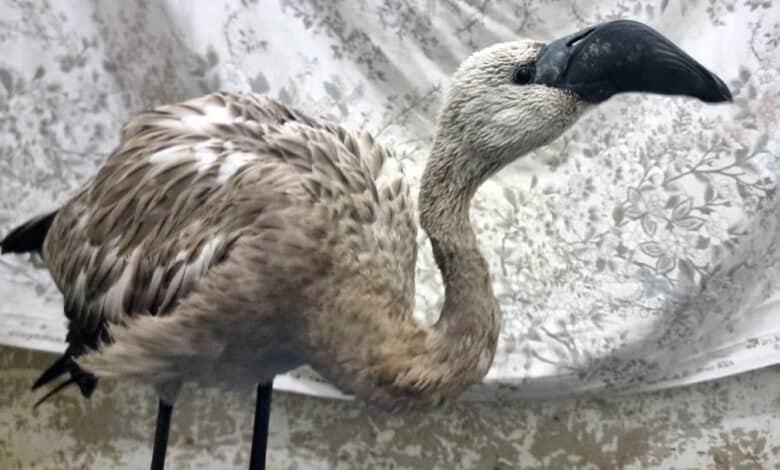
A dehydrated and exhausted juvenile lesser flamingo was rescued after being likely displaced to Willard Beach last week.
Wildlife Rescue’s Lindy Elmes was alerted to the bird by residents and rushed to the beach on September 1 to rescue it. Once safely captured, the flamingo was transferred to the Centre for Rehabilitation of Wildlife (CROW) in Durban for treatment and monitoring.
It remains in CROW’s care and is recovering well.
While flamingos are found in South Africa and can occasionally be seen along the coast, their appearance on Ballito’s beaches is rare.
Two species occur in South Africa: the greater flamingo and the lesser flamingo, which is the smaller of the two. Both species are typically found in open, shallow saline-alkaline wetlands, including salt pans, coastal lagoons and estuaries. The largest nearby concentration is generally found at iSimangaliso Wetland Park.
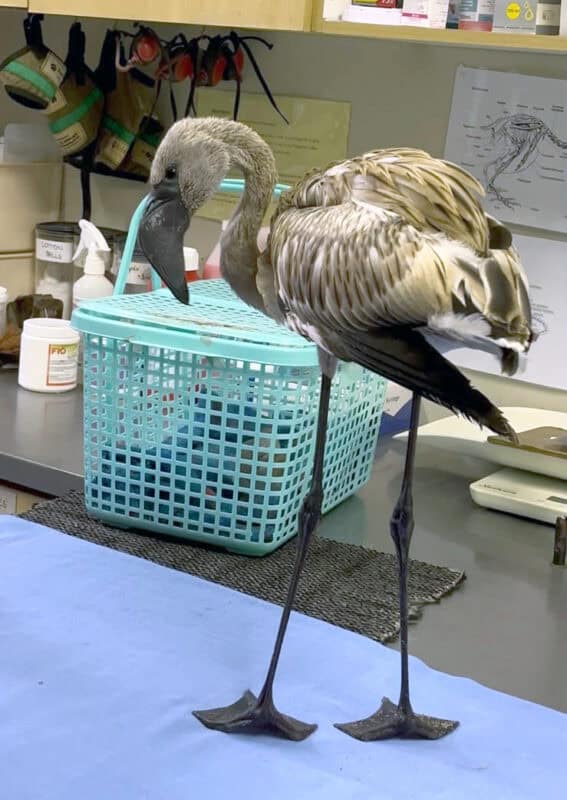
Photo: CROW.
While the reason for the young bird’s arrival in Ballito is unknown, conservation biologist Tania Anderson, a member of BirdLife South Africa’s Flamingo Research and Conservation Group, said there were several possible explanations.
“Sometimes individuals can be blown off course during storms, or they could be physically compromised by disease or simply not be as strong as other juveniles in the flock as they move between wetlands,” she said.
“The lesser flamingo appears to partially migrate between Namibia, Botswana and wetlands in South Africa, but not as regularly as true migrating birds that move annually between summer and winter feeding and breeding grounds.
“Their movements are more nomadic in nature, seeking out the most suitable feeding grounds if needed.”
Juvenile flamingos depend on their parents for food and are fed ‘crop milk’, a highly nutritious liquid produced by both parents.
This dependence makes separation from the flock particularly challenging for a young bird. As adults, lesser flamingos move in large flocks, often with greater flamingos. They generally travel between wetlands at night.
“The species feeds by wading in shallow water, with its bill upside-down, filtering cyanobacteria from the water surface and small diatoms from the mud surface,” said Anderson.
Although its journey to Ballito remains a mystery, the juvenile flamingo will have a chance to find its way back to the flock once it is fully rehabilitated and released into the wild.
Stay in the loop with The North Coast Courier on Facebook, X, Instagram & YouTube for the latest news.
Mobile users can join our WhatsApp Broadcast Service here, or if you’re on desktop, scan the QR code below.