

#TwoBits: Has tipping culture gone too far in South Africa?
A smile and cheerful service will earn a decent tip. A grumpy waitron can go fish!
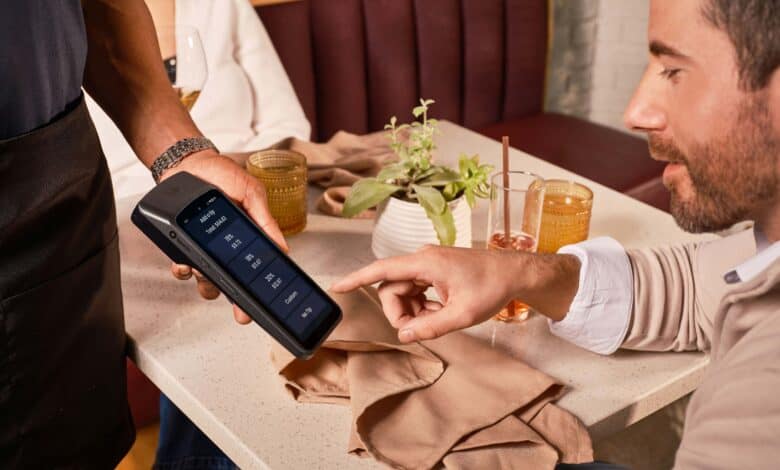
I am not a coffee person.
I do not know the difference between an Americano and a piccolo latte and I really don’t care that I don’t know. I’m happy with an instant coffee now and then but really, I prefer strong Ceylon tea.
With one exception. I do enjoy an iced coffee on a hot day. Every couple of weeks I go to a car wash and walk over to a nearby coffee shop to wait and scroll through my phone. Which is where I encounter a dilemma and the subject of this week’s column.
The routine is this: go to the counter; order an iced coffee; wait a few minutes; the server hands you your coffee. Then you are presented with a little Yoco card terminal. As you can see in the above photo, the price is R46. A tip is then suggested, at 10, 15 or 20 percent or an amount of your choosing. At the bottom is a bar that the customer must press to cancel the tip. All clear.
However, if you wave your card or phone over the terminal without making any choice, it rounds up the bill to R50, an increase of 8.7 percent. So it sommer decides to award itself a tip!
On the other hand, if you’re like me, you think: “What exactly has the coffee person done to deserve a tip? Apart from their job of making coffee?”
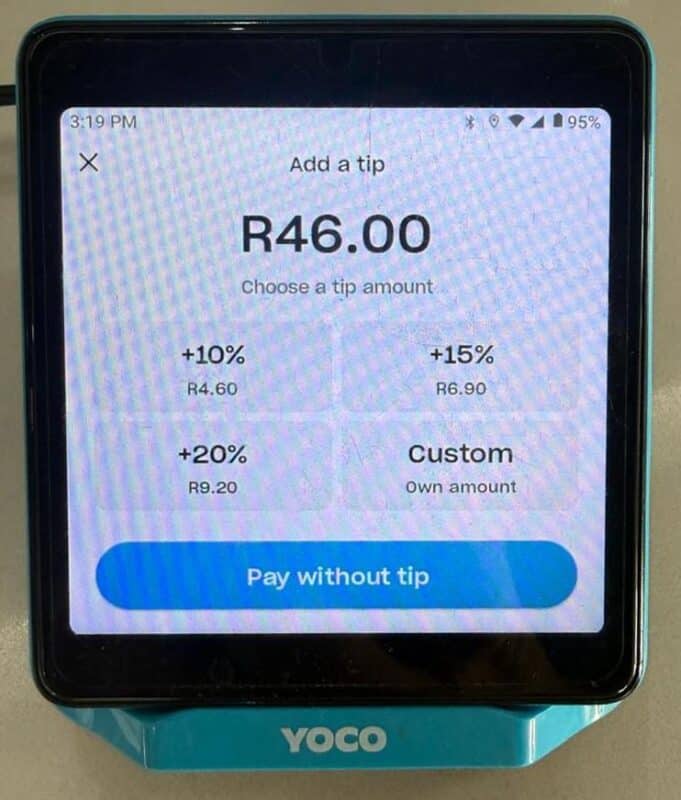
The answer is “nothing.” So I have learnt to hit the blue “No Tip” button that is designed to make me feel bad about wrenching coins from a starving person’s dying grasp. Am I being mean?
Last week the Courier posed the question on Facebook: “What do you think about tipping and how much?”
The majority agree with tipping of 10-20 percent. Some said they tip only for good service, while a minority objected to tipping. Others said employers should pay a decent wage and customers should not be expected to subsidise them.
I think the debate in SA about tipping is heavily influenced by social media with its bias to American values. It is my understanding that American restaurant owners, for instance, are not obliged to pay a minimum wage. Tips are expected to make up waiters’ wages. Whereas in South Africa, labour law stipulates that restaurant owners should pay at least minimum wage and tips cannot be counted towards that minimum.
Tipping practices vary worldwide, from the Far East (Japan, China, for example) to Australia, New Zealand, Spain and Scandinavia, where tips are not expected (though not rejected), to the US and Canada where 15-20 percent is common. In the US your bill can swell alarmingly with city and state taxes on top, plus sometimes a service charge! Then I get bitter!
Why do we tip waiters but not sales assistants, for example, is a question without a straightforward answer. One study found a positive but relatively weak relationship between service quality and tip size – weak enough to question tips as a dependable measure of staff performance.
“Rewarding good service” is only part of the explanation. Customers often describe tips as rewards for service, but there is also a simple inconsistency in percentage-based tipping: carrying a R1 000 bottle of wine does not necessarily require five times the work of carrying a R200 bottle, yet a fixed-percentage tip is five times as large. So tipping customs do not form a consistent scale of how hard people work or how valuable their service is. (I do tip car guards R5, though in an increasingly cashless society, who carries cash? That leaves notes. I might part with a rhino or an elephant, but not a lion or a buffalo, no way!).
The central distinction is between explaining the custom and justifying it. A waiter can reasonably anticipate tips in a workplace where they are established practice, while a customer can reasonably question why staff remuneration is not fully reflected in the advertised price.
Economically, customers fund staff costs either way – through the restaurant’s prices, a service charge, a tip, or some combination. The disagreement is largely about whether that payment should be transparent and predictable, or discretionary and dependent on each customer.
For me, the waiter’s attitude is everything.
A smile and cheerful service will earn a decent tip. A grumpy waitron can go fish!
Stay in the loop with The North Coast Courier on Facebook, X, Instagram & YouTube for the latest news.
Mobile users can join our WhatsApp Broadcast Service here, or if you’re on desktop, scan the QR code below.