
Minister marvels at SA science
AUCKLAND PARK - Several of the top dogs in the world of physics and science gathered at the University of Johannesburg last week as Minister of Science and Technology Naledi Pandor officially opened the 2014 South African Institute of Physics (SAIP) annual conference.
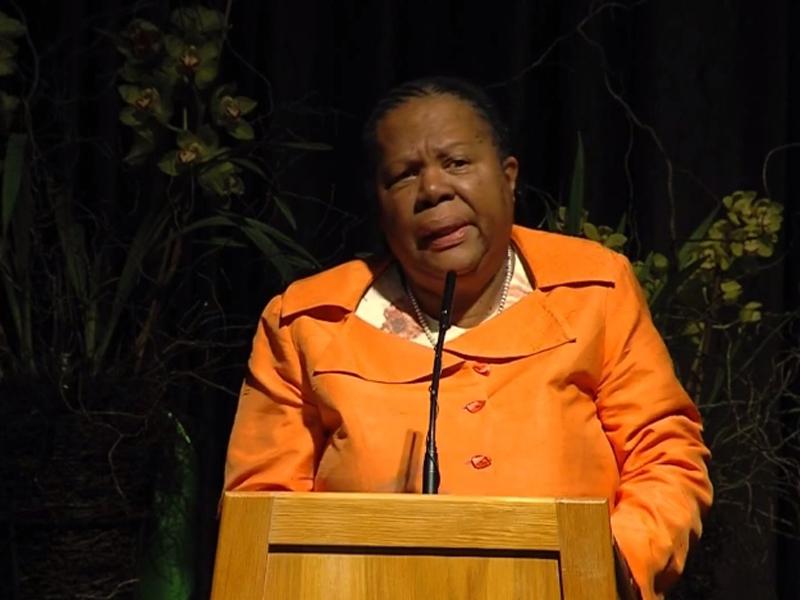
This four-day conference, hosted by the university’s Faculty of Science, attracted over more than 490 physicists from around the country.
Minister Pandor said it was an exciting time for science in South Africa.
“We have two huge scientific undertakings – MeerKAT and the Square Kilometre Array (SKA) – in our country right now,” she said.
MeerKAT is a radio telescope under construction in the Northern Cape. It’s billed to be the largest and most sensitive radio telescope in the southern hemisphere until the Square Kilometer Array is completed in 2024.
The Square Kilometre Array (SKA) will be the world’s largest and most sensitive radio telescope, about 50 times more sensitive, and up to 10 000 faster than the best radio telescopes of today. It will be so powerful it will be able to sense radio waves from objects billions of light years away from us. All this in our own backyard.
“I hope this conference will strengthen our international collaboration on key projects such as the SA-CERN programme, the Joint Institute for Nuclear Research (SA-JINR), MeerKAT, the Cherenkov Telescope Array (CTA) and the SKA,” the Minister continued.
Professor Hartmut Winkler, the conference chairman from the university’s Faculty of Science said that the last big Institute of Physics conference the university had hosted was in 2000, when the institution had a different name.
“This conference is happening at a time when there are several major developments generating excitement not only in the physics community but in broader society as well. A lot of the scientific discussions at the conference are expected to focus on these developments as well as the potential of new discoveries,” he said.
Prominent speakers included Professor Andrew Forbes ofThe Council for Scientific and Industrial Research (CSIR); Professor Emmanuel Tsesmelis of the European Organisation for Nuclear Research (CERN) and Oxford University, Prof Toshimi Suda of Tohoku University, Japan; nanoscientist Prof Eric Fullerton of San Diego University, USA; photovoltaics expert Prof Vladimar Djakanov, based in Germany; photonics specialist Prof Miles Padgett of Glasgow University; astrophysicist Megan Donahue of Michigan University, USA; Prof Cedic Linder from Uppsala in Sweden, and Prof Marcia Barosa from Brazil.
The conference opening wasn’t all about the marvels of science. For a breather in between the big concepts, the Soweto Marimba Youth League showed their stuff on stage, and made the Minister in particular, smile. She said as much.
“In 2013 François Englert and Peter Higgs won the Nobel prize in Physics for their work in predicting the existence of the Higgs boson,” she concluded.
“Time waits for no man or woman in the physics world. Now it’s the turn of some of the younger members in the audience to add to the number of Nobel prizes.”