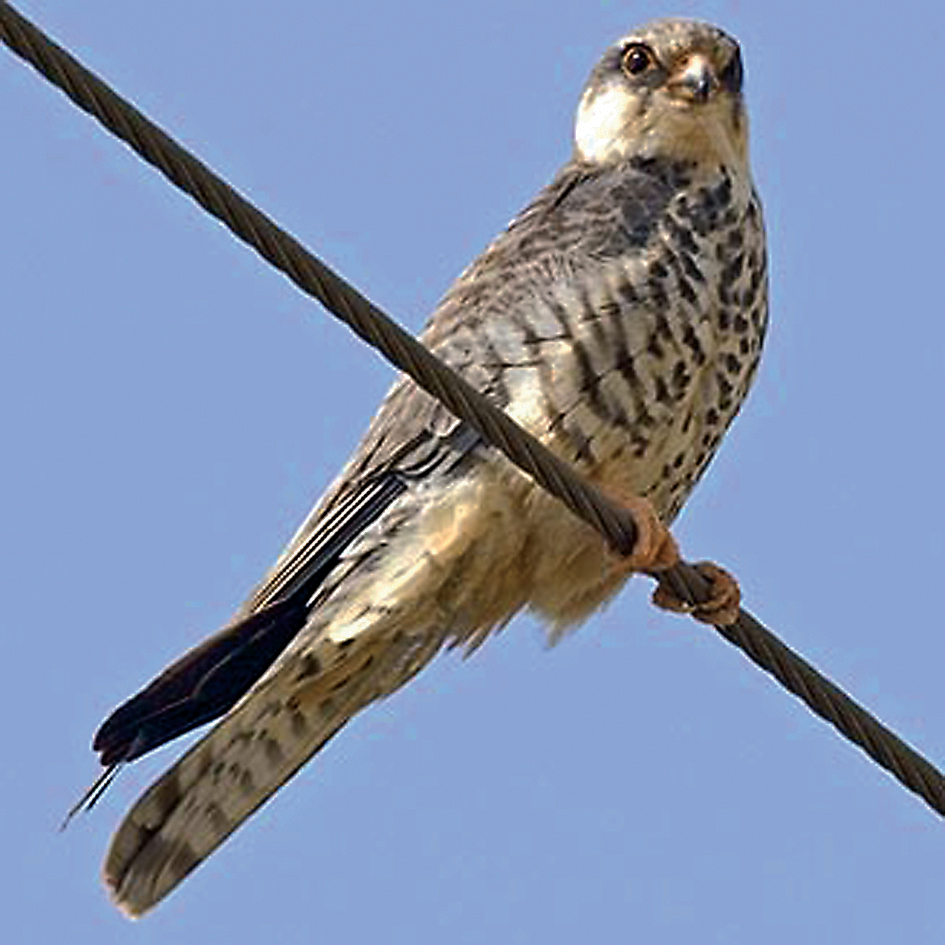
THE COLONY of Amur Falcons that come to Vryheid each year for our summer, arrived in town a bit earlier this year. In 2012 they arrived between December 4-6; this year the vanguard was seen on November 25, and hundreds more had flown in by November 27. On Monday evening this week, there were perhaps …
A female Amur falcon – Pic Biodiversity.THE COLONY of Amur Falcons that come to Vryheid each year for our summer, arrived in town a bit earlier this year. In 2012 they arrived between December 4-6; this year the vanguard was seen on November 25, and hundreds more had flown in by November 27. On Monday evening this week, there were perhaps a couple of thousand in the sky above Vryheid, as they prepared to settle for the night in the plane trees at the swimming bath in High Street. As they have done for as long as anyone can remember, these little raptors (they weigh about 100-180 grams, and have a wing span of 58-70 cm) will spend the summer days in the fields around Vryheid hunting “goggas”. They then fly into town to spend the night roosting in the swimming bath’s trees. As we approach our summer solstice and the longest day of the year, the birds are best visible from outside the Moth Hall in High Street from about 6:45pm to 7:15pm, depending on the cloud cover. They will depart from Vryheid, and from all the other towns in Southern Africa that have visiting colonies, towards the end of March next year. They fly thousands of kilometres to the breeding grounds in eastern Asia. The route they use seems to be up the length of Africa, over the Middle East and across Asia towards Siberia, Mongolia and northern China. In 2010, a female Amur Falcon was captured in Newcastle and fitted with a satellite transmitter. Her return route from northern China to Newcastle in KZN, showed she flew an epic 14,500km, starting in mid-October. The route included an leg of about 3,000km across the Indian Ocean, a leg that relies on favourable tailwinds. Added to the hazards that these remarkable birds face during their migration, is the prospect of being netted in Nagaland in north-eastern India, where they are viewed as a seasonal source of protein. It is estimated that as many as 145,000 of these birds were caught and killed annually, until an outcry by conservation organisations resulted in the implementation of a strategy to prevent these killings. How successful this strategy has been is not known. The female with the satellite tracker was known to have been in the area where these killings take place, so she was lucky to escape. One day, perhaps, or one year, when our colony and Newcastle’s colony fail to arrive, we’ll know the strategy failed.
At Caxton, every story is written by humans. We use AI only to perform quality checks - never to generate the news. Happy reading!