
Mozambique spitting cobra found in Vryheid family’s compost
A Mozambique spitting cobra found in Vryheid prompts a snake expert to share safety advice for residents and pet owners.
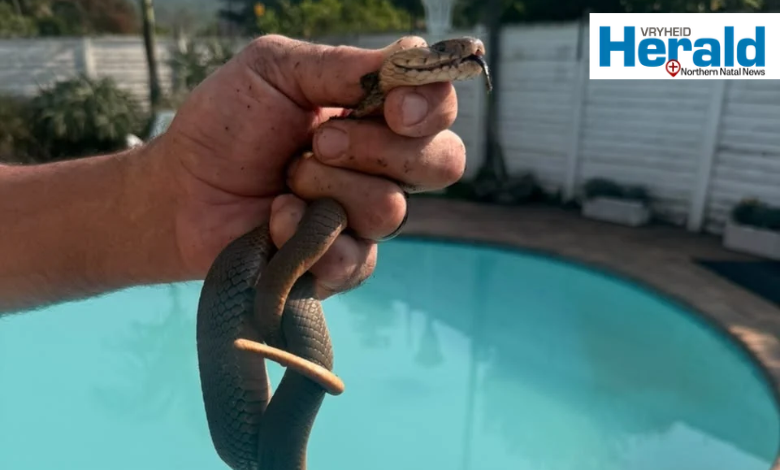
The Erasmus family in Kommissie Street were in for a surprise on Friday when they found a Mozambique spitting cobra, measuring just over one metre, in their compost.
With the recent warm weather, the Vryheid Herald spoke to Eshowe-based snake expert Amy Panikowski about the discovery, why snakes enter residential areas and what residents should do if they encounter one.
Panikowski has a background in wildlife education and years of experience handling snakes. She began training in venomous snake handling at Ndlondlo Reptile Park in 2016 and now catches snakes, conducts educational outreach and assists with snake identification. She is also permitted by Ezemvelo KZN Wildlife to work with reptiles listed under the Threatened or Protected Species (TOPS) regulations.
She confirmed that the snake was a Mozambique spitting cobra, identifiable by features including its salmon-coloured throat, body colour, black-edged scales and markings on top of its head.
Keep your distance from snakes
Panikowski warned residents not to handle snakes without proper training. Mozambique spitting cobras can spit venom from up to three metres away without raising their hoods. Incorrect handling can also injure the snake and make it more defensive.
She recommends keeping about five metres away from any snake and allowing it to move off.
“People need to be more responsible so they don’t get hurt and neither does the snake,” she said.
Although Mozambique spitting cobras, also known as mfezis, are common in areas within their natural range, their presence in residential areas can be unsettling. Panikowski said shrinking natural habitats, continued development and climate change can affect wildlife movement, while snakes may enter properties in search of food, water or shelter.
“We share this land with other wildlife. We can’t be shocked that there is nature in our nature,” she said, adding that snakes play an important role in controlling populations of rodents and other animals.
Why hot weather does not always mean more snake sightings
Panikowski also explained that very hot weather does not necessarily mean more snake sightings. When temperatures climb well into the 30s, snakes can experience heat stress and may seek cooler conditions, becoming more active in the morning or later in the evening.
“We rarely get calls in the thick of the heat,” she said.
Snakes may also enter homes to regulate their body temperature. While this does not happen in every case, Panikowski said snakes are just as susceptible to heat stress as humans, and people should not assume that extremely hot weather automatically means more snakes will be out and about.
What residents should know about snakebites
According to Panikowski, Mozambique spitting cobras account for the majority of serious snakebites in southern Africa. Their cytotoxic venom can cause pain, swelling and tissue damage, while venom spat into the eyes can cause blindness if left untreated.
Anyone bitten or spat in the eyes should seek medical attention immediately. Pets exposed to venom must be taken to a veterinarian.
“There are NO at-home remedies, so do not waste time,” she stressed.
Panikowski also warned against giving pets Allergex, as it does not neutralise snake venom.
If residents spot a snake, they should remain calm, keep people and pets away, and avoid harming it. If it is safe to do so, take a photograph from a distance and send it to a knowledgeable expert for identification. Photographs are generally more useful than videos because experts can examine the features needed to identify the species.
If a snake catcher is needed, contact a competent catcher and keep track of the snake from a safe distance until help arrives. Panikowski said it is important to know where the snake has gone so the catcher does not waste time searching for it.
If someone is bitten or spat at, medical treatment must come first. Panikowski advised against taking the snake to hospital, explaining that a photograph can help with identification while the injured person receives treatment.
“You don’t ask social media what to do,” she said.
Make your property less attractive to snakes
Residents can reduce potential hiding places by keeping gardens tidy, cutting grass short, removing building rubble near homes and picking up pet food bowls left outside, which may attract rodents.
Panikowski cautioned against burning tyres or spreading Jeyes Fluid to deter snakes, saying these methods do not work and can be harmful to people’s health. She also advised residents not to remove all trees and plants, as indigenous vegetation supports a healthy garden ecosystem.
Her advice is to learn about local snake species, keep a competent snake catcher’s number handy and leave snakes alone rather than trying to handle them.
“Snakes are here. For every snake one sees, there are plenty more one doesn’t see,” she said.
No snakebite cases reported at local hospital
The Vryheid Herald followed up on rumours of several snake encounters and possible snakebites in residential areas. AbaQulusi Private Hospital confirmed that it had not received, nor was aware of any patients with snakebites.
The Erasmus family caught the cobra and will safely release it on their farm.
The news provided to you in this link comes to you from the editorial staff of the Vryheid Herald, a sold newspaper distributed in the Vryheid area.