
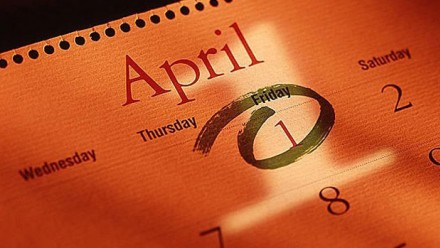
April 1 marks the one day a year where all bets are off and pranks are to be expected. But why do we celebrate April Fools’ Day, and what is the significance of setting aside one day per year to prank one another? In honor of April 1, 2014, here are five facts, trivia and myths about April Fools’ Day:
Why do we celebrate?
While the exact history behind April Fools’ Day is unclear, there is one widely believed theory for how April 1 became an annual day of trickery. According to Discovery.com, the holiday stems from people who refused to adopt the Gregorian calendar in favor of the older Julian calendar when it was established in the 16th century Europe. While most adjusted to the new calendar, which moved the New Year from April 1 to Jan. 1, those who refused to recognize the change were reportedly subjected to pranks and ridicule and were rumored to have been called “April Fools” for observing the holiday months later.
According to one report, April Fools’ lasts for two days in Scotland, with the second day focused on children pulling pranks “involving the backside.”
Different names in different places
While Americans know April 1 as April Fools’ Day, other locations celebrate the day under a different moniker. In France, where the day of pranks is rumored to have originated, the pranking day is referred to as “Poisson d’Avril” (April Fish), occurring to a report from CNN. Scotland’s participants reportedly call the holiday “Hunt-the-Gowk” (Cuckoo) Day and the following day, “Taily Day.” The ancient Roman version of April Fools’ was Hilaria. Meanwhile, Hindus celebrate the arrival of spring with the color festival of Holi.
Best hoax of all time?
According to the Museum of Hoaxes “Top 100 April Fool’s Day Hoaxes of All Time,” the BBC’s successful attempt to trick their viewers over five decades ago grabs the top spot. The prank, which took place in 1957 on the network’s show “Panorama,” reportedly pranked viewers by airing a segment on a false, burgeoning spaghetti harvest in Switzerland. According to the site’s report, the prank resulted in hundreds of inquiries as to how they could grow their own spaghetti trees.
First literary references
Despite its unconfirmed origins, April Fools’ Day is mentioned in literature that dates back to 1392.