
Water woes: When will they end?
The Benade family confirmed that Anika underwent successful chemotherapy in Durban and was recovering in Vryheid when she suddenly had a setback. Her oncologist was of the opinion that the bladder infection was caused by E.coli. AfriForum took water samples at the house where Anika was recovering on Friday, April 17, and sent them to the SANAS Accredited Laboratory.
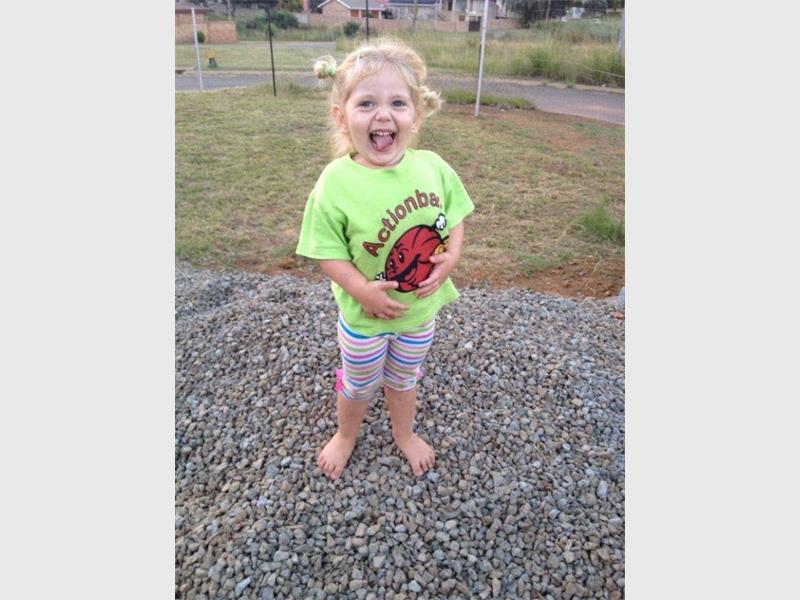
AFRIFORUM issued a warning last week to avoid the drinking water in Vryheid after three year old Anika Benade was once again admitted to hospital.
Anika suffers from Acute Lymphoblastic Leukaemia, a cancer of the blood, which starts from the white blood cells in bone marrow and can spread to other organs such as the liver, spleen and nervous system. She was admitted to hospital due to a bladder infection which, according to her doctor, was caused by E.coli bacteria. The incident was reported to AfriForum by Anika’s grandfather, Hendrik Benade.

For the third time this year, AfriForum’s Provincial Coordinator for KwaZulu Natal, Chris Fourie visited Vryheid to test the water. The civil rights organisation tested the water in January and found that the drinking water was not suitable for human consumption whereafter the Abaqulusi Local Municipality improved the water quality. When AfriForum tested the water again in February, they found the water suitable for human consumption.

The Benade family confirmed that Anika underwent successful chemotherapy in Durban and was recovering in Vryheid when she suddenly had a setback. Her oncologist was of the opinion that the bladder infection was caused by E.coli. AfriForum took water samples at the house where Anika was recovering on Friday, April 17, and sent them to the SANAS Accredited Laboratory.
“The chemotherapy makes Anika’s resistance to diseases and infections very weak. This infection is life threatening for her,” said Chris Fourie.
Had the results confirmed the presence of E.coli in the water, a criminal charge would be laid against the Municipal Manager by AfriForum, as well as a claim for compensation against the municipality for the family of the ailing young girl.
Microbiological analysis, however, failed to detect any coliform or E.coli bacteria, according to a follow up report by AfriForum.

Fourie said that the two water samples submitted to BN Kirk Laboratory for bacteriological analysis failed to detect any total coliform, faecal coliform or E.coli bacteria. The residual chlorine concentrations were, however, at trace levels and could not be detected in either of the water samples. This means that the water in Anika Benade’s grandparents’ home is safe to be used for human consumption.
“It is, however, important to note that the quality of the water is based on a snap sample extracted at that particular time, and in this case no impact on the water quality was identified. Residual chlorine in the distribution system at the furthest point is recommended to be at least 0, 25 mg/l, but this is not set as a limit. This value is used as good practice.”
17-04-2015 Chris Fourie – Provincial Coordinator for AfriForum in KwaZulu Natal ENG (2)
The presence of free chlorine (also known as chlorine residual, free chlorine residual, residual chlorine) in drinking water indicates that a sufficient amount of chlorine was added initially to the water to inactivate the bacteria and some viruses that cause diarrhoeal disease and that the water is protected from recontamination during storage. The presence of free chlorine in drinking water is correlated with the absence of most disease-causing organisms, and thus is a measure of the potability of water.
17-04-2015 Chris Fourie AfriForum se provinsiale koördineerder in KwaZulu Natal AFR (1)
AfriForum has not ruled out the fact that the potable water may be the source of the E.coli bacteria that was found in Anika’s blood because the Municipality allegedly may not have added a sufficient amount of chlorine to the water. The water could have been decontaminated during storage. AfriForum only took the water samples a few days after Anika had been admitted to hospital and therefore the sample may not have been a true indication of the water quality when she got sick.
AfriForum has requested that the Municipality do more regular water testing, and not only at the water treatment plants, but also at the water storage facilities. AfriForum will monitor the situation and will not hesitate to take action against the Municipality if necessary.
AfriForum has subsequently written to the Abaqulusi Municipality demanding that they ensure that the correct amount of chlorine is added to the potable water at all times.
Join AfriForum. SMS ‘Vryheid’ to 45267 (R1).