En Passant: Rats and mice – an introduction
OVER THE weekend I was doing a crossword; the clue was “Nocturnal rodent”; it was 10 letters; S-something-R-something-N-something-something-A-something-something. The only thing that I could think of that would fit and was vaguely mammalian was SPRINGHARE, but a hare is not a rodent, is it? I can’t pretend that I ever knew the biological classification system …
OVER THE weekend I was doing a crossword; the clue was “Nocturnal rodent”; it was 10 letters; S-something-R-something-N-something-something-A-something-something.
The only thing that I could think of that would fit and was vaguely mammalian was SPRINGHARE, but a hare is not a rodent, is it? I can’t pretend that I ever knew the biological classification system going from Domain through to Kingdom, Phylum, Class, Order, Family, Genus, and finally Species, but I know enough to understand that a hare is not a flippen rat.
So I dug out my copy of Smithers’ Mammals of Southern Africa, and discovered that our rabbits and hares belong to the Order Lagomorpha and the Family Leporidae, and that there are two Species of hares and five Species of rabbits, none of which being known as the Springhare.
Then I looked up rodents and discovered they fall into the Order Rodentia, I discovered that the Order does not include shrews, moles or hedgehogs, but does include rats, mice, gerbils, cane rats, dassie rats, dormice, squirrels, mole-rats and even the porcupine. And tacked on to the end of the Rodentia section was a rodent called a Springhare, or Springhaas in Afrikaans, or Pedetes capensis in technical parlance.
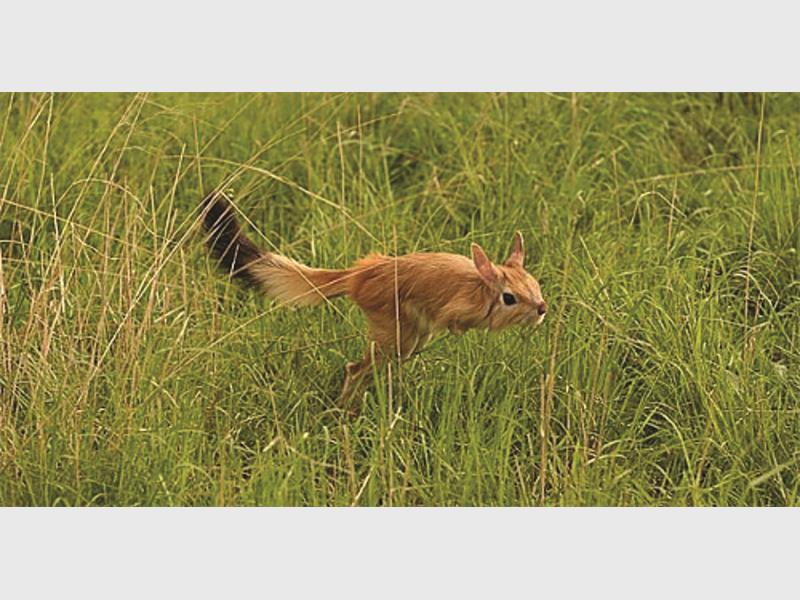
So, what is called a Springhare is actually classified as a rodent. And it is nocturnal but you don’t get them in KZN although you do find them in almost the whole of the rest of the country. It’s a funny-looking little creature, a bit like a hairy kangaroo but only having a total length of around 80cm and a weight of about three kilograms.
What amazed me about this whole episode was the astounding number of creatures that just in Southern Africa fall under the heading of Rodentia. Go on, take a guess, how many different species of rodents would you say there were running around this part of the world?
I dunno, you might say – a couple of rats, two or three different mice, one or two gerbils, dormice and squirrels, plus the cane rat, porcupine and two or three mole rats, plus the springhare… say 16 to 20 species. Wrong! In Southern Africa (which includes Namibia, Botswana, Zimbabwe and Mozambique south of the Zambezi) there are nine Families in the Order Rodentia, and 80 different Species!
That is a lot of rodents. Trust me, there are rodents you haven’t encountered or even heard of, partly because some of them are not found in northern KZN let alone Vryheid. For example, did you know there’s a rat called Brants’ Whistling Rat, and another called Littledale’s Whistling Rat? You get them on the West Coast and inland towards the Kalahari. As I understand it, it doesn’t hang around its burrow whistling Otis Redding’s “Sittin’ on the Dock of the Bay”, but it does whistle an alarm call when threatened.
Did you know there’s a rat called Sloggett’s Rat or the Ice Rat? Yes there is, and you’ll find it in Lesotho and upper Drakensberg areas up to 2,000 metres above sea level. It’s a smallish rat of about 80-odd grams, and apparently it likes gently sloping areas where it can sunbathe all day, a bit like the Kardashians but hairier.
Then there’s the Pygmy Mouse (actually five species of pygmy mouse) which you do get in this area and they weigh anything from just four to 12 grams. That is a Mini Mouse. On the cute scale that mouse could go to Hollywood.
And there’s the odd Multimammate Mouse (two species) which gets its name from the fact that the females can have as many as 24… how can I put this, 24 nipples, “12 pairs of mammae in two rows”, as Smithers puts it, running down their bellies. That is a lot of rodent bosom. Rodent casanovas of the Multimammate Mouse species are spoiled for choice. Were mice to wear bras, the Multimammate Mouse bra would be a feat of engineering.
This extended milk bar is apparently a “unique feature among southern African mammals”, and is understandable if it is realised that a litter of these mice can number 22 pups, although the average litter is 6 to 12. And yes, you get both Multimammate Mouse species in KZN. (Is a baby mouse called a pup? I dunno.)
Mole-rats are neither moles nor rats although still rodents, and on the “cute scale” are not. On the other hand, squirrels, of which there are six species in southern Africa, are cute, and quite often get jobs in Hollywood. Of the six species, only the Red Squirrel is found in KZN, in two or three isolated pockets along the north coast.
Gerbils, Smithers tells me, are more or less just mice with longer back legs, and I have heard of children keeping them as pets even though Smithers warns us that these supposedly lovable little rodents are “a reservoir for the plague”. And of all the mice you find here in southern Africa, did you know that only one, the Pouched Mouse, the Wangsakmuis in Afrikaans, has cheek pouches for carrying food?
Rodents can be destructive, but Smithers makes no mention of probably the most destructive of all, the rattus governmentus. One day I’ll write a book about it.