En Passant: The future – the solution
YEARS and years ago I wrote a column in which I imagined what it had been like to arrive in Vryheid by coach, in the early evening, back in the early days of this town’s history. It would have been a long, dusty and bumpy journey from Dundee, on a dirt road, probably with stops …
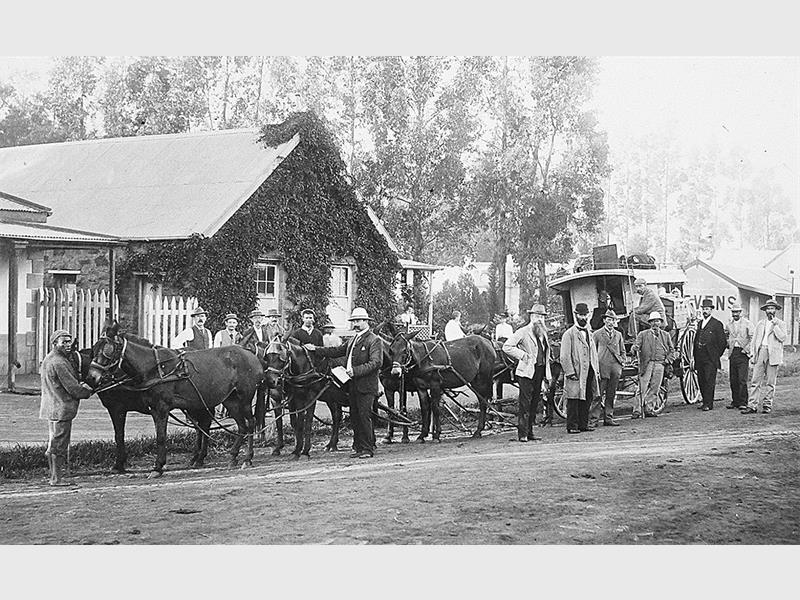
YEARS and years ago I wrote a column in which I imagined what it had been like to arrive in Vryheid by coach, in the early evening, back in the early days of this town’s history. It would have been a long, dusty and bumpy journey from Dundee, on a dirt road, probably with stops at deJagersdrift and Kingsley, and the only way you’d have known you were in Vryheid would have been the barking dogs and the occasional paraffin lamp shining in someone’s front room.
The town’s roads were gravel then, there were no streetlights, no cars and just occasional houses all the way up Church Street, with a “city centre” that looked like the set for a cowboy movie (except for the Klipkerk). The coach would stop near the Police Station, which then was the Magistrate’s office, or round the corner in Landdrost Street near the old Raadsaal, which is now one of the museum buildings.
That was the past, but last week I read a couple of predictions about the future and I wondered what Vryheid would be like then. Both predictions referred to the year 2050, which might sound a long way away, but 2050 is actually only 35 years ahead.
The one prediction was that by the year 2050 the population of Africa will have doubled, and since South Africa is in Africa and Vryheid is in South Africa, I presume that our population here in Freedom City will have also doubled.
The other prediction that I read, which has its own ramifications, said that by 2050 only one person out of 100 in South Africa will be white, a statistic that should appease black racists.
So, in 2050 Vryheid’s complexion will have changed – our neighbourhoods will all be predominantly occupied by black families and queues at the banks and supermarkets will have very few white people in them, my guess, older white people, perhaps pensioners tied to property and poverty.
The town planning thinking is (or was) that Vryheid will expand westwards towards Stilwater. But it seems to me that any expansion of the town will have to be based on commercial investment, and frankly, I cannot see any major investment coming to Vryheid unless the municipality can guarantee a continuous water supply.
Water will be the great issue of the future. Already there is not enough of it for our needs, that’s why currently there are restrictions. If our population doubled, so proportionally will the demand for water. If Klipfontein Dam’s wall was raised to its designed maximum, it’s capacity, as I recollect, only increases by around 73%.
Add to that the worse case predictions about climate change, and imagine a decade of successive El Niño effects. And I heard last week that we’ve just had the hottest July on record…
Vryheid is going to need another dam, and honestly, considering the cost of dam construction, and assuming that nationally, with the doubled population, demands for basic services have increased exponentially, little old Vryheid’s water supply will be the last thing central government will worry about.
Without some sort of economic growth, I can’t imagine the appearance of new large areas of residential properties such as exist now in Vryheid’s leafy streets. There will be some, sure, some similar to Edel Park where the difference in houses varies from opulent to sub-economic, but I think that fundamentally the homes that are standing now in 2015 in Vryheid’s residential areas, will be the homes of 2050. The difference will be that these homes will be occupied by two, three or even four families.
So where will the doubled population be? In those homes, and in the thousands of matchbox homes that will surround Vryheid, and, once the money runs out for the building of RDP houses, in vast squatter camps around the town.
The vast majority of people will be unemployed (perhaps the majority of people are already unemployed – does anybody know the statistics for Vryheid/AbaQulusi?). How on earth the municipality will be able to provide services, I do not pretend to know. None of those people will be in a position to pay for those services, let alone pay property rates.
I have no idea how many people, how many households, are on the municipality’s indigent lists, how many people get an allocation of free water and electricity. By 2050, that number will more than double.
I have no idea how the children of these households will be educated. If the population doubles by 2050, then by 2050 there will be as many people under the age of 35 as there are people already in the country in 2015. Half of them will want schooling.
There are two high schools in Vryheid – then there will have to be four, plus another Inkamana and Landbou. How many schools in Bhekuzulu? – double the number. And double the number of junior schools. In fact, if we begin now and build a new school every five years until 2050, we still will not have enough schools to accommodate the children of Vryheid in 2050. And by then, trust me, virtually all schools will be free of fees.
Then add Mondlo to the education equation!
To provide services to the residents, the municipality will have to eliminate “luxuries”. There will not be a swimming pool, there probably won’t be a library, and if there’s any sanity there won’t be a Mayoral Sports Day. Pavements will be a stuff up, roads will be potholed and parks will be wastelands.
It’s a gloomy forecast, but there is a simple solution, really simple…
STOP HAVING BABIES NOW!