Budget Roadshow reveals increases on the cards
With increases in utilities on the cards, the municipality will surely be under the scrutiny of the public to ensure that service delivery becomes a priority in future.

Elaine Rodway
ABAQULUSI Municipality, after receiving an unqualified audit opinion for the 2014/2015 financial year, is allegedly committing to Operation Clean audit and, according to the Budget Roadshow briefing notes, “will not stop improving until a clean audit is obtained.”
The Budget Roadshow, which was open to the public, came to a close with the final leg of the roadshow being held at Vryheid Library Hall on May 17. The Mayor, Cllr Patience N Khaba, addressed those present at the meeting, fielding questions from the public regarding the proposed budget for 2016/2017.
Strangely enough, in these tough economic times, according to the briefing notes from the Budget Roadshow, it appears that the municipality believes that the “economic outlook is improving, but requires that we pursue a different outlook if we are to address the challenges ahead…”
The need to prioritise projects and expenditure within the limited resources available was listed as one of the main challenges experienced during the compilation of the 2016/2017 budget.
“Council and management within AbaQulusi has a significant role to play in strengthening the link between the community and government’s overall priorities and spending plans. The goal is to enhance service delivery aimed at improving the quality of life for all the people within the AbaQulusi Municipality.”
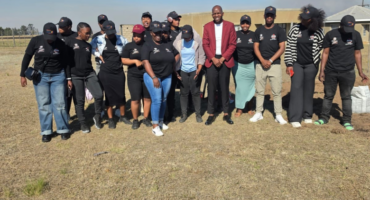
These words, included in the briefing notes, don’t seem to carry much weight, however, based on the ongoing animosity that lingers between workers and management at the municipality, with ‘striking’ workers up in arms regarding the poignant state of service delivery in AbaQulusi. Workers and union representatives maintain that, despite their willingness to deliver service to the community, their requests for equipment and supplies are met with allegations of insufficient funds to provide the necessary equipment or outright indignance by management. Perhaps matters pertaining to the maintenance and upkeep of the town and its infrastructure are not a priority.
The notes go on to say that “We need to work together for a common vision that connects the past to the present to make a better future possible. Change is not just a challenge to government, but affects all of society.”
“While building on our strengths, we have to tackle our weaknesses aggressively by professionalising our services and strengthening our accountability. Improving management and enforcing systems to fight corruption…”
Considering that AbaQulusi Municipality has, in fact, not had an actual Municipal Manager since 2012, any improvement in this field might be considered significant.
Revenues and cash flows are expected to remain under pressure in 2016/2017 and the municipality must adopt a conservative approach when projecting expected revenues and cash receipts.
Income from property rates is utilised for the provision of general services in the municipality such as roads cemeteries and parks and will be increased by 6,6% per household, with the exception of residential properties valued up to R80 000, who are exempted from paying rates.
NERSA has announced a revised bulk electricity pricing structure of 7,64% for municipalities. Due to electricity theft, illegal connections and false indigent claims, the losses experienced by the municipality in this field are in the region of R38 million. To combat this problem, consumers will bear the brunt even more than they already do and the municipality will allegedly be commencing with a new audit and consumers found with a tampered meter will be fined R5 000 and their services will be removed.
Street lights will be addressed in the coming financial year and the electricity department has committed to replacing street light conductors. 15 high mast lights were installed in the past year and another four will be installed in this financial year.
Water tariffs will increase by 10%. “What water?” one may ask… Well, according to the municipality, the increase is necessary to ensure that the cost of maintenance and renewal of purification plants, water networks and reticulation expansion is covered. Sanitation tariffs will also increase by 10%, as will the tariff for refuse removal.
The total anticipated revenue the municipality expects to receive is R518 million from rates, electricity, refuse, sanitation, water and grant funding which will be utilised for operational expenditure which includes payment to Eskom of R159 million, salaries, repairs and maintenance.
With these increases on the cards, the municipality will surely be under the scrutiny of the public to ensure that service delivery becomes a priority in future.