The battle of Delville Wood = part 3
The new Garden of Remembrance will also be unveiled on that day July 18
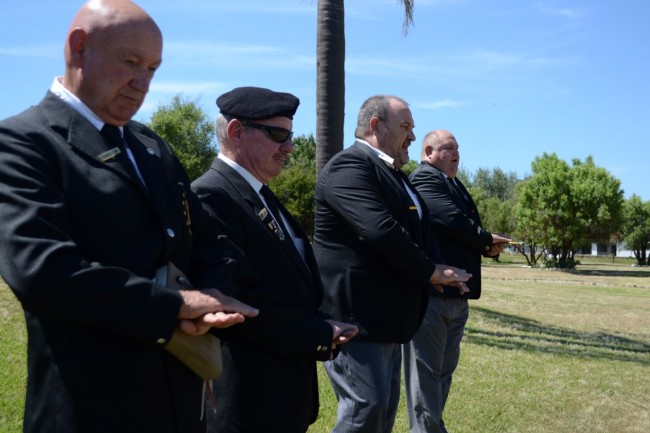
The famous battle of Delville Wood, where so many South Africans perished in 1916, will be remembered when the centenary of the battle is marked at a parade at the Dundee Cenotaph on July 18. The new Garden of Remembrance will also be unveiled on that day.
Most of the South African brigade remained at Talus Boisé during the attack by the 55th Brigade on Trones Wood. General Lukin also sent a company and a platoon to support other Commonwealth infantry units in Trones Wood and at the garrison of the Briqueterie. The Brigade now held only the south–eastern and the eastern approaches of Bernafray Wood and Longueval Avenue.
Longueval
On the morning of July 14, 1916 General Rawlinson’s attacking forces of the 26th and the 27th Brigades, Scottish 9th Division, were to assault the village of Longueval, adjacent to Delville Wood. The South Africans remained in reserve. The 28th and the 27th formed up near Montauban and moved to the start line of the attack.
At dawn, they stormed the German positions and forced their way into Longueval. Serious hand-to-hand combat ensued. The intensity of the fighting induced Maj.-Gen. W.T. Furse, the commanding officer of the 9th Division to offer the support of the 1st South African Infantry Regiment to the 27th.
The positions in the greater part of the wood were still unclear.
Several South Africans were wounded in this encounter. D Company’s commander was killed, and they were then taken into Longueval by Lt. Ginger Brown. “The 27th is using your first Battalion for the capture and consolidation of the northern half of Longueval, pushing patrols into Delville Wood, west of Strand and north of Princes Street. At 13:00 the divisional commander informed Lukin that the 12th Royal Scots had pushed through the northern half of Longueval. They were turned back by a machine gun in the northwestern corner of the wood. Artillery had been turned on this gun, but results were unknown. The three battalions of the South African Brigade that was to attack the wood was placed under the command of Lt-Col. William Tanner. Tanner visited the CO’s of the 26th and found out that the northern part of Longueval and the part of the wood adjoining all the streets were still strongly held by the Germans. The positions in the greater part of the wood were still unclear.
The 5th Battalion of the Queen’s Own Cameron Highlanders had in the meantime occupied and dug themselves in along Buchanan Street in the south-west corner of the wood. Ian Uys wrote that Colonel Tanner established his HQ at Buchanan Street. Colonel Thackeray remained with him but sent his 3rd Battalion to the far side of the wood. C Company, 2nd Battalion manned the southern perimeter closest to Longueval village.The company took casualties but accomplished their task (taking Waterlot Farm, on the southern edge) by 08:30 hours. Captains Clifford and Gray were killed in action in this encounter. Confusion reigned on the eastern perimeter as well. Captain McLachlan of C Company, the 3rd SA, and Captain Medlicott of B Company, the 3rd SA, sent queries to Colonel Thackeray at 07:50, with regard to this movement, but was answered in uncertain terms. At 08:40 hours Captain Medlicott queried Thackeray again, as these unknown soldiers, possible Germans or French colonial troops, started to trade fire with A Company.
The intensity of the enemy shelling and the shortage of ammunition now became major problems
Captain McLachlan was wounded in this encounter. Medlicott requested permission to sent patrols across the perimeter. At 09:15 hours, Captain Vivian, of A Company, signalled Thackeray that he was engaging troops advancing on the wood from the south and the east, but he did not know who they were. At 10:00 Captain Medlicott reported to Thackeray about the fighting in the entire southern sector of the wood. Rifle and Lewis gun fire reverberated through the wood, and at 10:00 hours Lieutenant Harold Elliot, from C Company, who had assumed command after McLachlan had fallen, reported that he is engaging the enemy to his south.
Captain Vivian and four of his men were now also wounded, and at 10:40 hours Major D.M. Mcleod, the OC of the 4th SA, which supported the battalions on the perimeters, made urgent requests for two Lewis or Vickers machine guns. “Enemy shelling wood heavily and their rifle fire getting very brisk. Enemy have trenches parallel to south road, also another on east.”
The intensity of the enemy shelling and the shortage of ammunition now became major problems. Casualties increased as the day progressed, and ammunition grew very scarce. Captain Tomlinson, D Company, advised at 16:15 hours that he could see two German companies massing for further attacks from a direction north of Flers. On his left flank the 2nd battalion had been subjected to severe enemy pressure on their north and north-eastern perimeters.
They were met by a withering rifle and machine gun enfilade, and both attacks failed comprehensively.
Later that afternoon the 2nd battalion again reported that the enemy was massing for another attack on the northern face. Captain Vivian was wounded by now, and a lieutenant Thomas took over command of A Company. The South Africans on the outer perimeters entrenched themselves for the night. Enemy shelling was continuous. Enemy snipers were becoming a problem. Colonel Thackeray sent Captain John Jackson to organize the defenses in the south-eastern corner of the wood, and he reported back that they were being heavily shelled. He suggested moving about 50 reinforcements back behind A Company in the event of an attack. The South African commanding officer, brigadier Lukin, was then ordered by Division to support the attack of the 11th Royal Scots. They were a component of the 27th Brigade, situated in the orchard in the northern sector of Longueval, between North Street and Flers Road.
The Scotsmen were to attack along North Street and the South Africans on a parallel course
in the wood, next to the Royal Scots. This combined attack was launched at 10:00 hours. They were met by a withering rifle and machine gun enfilade, and both attacks failed comprehensively.