
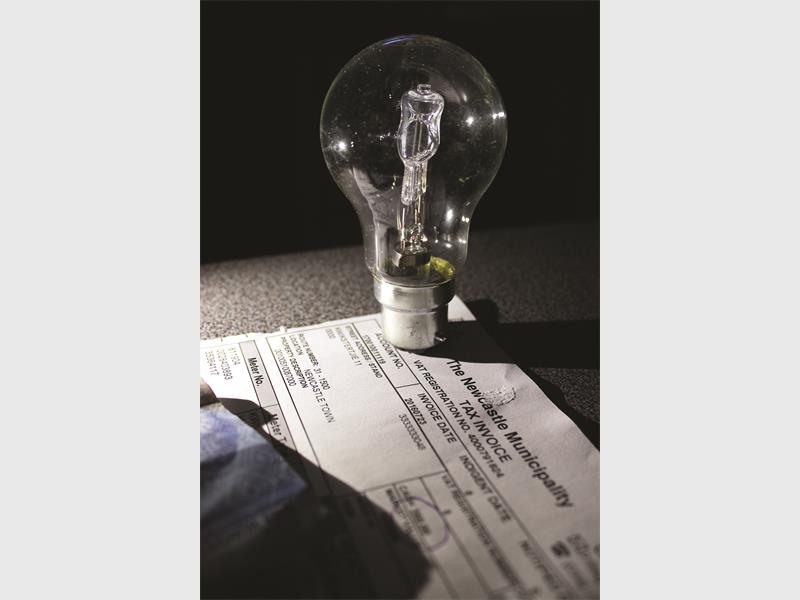
NEWCASTLE – Uproar over increased municipal accounts is nothing new to officials.
Director for Financial Management, Asha Haripersad said the furore over higher accounts in the winter months was an annual event, but remained the result of annual increases in July and August, and higher consumption.
Read: Be a part of the me and my pet competition and win!
“Account holders generally do not look at the reading dates to ascertain the period to which the consumption belongs, causing incorrect assumptions that the charges are incorrect…”
Mrs Haripersad said the meters relating to September 2016 accounts were read over the period of August 24 to September 8, compared to the previous month, from July 22 to August 7.
She stated households generally consumed more electricity in colder months.
“For example, the water coming into homes through the underground network is colder in winter months than in summer. This causes an extended period of time taken to boil a kettle, heat up the geyser, et cetera.”
Providing further insight, Mrs Haripersad said if a meter reading route was averaged, in which case a 12-month household average was used, in one month the actual reading in the following month could cause increased consumption.
This is because the reading from one month is corrected in the next, for purposes of accuracy.
“If averaged in one month, the actual reading the following month ensures any under- or over-averaging is corrected.”
Also read: Emphasising the worth of wearing pink
While the municipality made attempts not to average readings, Mrs Haripersad said it was sometimes unavoidable.
Last month, for example, Ncandu Park and Arbor Park were averaged.
“This means the readings for the period July 22 to August 7 were averaged. The actual reading was taken during the reading period August 24 to September 8, therefore there was a catch-up, as the averaged reading was too low for winter month consumption.”
On the topic of National Energy Regulator of South Africa (NERSA) high season tariffs, Mrs Haripersad confirmed these were not implemented, after the July levy was processed with the tariff, then credited.
She said this could be seen on accounts, proving the same tariff was charged all year round.
Mrs Haripersad said the municipality would always investigate queries received, but this did not automatically result in a review, amendment or deduction of the account dues.
“The first step would be to determine which transaction caused the query, and investigate accordingly. After receipt of the query and if the meter reading was not already double-checked during the reading/capture process, if necessary the reading on the meter will be physically checked again.”
Mrs Haripersad elaborated that if the reading is correct, the municipality could only attempt to explain the reason for the higher reading.
She said the account holder had the option to pay for testing of the meter.
If a meter is found to be faulty by the Department of Technical Services, the account would be reviewed and the testing fee refunded.
If not found to be faulty, the consumer is liable for the account and the fee.
Mrs Haripersad concluded by saying if it was determined there was an error in the recording of the original reading, the account would be reviewed.
However, not all charges on accounts refer to consumption, and this would be considered too.
“For example, an account could have attracted a service disconnection fee for non-payment thereof, and this would not just be reversed, as the procedure was carried out.”