
Anniversary of the D-Day landings commemorated
On June 6th, 1944, more than 150,000 U.S., British and Canadian forces stormed five different beaches along a 50-mile stretch of the Normandy region of France in order to fight Nazi Germany in World War II.
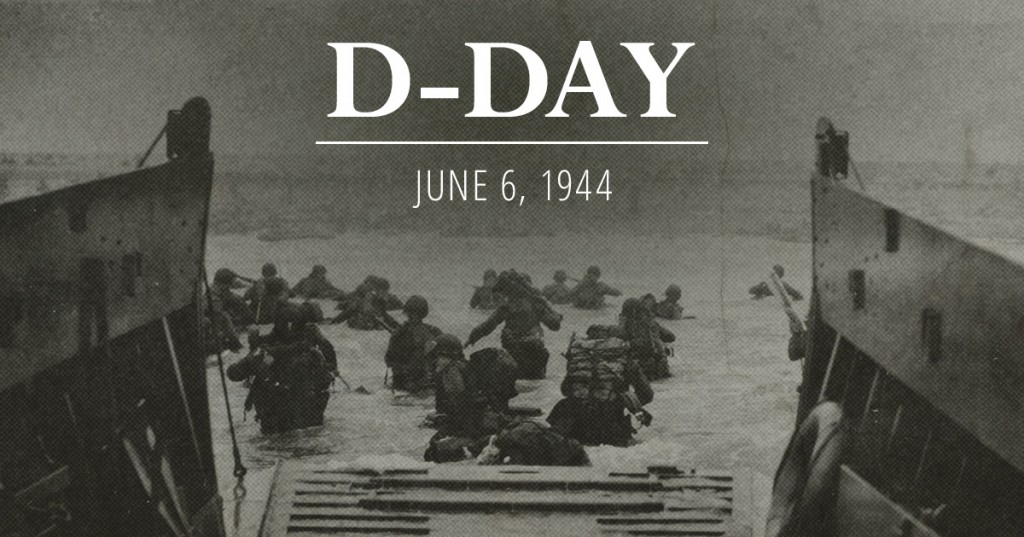
Today marks the 76th anniversary of the Normandy Landings, centred around the date of invasion, June 6, known as “D-Day”.
On June 6th, 1944, more than 150,000 U.S., British and Canadian forces stormed five different beaches along a 50-mile stretch of the Normandy region of France in order to fight Nazi Germany in World War II.
Allied causalities on D-Day have been estimated at 10,000 killed, wounded and missing in action: 6,603 Americans, 2,700 British and 946 Canadians.
Here is a look at D-Day. Allied troops invaded Normandy, France, on June 6, 1944, in order to fight Nazi Germany in World War II.
Facts: The largest amphibious invasion in history.
The invasion’s code name was Operation Overlord
General Dwight D. Eisenhower commanded the operation, and plans were made to land in Normandy, west of where the German troops and artillery were built up.
The “D” stands for Day. D-Day and H-Hour stand for the secret day/time an operation is scheduled to begin.
Code names for the five beaches where the Allies landed: Utah, Omaha, Gold, Juno, and Sword.
The date June 5, 1944, was originally chosen for the invasion, but bad weather forced the Allies to postpone a day.
More than 13,000 aircraft and 5,000 ships supported the operation.
Allied casualties on D-Day have been estimated at 10,000 killed, wounded, and missing in action: 6,603 Americans, 2,700 British, and 946 Canadians.
Timeline: August 19, 1942 – A raid on the French port of Dieppe resulting in heavy losses convinces D-Day planners to land on the beaches, so discussions and preparations begin for an Allied invasion across the English Channel.
May 1943 – The Trident Conference, a British and American strategy meeting on the war. In Washington, DC, Winston Churchill, President Roosevelt and their military advisers discuss, among other things, crossing the English Channel.
August 1943 – The Quadrant Conference, where the British and American military chiefs of staff outline Operation Overlord.
November and December 1943 – The Sextant and Eureka Conferences, where the British and American military chiefs discuss the specifics of the assault on France.
1944 – The Germans expect an invasion along the north coast of France, but they do not know where. They build up their troops and artillery near Calais, where the English Channel is the narrowest.
June 5, 1944 – Allied paratroopers and gliders carrying heavy equipment leave England to begin the invasion of France by air.
In a broadcast message to troops before they leave, Eisenhower tells them, “The tide has turned! The free men of the world are marching together to victory…. We will accept nothing less than full victory!”
June 6, 1944 – Overnight, a military armada and more than 160,000 troops cross the English Channel. Minesweepers go ahead to clear the waters in preparation for the thousands of landing crafts that will be carrying men, vehicles and supplies.
Between midnight and 8 am, Allied forces fly 14,674 sorties.
6:30 am – Troops begin coming ashore on a 50-mile front.
In a broadcast to the people of occupied Europe, Eisenhower says, “Although the initial assault may not have been in your own country, the hour of your liberation is approaching.”
Dundee will remember the centenary of the battle of Delville Wood on July 18 .

HAVE YOUR SAY:
Like our Facebook page, follow us on Twitter and Instagram or email us at dundee.courier@caxton.co.za. Add us on WhatsApp 071 277 1394.