Farmers tackle livestock challenges at Charlestown event
Charlestown farmers gained practical solutions for winter feeding, grazing management and veld fire risks.
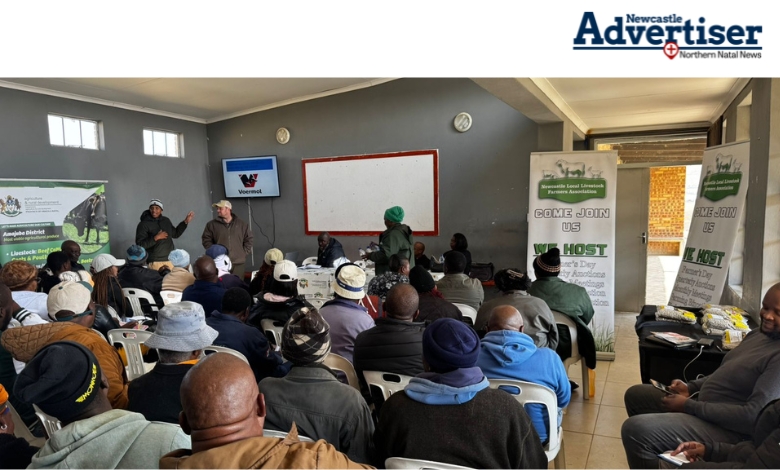
Communal livestock farmers from Charlestown and surrounding communities gathered last Tuesday (June 23) for a Farmers’ Day focused on addressing key agricultural challenges, including winter feed shortages, overgrazed communal rangelands and destructive veld fires.
The event was organised by Thobile Khuzwayo, agricultural advisor for the Charlestown area with the KwaZulu-Natal Department of Agriculture & Rural Development (KZN DARD), with support from the Newcastle Local Livestock Farmers Association.
The programme brought together agricultural researchers, emergency services representatives and livestock feed specialists to provide farmers with practical knowledge to improve livestock production under local conditions.
Farmers gain practical solutions for local challenges
Opening the programme, chairperson of the Newcastle Local Livestock Farmers Association, Mr Vusumuzi Kubheka, said the aim was to provide farmers with solutions they could immediately apply in their farming operations.
“The success of communal livestock farming depends on our willingness to learn, adapt and work together. Every lesson shared today, from grazing management to winter feeding, is an investment in stronger herds, stronger households and a stronger farming community,” he said.
Khuzwayo said the Farmers’ Day was organised in response to the realities facing Charlestown’s communal livestock farmers.
Many livestock owners rely heavily on communal grazing land, where overgrazing and declining winter veld quality reduce available nutrition.
Limited fodder reserves and the annual risk of veld fires place additional pressure on livestock and farming households.
She also announced that the department plans to host a future demonstration day where farmers can observe cover crops growing under local conditions and learn practical methods of integrating crop production with livestock farming.
Researchers share grazing and feeding advice
Researchers from the Dundee Research Station shared practical approaches to improving grazing management and animal nutrition.
Rangeland specialist Lindo Khumalo explained the importance of understanding Charlestown’s sourveld grass species, preventing overgrazing and controlling bush encroachment before it becomes widespread. He encouraged farmers to adopt rotational grazing practices through co-operation between livestock owners. He explained that natural landmarks and grazing areas can be used to rotate livestock even where communal grazing camps are not fenced.
Animal nutrition specialist Phumzile Msuntsha discussed how winter conditions reduce the nutritional value of grazing and shared feeding strategies to help farmers maintain animal health and body condition during colder months.
One of the highlights of the day was a practical demonstration showing farmers how to build a simple wooden hay bale box using locally available materials.
The demonstration showed how surplus grass can be harvested, baled and stored during the growing season to create valuable winter feed reserves, reducing dependence on purchased fodder.
Representatives from Voermol Feeds and Suthile Animal Feeds also shared advice on winter supplementation for cattle, sheep and goats.
Farmers received guidance on selecting suitable protein and mineral supplements for winter conditions.
Suthile Animal Feeds displayed its livestock feed range and rewarded 10 participants with feed samples after they correctly answered questions during an interactive session.
Farmers explore crop integration and fire preparedness
Agricultural advisor Mrs Msomi encouraged communal farmers to consider introducing cover crops and integrating crop production into their livestock enterprises.
She explained that farmers do not need large commercial farms to produce fodder, as home gardens and small available pieces of land can contribute valuable feed reserves during droughts and winter periods.
Fire safety also featured prominently during the programme. Mrs Khanyisa from the Newcastle Fire Department encouraged farmers to remain vigilant throughout the fire season by monitoring weather warnings, identifying periods of high fire danger, and ensuring that livestock can be moved safely during veld fire emergencies. She also highlighted the importance of training herdsmen in safe emergency response while maintaining good animal welfare practices.
Disaster Management representative Mr Mpilo Vezi said discussions are continuing to strengthen emergency response capacity in the Charlestown area, including possible co-operation with neighbouring emergency services where appropriate. He emphasised that stakeholders remain committed to improving emergency preparedness for local communities.
Farmers discuss future opportunities
During the question-and-answer session, farmers actively participated in discussions about challenges affecting communal livestock production.
One farmer asked how rotational grazing could realistically be implemented on unfenced communal grazing land. Presenters explained that successful rotational grazing depends on co-operation between livestock owners, grazing plans and effective local leadership. They said the system can work even under communal farming conditions.
Another discussion focused on invasive plants spreading across communal grazing areas. Participants proposed establishing a community-based invasive plant control programme, suggesting that young dip tank assistants and herdsmen could volunteer as eco-rangers to help remove invasive species. The proposal included seeking support from relevant government departments for training, personal protective equipment (PPE) and herbicides. Participants said such an initiative could improve grazing land while creating opportunities for local youth to contribute to environmental protection.
Representing deputy director Mrs PP Sibiya of the Newcastle KZN DARD Local Office, agricultural advisor Sabelo Gumede thanked the presenters and encouraged farmers to apply the knowledge shared during the event. He said that improved livestock production depends on responsible veld management, sound animal nutrition and proactive planning.
The Farmers’ Day brought together representatives from the Newcastle Local Livestock Farmers Association, the Amajuba District Livestock Farmers Association, Dundee Research Station, Newcastle Fire Department, Voermol Feeds and Suthile Animal Feeds.
Refreshments were served after the programme, allowing farmers to continue discussions with presenters and view the practical demonstrations.
Closing the event, Khuzwayo thanked the participating organisations, presenters and farmers for their support. She encouraged continued collaboration to strengthen communal livestock farming in Charlestown. She said initiatives such as the Farmers’ Day demonstrate the importance of partnerships in building resilient farming communities capable of meeting future agricultural challenges.
The news provided to you in this link has been investigated and compiled by the editorial staff of the Newcastle Advertiser, a sold newspaper distributed in the Newcastle area. Please follow us on Youtube and feel free to like, comment, and subscribe. For more local news, visit our webpage, follow us on Facebook and Twitter, and follow us on our WhatsApp Channel