An old soldier’s story
SATURDAY is Poppy Day, and you may see members of Vryheid Moths Freedom Shellhole selling poppies at the entrances to supermarkets. The proceeds go to worthy causes – last year the funds raised were donated to the SA Legion. Initially, the funds raised on Poppy Day went to World War I ex-servicemen and -women and/or …
SATURDAY is Poppy Day, and you may see members of Vryheid Moths Freedom Shellhole selling poppies at the entrances to supermarkets. The proceeds go to worthy causes – last year the funds raised were donated to the SA Legion.
Initially, the funds raised on Poppy Day went to World War I ex-servicemen and -women and/or their dependents, but there are no survivors of that war still alive. Then later, most of the beneficiaries were survivors of World War II, and there are now very few of those people left.
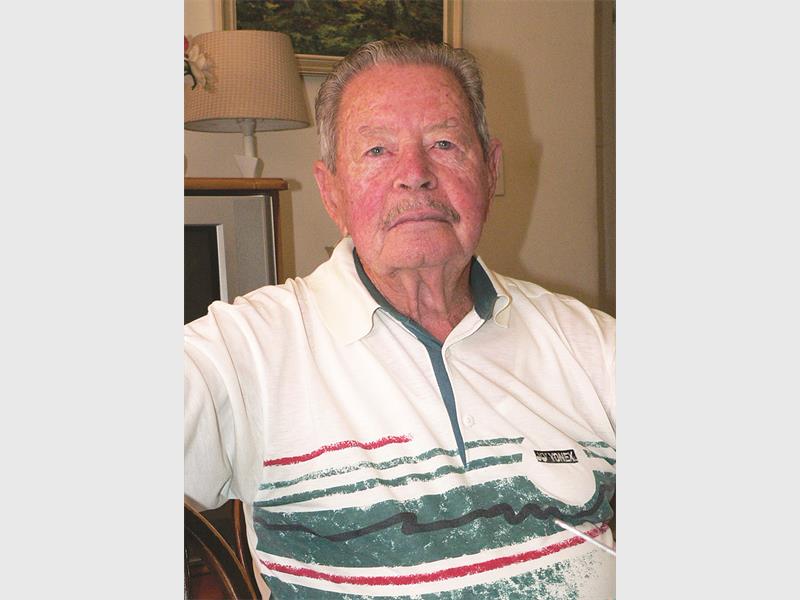
At Vryheid’s Freedom Shellhole there is now just the one World War II veteran member. He’s Eddie Lowe.
Edwin “Eddie” Lowe, who turns 92 in March, was born in 1924, attended Mansfield High School in Durban but left school early, and by 16 years old was a wages clerk at C&E Morton, the makers of Tartan jams, a brand older readers might recognise.
He joined up on Valentine’s Day, February 14, 1941, a month before turning 17 years old, and did his six months of basic training at Voortrekkerhoogte. He wanted to be an aircrew member in the South African Air Force, but they said he was colour blind and sent him to the flying school at Kimberly where he was taught to repair and maintain aircraft – firstly Hawker Hinds and Harts, which were single-engine biplanes. Being a flying school there were many opportunities to fix aircraft. He also did an advanced course at Swartkop Air Force Base.
In April 1943 Eddie (and 4,000 others) was sent to North Africa, leaving by ship from Durban and heading towards Suez. They stopped just once, at Aden, to collect water, contaminated water as it turned out because the whole ship had diarrhoea, and with inadequate toilets Eddie describes the ship’s sides as “-splattered”.
Arriving in Egypt, they were transferrerd by a train pulling cattle trucks, with 50 men per truck, to a base 10km outside of Cairo, and then Eddie was posted to 12 Bomber Squadron SAAF at Tunis in Tunisia.
The Battle of El Alamein was over, and indeed the Battle for North Africa was over, and the war had moved to Sicily and Italy. South African troops had originally been restricted to operations in Africa alone; moving out of Africa necessitated the swearing of a new oath for service beyond Africa. Eddie swore the oath and was posted to the tiny but strategically important island of Malta.
Malta, between Sicily and North Africa, was a naval and airforce base, and was described as “the most bombed place on earth”. But that was where 12 Bomber Squadron was based, flying Boston bombers with crews of four. At 4:00-4:30pm, every afternoon, Italian bombers escorted by German fighters would take off from Sicily to bomb Malta.
Eddie says the bombing didn’t scare him, “it was an adventure”, but Malta was where he saw his first tragedy when a plane crashed on takeoff and the crew were burned to cinders.
Then as the war progressed, Eddie’s squadron was based in Sicily (from November 1943 to January 1944), and then from January ’44 in Foggia in south-east Italy. It was there that the squadron was re-equipped with Maurauder bombers, with a crew of six and the ability to carry four tons of bombs.
And again, as the war progressed, the squadron moved north, up the calf of the boot of Italy – to Pescara, Ancona, finishing the war at Udine, inland and north of Venice.
The war in Europe ended in May 1945, and by November that year the Squadron was back in Egypt from where the men were flown by Dakota back to South Africa. There was talk about sending the squadron to the Far East but it came to nothing when Japan surrendered in August 1945.
So the war ended 70 years ago this year.
Now, when he thinks about it, one-time Leading Air Mechanic Eddie says, “I did the right thing. It was an experience, not always enjoyable, but an experience”.
His most enduring memory is of Good Friday, 1944 when the squadron was doing what was called “shuttle bombing” of the “Gothic Line”. Six planes at a time would take off, bomb the line, return, refuel, rearm, and fly off again.
“I was waiting for my plane,” says Eddie, “and all of a sudden there was a huge explosion in the next ‘possie’ 50 yards away. They’d dropped a bomb they were loading into the plane. I don’t know why it exploded – but eight men, crew and mechanics were killed.
“The blast knocked me over: just as well as one of the plane’s engines flew right over me and set the grass behind me alight. Had I not hit the ground, who knows…”
Eddie Lowe joined the Moths’ Umbilo Shellhole in 1946. Next year he will have been a Moth for 70 years, and he still believes in its tenets: “Sound Memory; True Comradeship; Mutual Help”.
And Poppy Day.