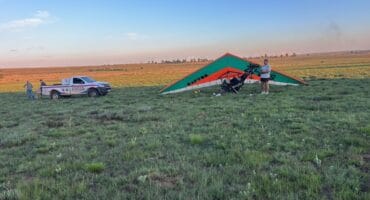
First drone to delivered blood is coming to Vereeniging
VEREENIGING - On Wednesday, May 29, the South African National Blood Service (SANBS) launched the first TRON Unmanned Aerial Vehicle (UAV) with its vertical take-off and landing (VTOL) fixed wing system to deliver blood for use in emergency situations in remote areas.

Hettie Fowlds
VEREENIGING – On Wednesday, May 29, the South African National Blood Service (SANBS) launched the first TRON Unmanned Aerial Vehicle (UAV) with its vertical take-off and landing (VTOL) fixed wing system to deliver blood for use in emergency situations in remote areas.
Vereeniging and Sebokeng are some of the first areas in the country where the drone will be tested. The Tron UAV, which has the ability to take off like a helicopter, flies like a plane and lands like a helicopter, is developed by a German company called Quantum Systems. “We believe that this is an innovative step in the history of blood transfusion. The SANBS is determined to improve rapid access to life-saving blood products in rural areas through the use of drone technology. Our concept is globally unique in that we will provide two-way logistics: patients can receive emergency “O negative” blood from one of our blood banks via drone. The same drone can then take that patient’s blood sample to the blood bank for comprehensive cross-matching and then safely and rapidly deliver compatible blood back to the patient,” says Dr Jonathan Louw, CEO of SANBS.
He stated that the idea was born out of a discussion with the Department of Health on how to improve blood supply to remote areas in a way to reduce the mortality rate of patients in need of blood. Louw listed the criteria that had to be met during the research and design process:
1. Speed: The drone needs to be fast enough to ensure that patients receive blood before they are likely to bleed out.
2. Two-way logistics: The drone needs to be able to transport emergency blood to the patient, but also needs to transport a sample of the patient’s blood back to the blood bank to have it cross-matched for compatible units to be sent.
3. Physical conditions: The drone needs to ensure that neither G-force nor temperature affects the integrity of the blood.
4. Safety: The drone must be able to glide to the ground in an emergency or deploy a parachute if necessary. It must also be autonomous.
5. Payload capacity: It must be able to transport at least 4 units (2 kg) of blood.
6. Distance: To get to rural areas the drone needs to be able to fly long distances.
7. Cost: A drone flight by SANBS can be done for as little as R10. This is much cheaper than flying blood in via helicopter or by road travel. Dr Louw believes that all seven criteria is met with the Tron, which will be implemented in Vereeniging in the near future for the proof of concept.
The drone will be flying between the blood bank at Sebokeng Hospital and Vereeniging-Kopanong Hospital. The hospitals were carefully selected based on the semi-rural areas between the two hospitals as well as the amount of “emergency blood” cases the hospital has on a daily basis.

when it was introduced to the media.