
Thousands of kilometres on routes unmapped
Swallows live for up to 11 years and start breeding at 2 years of age. They are excellent fliers but often land in large groups on telephone poles etc. At the end of a day, they will fly in ever growing numbers above their communal nesting site before settling altogether almost instantly and simultaneously to sleep.
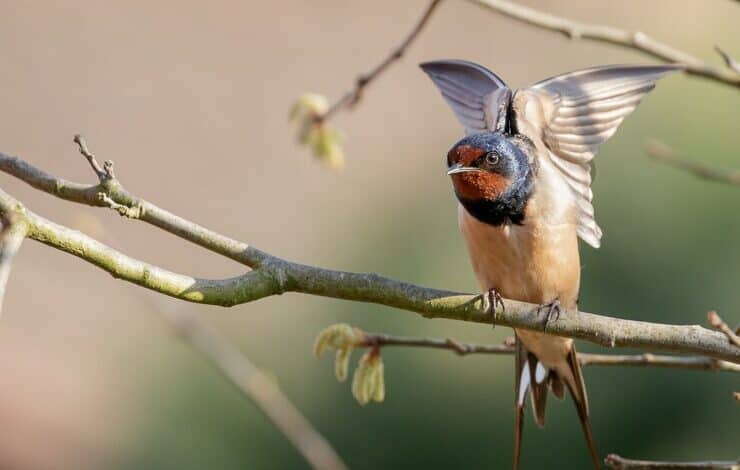
Swallows and Swifts are common migrants to South Africa. They are some of our most beloved birds, heralding the beginning of Summer each year with their amazing arterial displays.
Here in South Africa, we get about 13 species of Swift and 20 species of Swallow visiting our shores each year. Amongst other less common Swallows and Swifts we get the Barn Swallow, White Throated Swallow, Greater Striped Swallow, Pearl Breasted Swallow and the Black Sawing Swallow, the Banded Martin, House Martin and Sand Martin, European Swift, Black Swift, Bradfields Swift, White Rumped Swift, Little Swift, Horus Swift, Little Swift, Alpine Swift and Palm Swift.
Both swallows and swifts migrate every year from Europe to South Africa to nest and breed., returning to Europe when our winter starts. A distance of over 24 000km round trip. Their
routes are unmapped, but it is commonly known that they fly amazingly long distances to reach their destinations.
Swifts on the other hand very seldom land, apart from when they are visiting their nests, they occasionally cling to the sides of buildings or other verticalsurfaces. They eat, sleep, drink and mate whilst flying.
Swifts also spend less time here in South Africa than Swallows do.
Swallows are easily recognised by their long, deeply forked tails and pointed wings which are of a shorter wingspan than the Swifts who have much longer, more pointed, boomerang looking wings and very much shorter forked or fanned tails. Swifts are also much darker in colour.
Both these beautiful little birds usually arrive here any time between July/August to April each year although they have been known to arrive and leave at different times as well. The Lesser Striped Swallows are usually present all year.
Male and female Swallows as well as male and female Swifts are almost identical in appearance.
Swallows:
Swallows live for up to 11 years and start breeding at 2 years of age. They are excellent fliers but often land in large groups on telephone poles etc. At the end of a day, they will fly in
ever growing numbers above their communal nesting site before settling altogether almost
instantly and simultaneously to sleep.
This is often likened to the murmuration flights of the Starlings in Europe.
Swallows always drink on the wing, flying low to sip water.
It takes a pair of swallows over 2 months to build a new nest, around 1,200 journeys to painstakingly carry one tiny ball of mud at a time in their beaks and then carefully and precisely mould it together with saliva to form a nest.
The female takes charge of lining the nest.
Swallows usually nest together in large colonies of breeding pairs usually close to water where insects are more abundant.
Their nests are returned to year after year – sometimes for over 50 years by the same colony of swallows – a completely unique circumstance – and a breeding pair will instinctively return regularly to their very own nest amongst the hundreds of nests that one often seen under bridges or eaves of houses or old barns around South Africa.
These colonies enlarge each year with the next generation returning to start families of their own the following year.
Colonies can sometimes reach over 8000 birds at times – that is if their nests are not destroyed by humans or natural causes such as flooding etc.
They usually lay 3-5 eggs which take around two weeks to hatch and a further 3-4 weeks for the fledgelings to leave the nest. The babies are fed by both parents. Swallows can often
have 2 or more clutches per breeding season.
The South African Bird Ringing Unit (SAFRING) regularly catch and ring these little birds to gain more knowledge of their migratory routes.
Swallows’ common enemies are kestrel, hawks, falcons, owls, gulls, rats, squirrels, domestic snakes and snakes.
Birdlife International indicates that there has been a 40% decline in the number of migratory birds over the last 3 decades. In 2008 more than 1.1 million birds were illegally caught and slaughtered, mainly for fun, in Cyprus despite 90% of migratory birds flying over Cyprus being protected.
Birdlife International and Birdlife SA have recently launched the “Born to Travel Campaign” to protect migratory birds along the African-Eurasian flyway.
More than 70 Birdlife partners are working on joint conservation projects . You too, can get involved in this project by finding out more and contacting them via their website.
SWIFTS:
There are around 100 species of swifts around the world.
The Swifts’ closest genetic relations are hummingbirds. They are not related to Swallows or Martins in any way.
Swifts rarely touch the ground; they have tiny feet and almost no legs having adapted to their life of almost continual flight. They live for up to 21 years of age although their average lifespan is 5 and a half years. They have been known to fly over 1,300km in under 3 days, whilst their migratory routes are generally unknown.
They nest out of sight in holes or crevice’s or in reeds along riverbanks. Most nests are built by the male over a period of 35 days.
Their nests are made from grass and other plant material as well as feathers which are glued together with saliva. They lay 2-3 eggs which can take 3 to 4 weeks to hatch and a further 5-8 weeks for the fledgelings to leave the nest.
Swifts usually only breed one clutch of babies a year. The adult swifts migrate North within days of the chicks leaving the nest.
The Swift is registered on the Red List as an endangered species, which means that there are real concerns for their future. This is due to their declining numbers brought about mainly by their food sources radically declining. It is illegal to kill or harm them or to damage their nests or take their eggs. In China their nests are harvested for their aphrodisiac properties and birds nest soup, leading to a further decline in their numbers.
The Swifts common predators are the Eurasian Hobby, Sparrowhawks and common Buzzards amongst others.
Migratory birds are already severely compromised when migrating due to climate change, pollution, insecticides, the lack of rainfall in their migratory path and the increasing decline of
insects which they catch and feed to their young or eat in flight during migration, as well as severe storms etc.
Due to these factors these amazing birds will now be faced with less time in which to raise a brood, teach the young fledglings to fly, hunt, grow strong and be prepared well enough for their long and dangerous migration back to the UK.
REFERENCES: Google: Information on Swallows/Swifts; Wikipedia : Living with Birds – 21; Wildlife facts on Swallows/Swifts; Britannica: Swift/Swallow Migration, Nesting and Feeding
All about Birds : Swallows/Swifts; *Vedantu _ Swallow Bird – Habitat, Behaviour, Lifespan, Shape; Swift Bird – The “footless” bird.; SAFRING – https://safring.birdmap.africa; Birdlife International and Birdlife SA – https://birdlife.org.za and https://www.birdlife.org; Roberts Birds of Southern Africa Fifth Edition – 411 to 421 Swifts and 518 to 537 and 904.