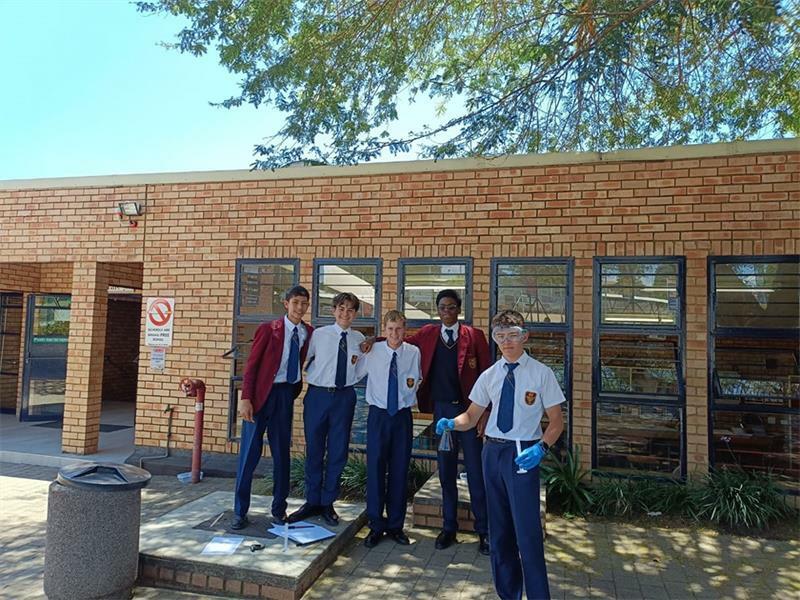
Grade 11 science learners at Trinity House Randpark Ridge recently engaged in a hands-on practical investigation aimed at synthesising copper nitrate from copper turnings and concentrated nitric acid. This initiative provided students with valuable experience in chemical calculations and laboratory procedures.
According to the head of the department of physical science at Trinity House, Shelden Millett-Clay, the investigation is where learners learn about chemical calculations and determining percentage yield. The practical aspect enables students to apply theoretical knowledge and develop skills in accuracy, reliability, and safety.
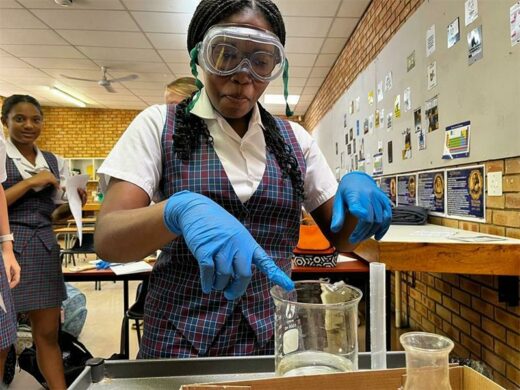
“In Grade 11 science, we start with the section called stoichiometry, which involves all chemical calculations, including determining percentage yield widely used in industry to ascertain whether a chemical reaction is viable or not,” said Millet-Clay. “We give this investigation to the students to enable them to have hands-on practice with the use of various forms of apparatus and chemicals, to encourage accuracy, reliability, safety, and to determine whether the investigation they are doing is a fair test or not.”
She explained that this investigation is important for the learners when they attend university. “They will have the advantage and benefit of having handled chemicals and apparatus in a responsible, safe manner and will have practised the accuracy required in chemical investigations.”
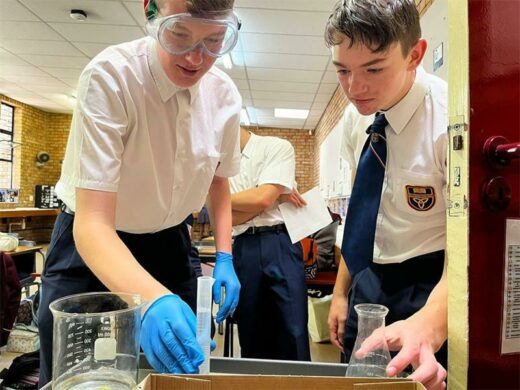
The investigation involved multiple steps, beginning with a pre-practical lesson to ensure learners were aware of safety aspects and the handling of dangerous chemicals. The process began with students measuring the required mass of copper turnings and adding concentrated nitric acid under staff supervision. The synthesis process produced copper nitrate.
Following the synthesis, learners recovered the copper nitrate crystals by gradually boiling the solution. They then measured the mass to calculate the percentage yield of copper nitrate. Millet-Clay noted that the purpose of the investigation is to achieve as close to a 100% yield as possible. “The purpose of the investigation is to be as accurate as possible. The yields usually turn out to be between 78% and 88% which is very good.”
She said that through this practical investigation learners not only gained valuable experience but also enjoyed themselves. “The students enjoy the investigation as it is the first one of the year, they are doing chemistry practically and they are testing their skills as chemists.”
Related Article: The King’s School learners celebrate Valentine’s Day in style