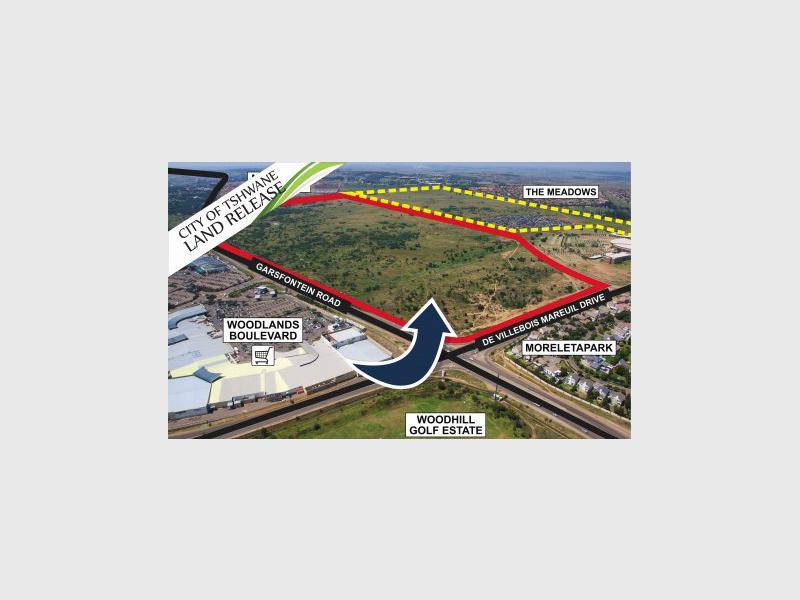
The sale of two adjacent prime properties in the Woodhill area in the east of the city – one of them home to some 1 000 illegal squatter dwellings known as Plastic View – has merely been postponed by the Tshwane metro.
This became clear from a list provided by the metro last week on properties sold by public auction.
The two parcels of land on the corner of Garstfontein Road and DeVillebois Mareuil Drive were also set to go under the hammer last week with 18 other properties which Tshwane had released for auction to raise money to improve the lives of the poor in the metro.
However, the sale of the Plastic View land was halted by the squatters whom, with the assistance of Lawyers for Human Rights last Monday brought a successful 11th hour urgent interim interdict to protect their right to reside on the land.
In its list supplied to Rekord after completion of the auction, the metro said the sale of the two properties concerned had been “postponed”. Clarification on what exactly this meant could not be obtained from mayoral spokesperson Blessing Manale.
Despite an undertaking in a sworn statement before the High Court in Pretoria on Monday that Plastic View residents would be resettled within 54 weeks at an adjacent property one kilometre from where their shacks were now and therefore their rights would be protected, Judge Legodi Phatudi stopped the auctioning of the land.
Phatudi granted the interdict to residents, also known as the Woodlane community – stopping the sale of the land pending an application to set aside the municipality’s decision to sell it on auction.
The judge however rejected part of the application, brought by Plastic View residents on behalf of all squatters and homeless in Tshwane that 74 other properties also not be auctioned off.
Tshwanwe metro announced the land release programme months ago, giving details of some 80 properties to be sold on public auction to raise funds for infrastructure development and other housing needs of the poor in the metro. The auction of municipal land was a first in the country and a total of R154,4 million was realised at the auction.
In his affidavit opposing the application, Tshwane metro strategic executive director of group legal services, Bruno Seabela gave the assurance that Plastic View squatters would have right of tenure on the land until such time as they were relocated to an adjacent property one kilometre away.
The metro argued before court that legal and proper relocation of the squatters was a condition of sale and that the buyer had to adhere to the conditions.
“If residents of Woodlane are not relocated within 54 weeks of the sale, the metro would buy the land back from the buyer,” Seabela stated in court papers.
The city maintained it had financial problems and urgently needed the income from the properties.
Phatudi rejected the metro’s argument, saying Plastic View had been the subject of a number of court cases, including two judgments by the Supreme Court of Appeal which established the occupancy rights of the residents.
The applicants contended there was no innovative method of resolving the matter and the metro had not even informed them the land was earmarked for public auction.
The judge ruled there was no doubt the applicants had a legal right to the property – a right entrenched by two previous court rulings.
He said the applicants had an apprehension of irreparable harm and it was common cause that should the mandate to The High Street Auction Company to auction the property proceed, the applicants would have no certainty of what would happen to them should the property be sold to another party.
“In my view, the sale of the property before relocation of the applicants is the invasion of the applicants’ rights and their legitimate expectation to be consulted prior to sale or development has been embarked upon,” the judge ruled.
He said the occupation of the land by a developer constituted proof of a reasonable apprehension of injury to applicants’ rights and Tshwane metro could not persuade him of another remedy available at the applicants’ disposal, other than they would not be evicted from the area and the deed of sale ensured non-eviction.
“In my view, the only ordinary remedy at the applicant’s disposal which provides them with the necessary protection is an interdict pending the finalisation of a review. I am however not persuaded to grant the interdict in respect of all properties within the jurisdiction area of the municipality. It is not clear from papers and submissions by applicants that they are acting in the interest of the public at large in this instance,” the judge ruled.
Although Phatudi only ordered the interim halting of the sale of one land parcel, it could not be established at the time of going to print why the metro had decided to postpone the sale of the adjacent property as well.
Seabela also did not give details of exactly where the almost 3 000 squatters would be relocated to, only stating it was a kilometre from where they were currently residing and that it would be adjacent to the notorious squatter camp that had been a bone of contention for several years, especially for several home owners’ associations in the upmarket area.

For more community news, visit Rekord’s websites:
Also like our Facebook page and follow us on Twitter and Instagram.
We have exciting news! We’re offering a free alert to help you always be in the loop. Send an email with the word ‘Subscribe’ to breakingnews@rekord.co.za to receive your free breaking news update.