Building the people’s Capital
Tshwane executive mayor Kgossientso Ramokgopa on Thursday delivered his State of the Capital Address at Freedom Park where he spoke about the highlights of the past few months and a host of exciting new plans for the city
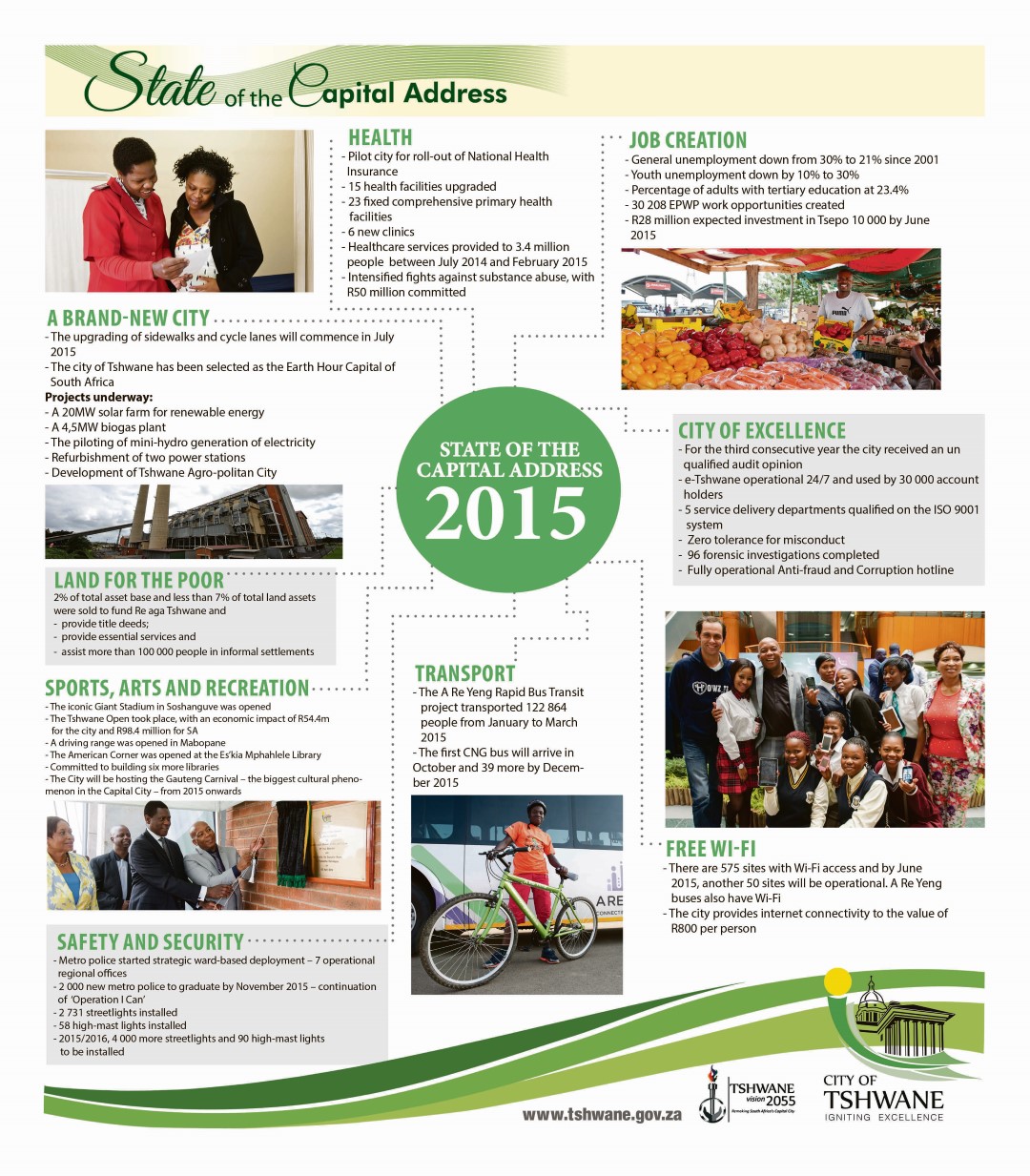
Delivering his State of the Capital Address at Freedom Park on Thursday, Tshwane Executive Mayor Kgosientso Ramokgopa clearly spelt out his plans for the remaking of the People’s Capital through radical economic transformation and spatial justice.
The 2015 State of the Capital City Address takes place in the context of the 60th anniversary of the adoption of the Freedom Charter in Kliptown in 1955.
The 2015 State of the Capital City Address also takes place in the context of 15 years of the establishment of local government in its current form.
The City of Tshwane (CoT) is the fourth-largest municipal economy in the country.
As measured by gross domestic product (GDP), the City contributes 10.1% to national gross domestic product.
Tshwane clearly displays great potential, with relatively high rates of people with higher education, the fastest growing local economy in South Africa and the se-cond highest average household income within Gauteng.
In 2001, our unemployment rate was over 30% and today it is 21%; more importantly, in 2001 our youth unemployment was over 40% and now it is close to 30%.
In 2001, 9.1% of people over the age of 20 had no schooling; today only 4.1% of adults have no schooling.
Our City claims the highest percentage of adults with a tertiary education – 23.4% in CoT, compared to 16.6% in Cape Town or 19.2% in Johannesburg.
The moratorium on the issuing of informal trading licences has been lifted.
It is evident that education is a critical sector within the City’s economy and has, indeed, been the fastest growing sector within the City in recent years.
Free Access to Wi-Fi Connectivity
Today, there are 575 sites that have access to Wi-Fi and by June 2015, another 50 sites will be live. A Re Yeng buses are also Wi-Fi enabled.
The City is currently providing internet connectivity to the value of approximately R800 per person, per device, per month at no cost to residents.
The City’s vision is to eventually provide Wi-Fi connectivity in every street, every corner and every household in the Capital City.
Job Opportunities
30 208 EPWP work opportunities were created between July 2013 and June 2014. The target is 40 000 by June 2015.
Tshepo 10 000: there are 405 newly registered co-operatives on the Tshepo 10 000 programme and 193 co-operatives are registered vendors.
Absa has trained 9 344 beneficiaries on team building, group dynamics and financial management and in conjunction with the University of Pretoria, entrepreneurial training has been provided to over 10 600 beneficiaries.
The City has awarded contracts to Tshepo 10 000 co-operatives with opportunities at a total rand value in excess of R273 million by the 2016/17 financial year, with R27 million committed in the current financial year and R135 million in the 2015/16 financial year.
We expect to invest R280 million in co-operatives through targeted procurement from them by the end of June 2015.
A Business Process Outsourcing (BPO) park in the Hammanskraal area is currently being developed. It is estimated that it will attract approximately R525 million investments in infrastructure and will create
over 1 000 job opportunities during construction of the first phase, and 3 300 new job opportunities will be created upon completion of all three development phases of the project.
Re aga Tshwane and Land Ownership
Through this magnificent programme, we will issue title deeds (ownership of land) and provide a basket of essential services including prepaid electricity, water, on-site sanitation and refuse collection.
The land parcels that were recently auctioned and those planned for future auctioning constitute less than 0.05% of Tshwane’s total land mass, less than 2% of the total asset base of the City and less than 7% of total land assets.
The proceeds of the Auction will fund Re aga Tshwane.
Through the first phase of the release of these parcels, the City has raised approximately R190 million, aimed at funding infrastructure and formalising informal settlements.
Through Re aga Tshwane we will restore the dignity of over 100 000 people who currently live in informal settlements without the most basic infrastructure.
The City of Tshwane has transferred a significant amount of land by way of donation. Over 148 land parcels have been transferred to churches and the taxi industry. CoT has also converted leaseholds to full titles to over 50 black township business people in Mamelodi, Atteridgeville and Marabastad. The land donated to churches has a municipal value in excess of R60 million.
It will give us great pleasure to see land ownership restored to our people. Since the beginning of this financial year, over 4 000 title deeds have been issued and almost 18 000 have been issued since 2011.
The City has a total of 8 237 uncollected title deeds that need to be claimed by their rightful owners.
Tshwane Vision 2055
We have selected four sectors in which we want to focus our efforts in the next 15 years towards the achievement of Vision 2055, namely: education and the know-ledge economy; agriculture and
agro-processing; business and diplomatic tourism; and the green economy.
For each of these sectors, the City will have a renewed focus sustained by an implementation plan that is being developed in consultation with key stakeholders.
Catalytic Projects
• Caledonian Inner City Park
• A Re Yeng
• Government Boulevard
• West Capital Development
• Tshwane House
• African Gateway
• Symbio City
East Capital development, which will unlock between R4 billion and R6 billion of private sector investment.
The A Re Yeng project has been operational from Jan 2015 in Trunk Line 2A from the CBD to Hatfield.
The A Re Yeng fleet has transported 122 864 bus commuters from January to March 2015, with an average of a 40% increase in daily users.
The first CNG bus will arrive in October this year with a further 39 CNG buses expected towards the end of the year.
The taxi industry is the sole shareholder of the City’s multi-billion rand Bus Rapid Transit (BRT) system, which demonstrates our commitment towards the creation of shared wealth within the City.
The A Re Yeng rapid transit system for Tshwane will continue to be rolled out in phases. The CBD to Wonderboom station in the north of the City is expected to be operational by November 2015.
A pre-feasibility study was done for the Light Rail Transit system, which will integrate with the Gautrain and A Re Yeng systems.
We completed, amongst other initiatives, the upgrading of sidewalks and cycle lanes along Nana Sita Street between Paul Kruger Street and Nelson Mandela Drive, thereby contributing to enhanced levels of liveability within the City.
In addition, due to the high pedestrian volumes around the Sunnyside station precinct, the construction of non-motorised transport (NMT) facilities has been prioritised and is expected to commence in July 2015.
Building the People’s Capital
Through our sustainability initiatives, we have been selected by an international panel of experts as the ‘Earth Hour Capital of South Africa’, which is indeed a significant achievement.
Core sustainability projects: a 20MW Solar Farm to inject a significant amount of renewable solar energy into the City’s energy mix; the replacement of mercury, sodium vapour lamps and fixtures with energy-efficient induction, LED- and solar-powered street lighting; up to 6MW/h biomass-powered electricity generation for use by targeted off takers throughout the City.
We have pioneered a wheeling agreement with Bio2Watt to support the establishment of a 4.5MW Biogas plant in Bronkhorstspruit, supplying most of its electricity to BMW.
We have piloted the mini-hydro generation of electricity, in partnership with the University of Pretoria, to this effect a hydro-power turbine will be installed at the Annlin reservoir.
The refurbishment of our power stations in Rooiwal and Pretoria West has the potential to generate 1 000MW of power.
The City has vowed to keep the power stations operational and for this winter, no less than 100MW will be generated from the power stations.
Waste separation at the source remains a key challenge for our residents and we will continue to enhance our citizen outreach programmes to drive the message home.
In this regard, the roll-out of a standard weekly waste collection service was initiated in 2009 and it has so far seen approximately 60 000 bins handed out across the City.
To complete the standardisation of waste infrastructure across Tshwane, over 200 000 bins will be handed out in Regions 7, 6 and 1 of the City.
In line with our Vision 2055 outcome of creating a resource-efficient and resilient Capital City, phase 1 of the Tshwane Food and Energy Centre in the Tshwane Agropolitan City in the east, has begun. This project will contribute towards renewable energy generation through solar and biogas plants, urban food production, SMME development, employment creation and social cohesion.
As of December 2014, we have provided electricity to over 50 000 households and by the end of the current financial year, this number will have increased by approximately 8 000, thus exceeding the committed 5-year IDP target of providing electricity to 68.3% of Tshwane households.
As part of eradicating the current electrification backlog, in the 2013/14 financial year, the City has electrified a total of 15 601 houses in both Tshwane- and Eskom-supplied areas against a target of 9 000. In the current year, 15 000 more households will have access to electricity with an additional 6 000 households planned for electrification in the 2015/16 financial year.
The electricity-for-all programme is focussed on electrifying areas being formalised by the Re Aga Tshwane team and in excess of 16 600 households have been electrified since the inception of the electrification of informal settlements programme.
Creating a Health-Oriented People’s Capital
The City was one of the few districts selected as a pilot for the roll-out of National Health Insurance (NHI).
As part of our commitment towards the roll-out of NHI, the City has implemented ward-based outreach teams (WBOT) in 42 of the City’s 105 wards as planned.
A total of 15 of 26 healthcare facilities in the City of Tshwane need to be upgraded to enable the full implementation of NHI.
Comprehensive primary healthcare services are currently being rendered at 23 fixed facilities.
We have renovated and built new clinics in Doornpoort, Olievenhoutbosch and
Danville and in the new financial year, three new clinics will be completed in the Gazankulu, Zithobeni and Soshanguve areas.
Furthermore, during the current MTREF cycle, the City will also ensure that clinics in the Rayton and Bronkhorstspruit areas are appropriately upgraded to ensure universal and equitable access for all residents.
Our healthcare facilities in the City have provided services to more than 3.4 million people between July 2014 and February 2015.
We are intensifying our fight against substance abuse, particularly that of
nyaope. We have commenced with roadshows, which will take place in all regions of the People’s Capital. The first roadshow was held in the CBD in March 2015.
Soshanguve and Mamelodi will follow.
A total amount of R50 million has been committed to the fight against substance abuse in the new financial year.
Clustered, ward-based local drug action committees have been established in Ga-Rankuwa, Winterveld, Soshanguve South, Mabopane, Hammanskraal, Olievenhoutbosch, Eesterust, Mamelodi and Atteridgeville and identified programmes are being implemented by social workers.
These include: training, community awareness campaigns, partnerships with relevant stakeholders and skills development for rehabilitated users, amongst other initiatives.
We have also piloted paperless solutions within the sphere of healthcare through the biometric patient identification system, preventing duplication. The roll-out of the biometric system to all clinics in the City will continue in the 2015/16 financial year and subsequent years.
A Capital City anchored in Sports, Arts & Recreation
The iconic Giant Stadium in Soshanguve was opened amid much fanfare.
In keeping with our tag-line of ‘It’s more than just golf!,’ the Tshwane Open was mooted to showcase the City of Tshwane as a tourism destination of choice. The third Tshwane Open took place in March of 2015 at the prestigious 105-year-old Pretoria Country Club.
Grant Thornton established that the 2014 Tshwane Open had a total economic impact of about R54.4 million for the City and R98.4 million for South Africa as a whole.
Another significant legacy of the tournament has been the development of the game at the Mabopane driving range, north of the city.
The City of Tshwane has decided to host the tournament for another three years, as we believe that this will go a long way toward positioning Tshwane as a Capital City of Excellence and building and uniting our people.
Earlier this year, the U.S. Embassy, in collaboration with the City of Tshwane, officially opened the American Corner at the Es’kia Mphahlele Library.
We welcome the commitment of the Gauteng Department of Sports, Arts, Culture and Recreation in supporting the expansion of access to libraries by committing to building six libraries in Tshwane in the 2015/16 financial year in Atteridgeville, Hammanskraal, Soshanguve, Ekangala, Akasia and Mamelodi.
The City will be hosting the Gauteng Carnival, the biggest cultural phenomenon in the Capital City, from 2015 onwards. The 2015 Gauteng Carnival arrives at a time when the country is celebrating 60 years of the adoption of the Freedom Charter.
Ensuring Safety and Security for all
The Tshwane Metro Police Department (TMPD) commenced with extending its strategic ward-based deployment within Tshwane and can now proudly say they have 7 operational regional offices providing a 24/7 metro policing service.
A total of 2 000 metro police trainees will also formally graduate by the end of November 2015 and will be deployed to all 105 wards across Tshwane.
True to our commitment in last year’s speech, the TMPD has continued with the roll-out of CCTV cameras and 151 have been operationalised within the City.
The TMPD will continue with ‘Operation I Can’. The focus of the operation is, amongst others, on the removal of illegal advertising; illegal formal and informal trade activities; the removal of illegal taxi holding areas; illegal structures on council-owned road reserves; illegal public and private transport activities; illegal electricity connections and water use and spillage. These measures are proving to be greatly successful in achieving an enhanced level of liveability within the City.
Access to electricity and lighting also contributes towards the reduction of crime and ultimately, a safer city.
A total of 2 731 streetlights and 58 high mast lights were installed since the 2013/14 financial year. Towards the end of the 2015/16 financial year, we aim to install a further 4 000 streetlights and 90 high-mast lights.
Accelerating Service Delivery and Improving Financial Viability
For the third consecutive year, the City has received an unqualified audit opinion, which implies that our annual financial statements are credible with respect to information reported.
e-Tshwane has enabled the availability of certain services on a 24/7 basis and provides a real-time update of accounts, accessing of e-statements, paying for services, the loading of meter reading and the reconnection of services within 4 hours of effecting a payment.
Over 30 000 account holders are already using the system since its launch in November 2014 and a total of 120 000 accounts have been registered.
Five of the City’s service delivery departments have been certified and the ISO 9001 system has been implemented in all seven regions.
The City of Tshwane is currently the only municipality in South Africa to have five departments responsible for direct service delivery certified on the ISO 9001 Quality Management System. The project will be completed in the 2015/2016 financial year.
We have adopted a zero-tolerance approach to any form of misconduct based on the underlying precepts of fairness and workplace justice.
The City successfully completed 96 forensic investigations during the 2013/2014 financial year and 112 in the current financial year, with 43 matters having been referred for disciplinary action during the current financial year.
The Anti-Fraud and Corruption hotline is fully operational and a minimum of five reports are received daily from the hotline. Twenty arrests have been effected as a result of information received through the hotline.
The Whistleblowing Policy was approved to encourage employees and members of the public to report their suspicions of maladministration, fraud and corruption.
The whistleblowing campaign has successfully reached over 500 000 members of the community through public activations, radio advertisement and print.
Also read:
Tshwane debts higher than other metros
GALLERY: State of the Capital Address 2015
Do you have more information about the story? Please send us an email to editorial@rekord.co.za or phone us on 072 435 7717.
For free breaking and community news, visit Rekord’s websites:
For more news and interesting articles, like Rekord on Facebook or follow us on Twitter.
- We have exciting news! We’re offering a free alert to help you always be in the loop. Send an email with the word ‘Subscribe’ to breakingnews@rekord.co.za to receive your free daily breaking news update.