No proof municipal water is cause of typhoid outbreak
Pretoria accounted for seven cases between December and February.
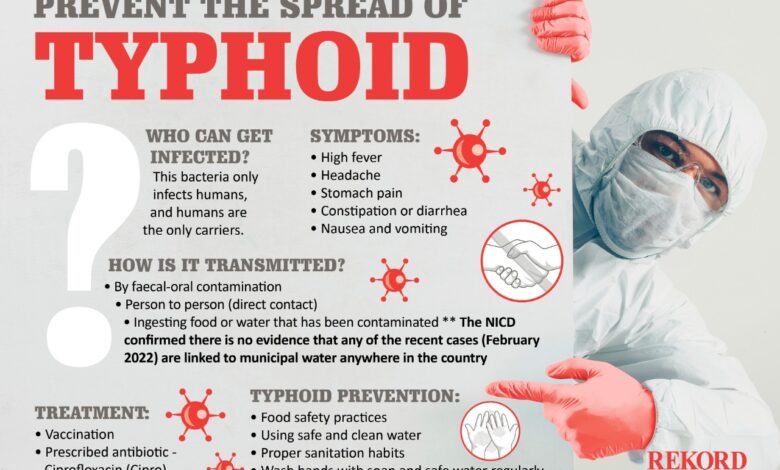
The National Institute for Communicable Diseases (NICD) has dismissed rumours that the source of enteric/typhoid fever in parts of the country was a result of contaminated municipal water.
The disease includes typhoid fever (caused by the bacterium Salmonella Typhi) and paratyphoid fever (caused by the bacterium Salmonella Paratyphi A, B and C).
A cluster outbreak of the disease in the country was reported on Friday, with cases in the Western Cape, North West, as well as Gauteng, being confirmed.
Tshwane accounted for seven cases between December and February. In a statement on Monday afternoon, the NICD said “there are numerous social media posts with false information about enteric fever in South Africa that are attracting widespread attention and causing needless concern and panic at the moment.”
“These posts allege either that there are currently cases of enteric fever in certain towns or provinces caused by contaminated municipal water, or that the bacteria causing enteric fever have been identified in certain municipal water sources.
“These statements are factually incorrect. There is no evidence that recent cases of enteric fever are linked to contaminated municipal water in any part of the country. There is no evidence that the bacteria causing enteric fever have recently been identified in municipal water sources anywhere in the country.”
In an earlier statement, the NICD said the contamination of municipal water was extremely unlikely to be the source of infection in any of these cases due to their demographics, places of residence and source(s) of drinking water.
Tshwane health MMC Rina Marx said her department was closely monitoring the situation and would continue to do so.
“In the past three months, starting from December 2021 to February 2022, only seven sporadic laboratory-confirmed cases were reported through the national medical notification system,” she said. “Two of these cases were reported in December 2021, four cases in January 2022 and one in February 2022.”
She said this was no reason for people to panic as it is not classified as an outbreak.
“So far, the sporadic cases in Tshwane do not meet the WHO definition to be classified as an outbreak,” she said.
“Residents who suspect their water is contaminated are advised to boil the water before consumption.”
She urged residents to practise comprehensive hand hygiene and those with symptoms to visit their nearest health facility for investigation, diagnosis and treatment.
“Typhoid fever is treated with antibiotics that should be available in all health facilities. The City is working with all its relevant stakeholders to monitor the situation and calls for calm as there is no need to panic.”
Marx said typhoid is a notifiable disease and should be reported to the Department of Health by the diagnosing health facility.
Symptoms may include a fever that is on and off during the first week but becomes sustained (lasting for 48 hours), headache, abdominal pain or cramps, nausea and vomiting, constipation or diarrhoea. Flu-like symptoms may also occur.
ALSO READ: What you need to know about typhoid fever
Do you have more information about the story?
Please send us an email to editorial@rekord.co.za or phone us on 083 625 4114.
For free breaking and community news, visit Rekord’s websites: Rekord East For more news and interesting articles, like Rekord on Facebook, follow us on Twitter or Instagram