Tshwane metro: “Residents owe us R6.2bn and we are coming for it”
Tshwane is attempting to rescue itself from bleeding money by relaunching its electricity disconnection campaign that has not yielded a significant boost in ending its drought of payments to Eskom.

Tshwane is attempting to rescue itself from bleeding money in a reactivation of its electricity disconnection campaign, collecting R6.2-billion over six months from the highest indebted property owners.
The drive, which is known to name and shame the biggest defaulters, was initiated in 2021, however, it did not yield a significant boost in ending the drought of payments to Eskom.
The metro’s debt spiralling close to R4-billion this year.
According to the finance MMC Jacqui Uys, R6.2-billion was being pursued from property owners in the name of the Tshwane Ya Tima campaign.
Embassies, businesses, government agencies and other registered household members owing Tshwane are under its credit control microscope.
The revenue collection campaign is on a drive to disconnect the electric power of defaulting clients who run up high service bills and fail to pay their monthly invoices.
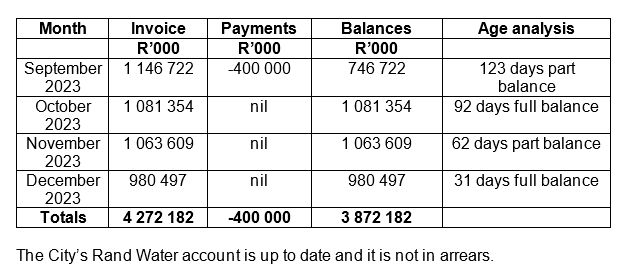
Uys said in February the metro had hit the ground running to collect what it was owed on all accounts after it paid Eskom only R400-million in September last year.
This is as Tshwane’s September invoice tallied over R1-billion.
Uys said the Tshwane Ya Tima drive has in the early part of the year been refocused to target the top 1 500 highest owing clients, owing the city R6.2-billion.
She said on February 5, Group Financial Services had already issued 188 disconnection job cards.
Electricity meter and circuit breaker removed after the meter was found to have been tampered with. The owner has been issued with a R27k fine. He will also have to pay a reconnection fee plus 30% of the debt which is standing at R230 k. #TshwaneYaTima pic.twitter.com/wj2U1jbDXR
— City of Tshwane (@CityTshwane) February 6, 2024
Student accommodation in Pretoria North has been disconnected. The account is R1 800 000 in arrears. #TshwaneYaTima pic.twitter.com/qoEaKePgEz
— City of Tshwane (@CityTshwane) February 6, 2024
Uys said 70 accounts were successfully disconnected, while steep fines for meter tampering and illegal connections were imposed.
Residential households owed R50-million.
Uys said the number one priority for the finances department was to attempt to rescue Tshwane.
“We’ve been making the hard decisions, like foregoing salary increases, because we are in financial difficulty.
Aggressively cutting off non-paying consumers, going after illegal connections, leasing non-performing assets, unlocking private energy generation, and devising partnerships with the private sector are all aimed at getting the books to balance and delivering value for ratepayers money,” Uys said.
“We are fighting for the future of the city.”
Uys said Tshwane was taking responsibility for the debt to Eskom.
She said the metro had managed to enter a payment plan and since the beginning of December was paying the arrears of September, October and November in instalments.
“We have been open with Eskom that we will likely default in the winter months due to higher accounts, but that we commit to be in a better position at the end of 2024 than what we ended 2023.”
[WATCH] MMC for Finance Jacqui Uys leads our #TshwaneYaTima teams as they disconnect non paying residents. We are relaunching Tshwane Ya Tima to help improve revenue collection. @CityTshwane pic.twitter.com/YPlDpAcHuX
— Mayor Cilliers Brink (@tshwane_mayor) February 7, 2024
Tshwane spokesperson Selby Bokaba told of how a September 2023 invoice was settled with R400-million, while the following three months’ invoices were not serviced by a single cent.
“The amount owing to Eskom as of January 31 is almost R4-billion.”
Bokaba said the metro had been collecting 90% of its revenue target in the past three months, however, collection levels should be higher than 95%.
“In essence, we only missed our collection target by 5%.”
During a recent council sitting, mayor Cilliers Brink said the debtor’s book was sitting at R23.3-billion.
Tshwane implored residents to pay their bills because many had not been paying for water, property rates and waste management. This does “not only hamper improvement to essential services but creates an unfair burden on customers who diligently settled their bills each month”.
Eskom earlier announced that R3-billion of the R4-billion it had invoiced Tshwane was overdue.
Power utility spokesperson Amanda Qithi said Eskom was doing everything in its power to recoup what the Capital City owed after it had filed legal proceedings against the metro.
“The matter is still in litigation. Eskom engages with the municipality and exhausts all avenues to try and recover what is due to it. However, in certain instances, the utility is forced to escalate the overdue debt to the National Treasury.”
Eskom has not been pleased with the Capital City’s failure to honour its debt for several years now.
“The payment patterns by Tshwane have deteriorated to concerning levels that further threaten Eskom’s liquidity, financial performance and sustainability,” said Eskom, adding that the erratic payments dated back to 2022.
Along with other measures, #TshwaneYaTima is being reinstituted, this time not as a campaign, but as a standard operating procedure. So we are coming to disconnect all defaulting clients including councillors & City officials. #TshwaneSoCA2023 #MayorBrink @CilliersB pic.twitter.com/HpS3hwO1Sn
— Mayor Cilliers Brink (@tshwane_mayor) May 18, 2023
Do you have more information about the story?
Please send us an email to bennittb@rekord.co.za or phone us on 083 625 4114.
For free breaking and community news, visit Rekord’s websites: Rekord East
For more news and interesting articles, like Rekord on Facebook, follow us on Twitter or Instagram