Residents owe Tshwane more than half of total debt
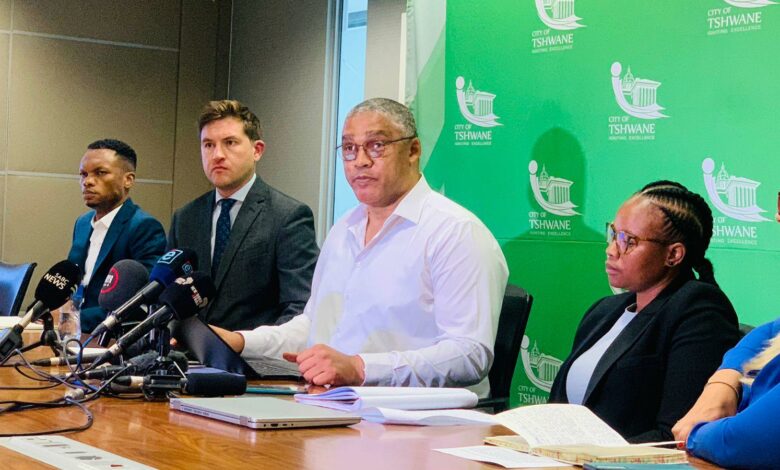
Mayor Cilliers Brink said the metro would be sharpening up credit control and debt collection.
Tshwane’s debtor’s book has inflated by R6-billion since 2021, with vast defaulters in this timespan increasingly being residential property owners, according to this year’s municipalities debtors book.
In 2021, the debtor’s book stood at R17-billion and deteriorated to R23.3-billion by 2024.
As of March 2023, the Tshwane debt spread was:
– Residential: over R10-billion
– Business: over R5.2-billion
– Inactive: over R1-billion
– Indigents: over R1-billion
– Government: over R974-million
– Sundries: over R888-million
– Inter-departmental: over R29-million
– Employees: over R26-million
– Embassies: over R7.2-million
– Councillors: over R2.9-million
The total debt stood at more than R20-billion.
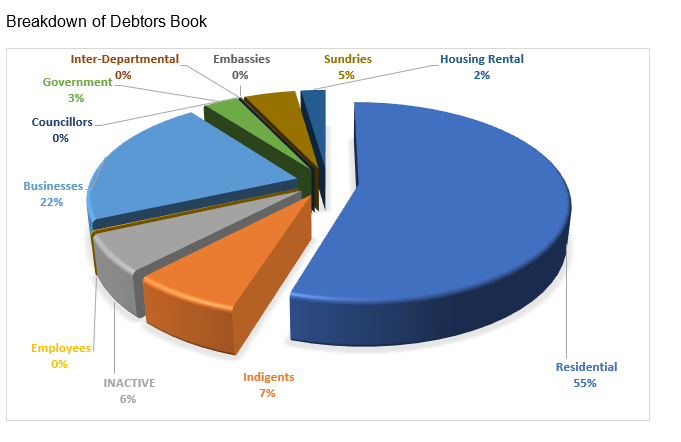
In less than a year, the debt has grown by over R2-billion with 55% of residential owners, 22% of business and 3% of government being parcel of the R23.3-billion debt.
The likes of councillors, embassies, inter-departmental institutions and employees have all managed to reduce their arrears.
Tshwane however planned to collect about R6.2-billion of the R23.3-billion over the next six months by reactivating the Tshwane Ya Tima campaign after it missed its 95% collections target for four months.
In September only 82% of the revenue target was achieved, in October 93%, in November 86% and 92% in December.
The recently hatched plan is a bid to rescue Tshwane already drowning in debt, especially following its failure to service Eskom invoices which amount to R3.8-billion.
In this plan, Tshwane is set to undergo a R1-billion reduction in expenditure each month for the next six months in a bid to reduce bulk expenses.
Tshwane metro spokesperson Selby Bokaba said: “We’re targeting 1 500 high-end consumers who owe us R6.2-billion but we will start with the first top 500 customers from whom we can collect R3.2-billion arrear debt.”
WATCH:
Mayor Cilliers Brink said the metro would be sharpening up credit control and debt collection.
“The Tshwane Ya Tima campaign that was rolled out in 2022 was very effective. We wanted it to become standard operating procedure for the city, but our efforts were undermined by the strike.
It is difficult to run a large-scale credit control effort, disconnecting high-value accounts and sending a warning to all other consumers, if your city is burning and waste is piling up.”
Brink said the metro would make available all resources, including systems and personnel to the project.
“Tshwane Ya Tima will be rolled out with even more intensity than in the past. We will update our credit control and debt collection toolbox, including issuing summons and taking properties in execution for judgment debt.
We will also make sure that everyone gets a bill, if not online, then on their phone. We can no longer count on the Post Office, nor require residents to visit municipal offices once a month. We must use technology.”
Brink said the focus would be on the top indebted consumers.
“We work through a backlog. We will also become stricter on other consumers.”
He said part of the financial rescue mission was to offer tariffs cost-reflective and manage down costs.
“In the budget for the new financial year that starts on July 1, 2024, we will ensure that these tariffs are as cost-reflective as possible. This does not simply mean higher prices but, more importantly, managing our costs downward. Our efforts will be focused on getting better value for money for residents who pay rates, tariffs and charges.”
He further vowed to update tariffs for upmarket properties.
“The metro will update the property valuation roll in 2025. We believe there are many discrepancies on our valuation roll.
Anyone who searches Property24 or similar apps will find large, upmarket properties in Tshwane on which nominal property rates are payable. An example of this is a house that is for sale at R14-million with property rates of less than R3 000 a month.”
He said in other parts of Tshwane, large developments had been built on unproclaimed land where agricultural rates were still being paid.
“These are not all the anomalies to be sure, but they add up.”
He said the metro hoped that the plan to save R1-billion would yield results by 2025 and assist in managing the Eskom debt.
Do you have more information about the story?
Please send us an email to bennittb@rekord.co.za or phone us on 083 625 4114.
For free breaking and community news, visit Rekord’s websites: Rekord East
For more news and interesting articles, like Rekord on Facebook, follow us on Twitter or Instagram