Tshwane council approves adjustment budget
A majority of 116 council officials supported the adjustment budget, 81 opposed it, and no one abstained.
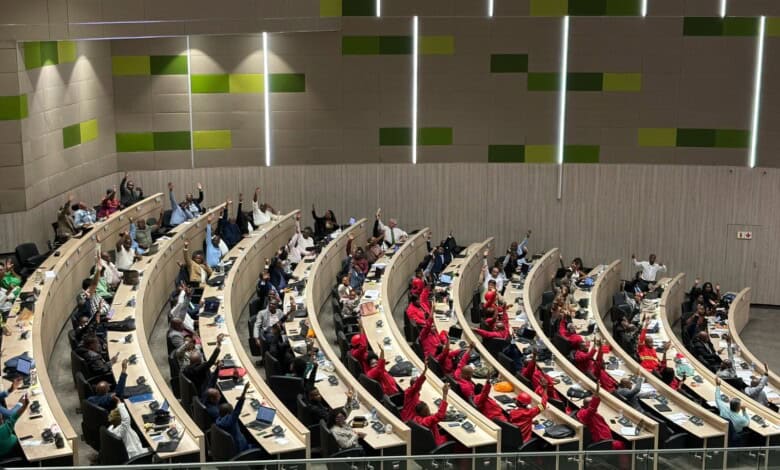
The Tshwane council approved the 2024/25 adjustment budget and the innovative incentive and debt-relief scheme in a decisive move toward financial stability.
The adjustment budget was voted for by 116 councillors, while 81 were against it.
The budget sets targets for the implementation of a new Revenue Recovery Plan, in which the metro anticipates generating an additional R2.1-billion in revenue by June 30 by focusing on improving billing accuracy, enhancing revenue collection, and enforcing stricter credit control measures.
Tshwane also committed to recovering historical debt, expected to generate R1.4-billion.
Mayor Dr. Nasiphi Moya, during the council meeting on February 28, mentioned that the budget was aimed at improving the metro’s financial health while ensuring continued service delivery.
The adjustment budget comes as the metro’s mid-year expenditure stands at R22.1-billion, which is 14% below the year-to-date budget.
Despite total expenditure increasing by R704-million (1%), the city has recorded a surplus of R3.7-billion due to careful financial management.
Moya said water service charges increased by R160.6-million (3%) due to improved billing accuracy and revenue collection.
She stated that interest earned from receivables surged by R437.2-million (33%) following the implementation of stricter credit control measures.
Property rates revenue grew by R64.9-million (1%), reflecting a stable tax base.
However, fines and penalties saw a decline of R71-million, which prompted the metro to review enforcement mechanisms to address non-compliance.
The adjustment budget focuses on resource efficiency, limiting spending growth to essential service areas.
“A R346.5-million reduction in employee-related costs as part of cost-containment measures.
“An R1.4-billion increase in debt impairment to better manage non-performing debts and a reduction of R834.2-million in depreciation and amortisation costs due to more efficient asset management are some of the key adjustments,” said Moya.
While the new administration inherited an unfunded budget for the 2024/25 financial year, legislation allows for adjustments to be made to the budget creating an environment where the city can reduce the deficit and prioritise spending towards essential service delivery items.… pic.twitter.com/e6KJyc8YCW
— Dr Nasiphi Moya (@nasiphim) February 27, 2025
Moya said R11-million has been allocated to the procurement of machinery and tools to maintain public spaces, including parks, streets, and community areas, as this will enhance in-house capacity for regular grass-cutting and maintenance.
She said the metro has also allocated R8-million to essential protective equipment for firefighters.
“An additional R242-million has been allocated for water tankers, a short-term solution to water supply disruptions due to infrastructure challenges.
“The metro also allocates R315-million towards strengthening security services to combat the rising incidents of infrastructure theft and vandalism.”
The council approved the incentive and debt relief scheme. This initiative aims to clean up the metro’s debtor’s book by encouraging residents and businesses to settle long-outstanding debts.
How the City of Tshwane’s debt relief scheme will work;
To encourage residents and businesses to settle outstanding municipal accounts, debt will be structured according to the period owed:
•For residential customers, the scheme offers a full collection of debt from the past…
— Dr Nasiphi Moya (@nasiphim) February 27, 2025
Moya expressed gratitude to the metro’s coalition partners for their continued support in restoring Tshwane’s financial health.
The multiparty government in Tshwane consisting of the EFF, ActionSA, ANC, AIC, ACDP, DOP, PA, GOOD, and PAC was pleased to see that this adjustment will look to reduce the deficit and bring the metro closer to a fully funded budget.
“The coalition parties recognise the dedication of city officials and all stakeholders who have worked tirelessly to come to these necessary adjustments.
While there is still much to be done, the achievements that have culminated in this adjustment budget build on a foundation for further progress.
“As coalition partners, we remain committed to ensuring that Tshwane continues on a path of sustainable development, good governance, and service excellence.”
The parties said they will continue to work together in the interests of all residents to build a capital city that is responsive, inclusive, and forward-looking.
DA Caucus leader in Tshwane, Cilliers Brink said this budget adjustment will increase outsourced contracted services in nearly every department.
“The biggest increases go to water tankers and watchman security services. This is a budget for water tanker contractors and the owners of security companies doing business with Tshwane.
“It reflects an ANC agenda, one that serves their cadres and tender-preneurs. It will do nothing for the honest, hardworking people of the Capital City,” said Brink.
He said that with five months left of the municipal financial year, the mayor wants to increase spending on water tankers by 62%, adding R242-million to the R378-million in the original budget.
“She wants to increase spending on watchman security services by 103%, adding R315-million to the R307-million in the original budget.
“So why is the mayor asking the residents of Tshwane for R315-million extra for watchman security services in the five months left of the financial year?” said Brink.
“Why not budget R100-million of the R315-million on security technology like cameras, motion detectors, and control rooms to link armed response teams with stationary guards?”
Brink said the upgrade of the Kwagga electricity infeed station is being defunded by R5-million, whereas Kwagga provides the backbone of the city’s electricity supply.
“It seems that the mayor is budgeting for dark streets, water leaks, power and water outages, and maximum pressure being placed on ward councillors by a frustrated public.”
Freedom Front Plus spokesperson Peter Meijer said the new administration is not serious about reducing the costs.
“The Budget Steering Committee make a point that one of the focus areas should be to reduce water and electricity losses, which is a good point.
“But you are surprised when you read the budget and find that there is a reduction for the replacement of water pipes,” said Meijer.
Do you have more information about the story?
Please send us an email to bennittb@rekord.co.za or phone us on 083 625 4114.
For free breaking and community news, visit Rekord’s websites: Rekord East
For more news and interesting articles, like Rekord on Facebook, follow us on Twitter or Instagram or TikTok.