Raslouw pollution points to deeper waste crisis
Despite an earlier investigation into the toxic smoke in Raslouw, residents say conditions are worsening, with no sign of meaningful intervention.
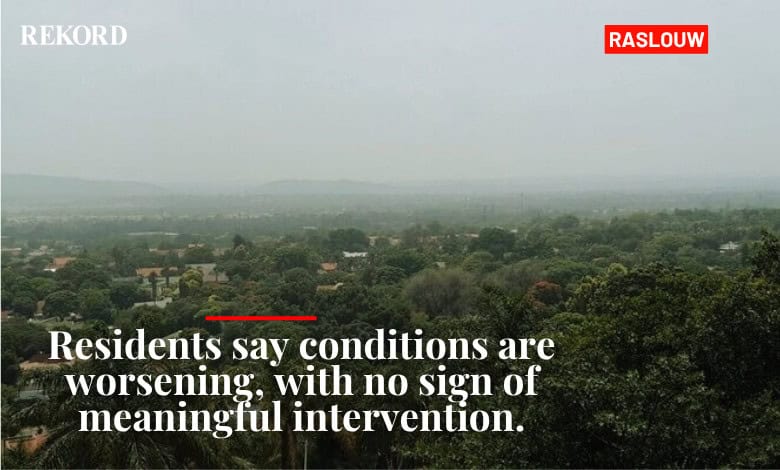
Residents at the Raslouw Gardens Estate continue to suffer from air pollution caused by foul, toxic-smelling smoke affecting the area.
Recent complaints follow an investigation in May by the Tshwane Emergency Services and the Department of Environment.
Raslouw Gardens Estate manager Louis de Koker recently told Rekord the estate is situated near the Sunderland Ridge industrial area and directly adjacent to the Mooiplaas informal settlement, where the source of the pollution appears to originate.
He said that while residents appreciated the response from the metro’s department of environment and their acknowledgement of the investigation in May, they are alarmed that no meaningful change has occurred since.
“The problem persists with growing intensity. The air is often filled with thick, toxic-smelling smoke that poses significant health risks to our families, including children and the elderly,” he said.
De Koker claimed that the department had specifically recognised the waste-burning activities within the informal settlement as the source of the pollution.
Despite this acknowledgement, he said the problem remains unresolved and has only intensified.
“The source was identified by the department and confirmed by our observations. It appears to be consistent and mainly originates from the uncontrolled burning of waste in the informal settlement,” said De Koker.
He emphasised that while the estate community understands that residents in Mooiplaas may lack access to proper waste disposal facilities and environmental education, this points to a deeper systemic issue that cannot be ignored.
“This highlights a deeper systemic issue that requires proactive and sustainable intervention from the relevant departments,” he said.
“It is the responsibility of the authorities to ensure that such public health risks are addressed not only reactively but also with long-term preventative strategies.”
De Koker noted that the community is now requesting a comprehensive investigation into ongoing pollution sources. The investigation must focus particularly on night-time activity, along with clear timelines, accountability, and formal updates on both short-term actions and long-term plans from Municipal Health Services and the Gauteng Department of Environment.
“We are also calling for meaningful engagement with the Mooiplaas informal community to help establish humane, lawful, and sustainable waste management systems, alongside education and infrastructure support,” he added.
“This situation affects not just our comfort but our health and quality of life.”
Resident Yusuf Kirwan also expressed alarm at the worsening conditions, saying that the pollution has become increasingly unbearable.
“The air pollution is getting out of hand. The pitch-black smoke in the area is unbearable and makes it hard for those with respiratory health conditions,” he said.
He said that while the smoke appears to be coming from the Mooiplaas area, nothing has been done to stop it.
“This smoke makes me feel heavy-chested, and my eyes burn every day,” he added.
Kirwan emphasised that the issue affects not only the comfort of residents, but also their daily well-being and ability to go about normal routines.
The initial investigation into the smell began after residents reported a disturbing odour lingering in the air, particularly in the mornings and evenings.
At that time, Tshwane Emergency Services acting spokesperson Tebogo Maake confirmed the department had investigated the complaint on two separate occasions.
However, no smell was detected during those inspections.
Maake said that because the source could not be identified at the time, the matter was referred to the Department of Environment for further investigation.
He added that if the smell was detected again, they would consider activating a HAZMAT (hazardous and toxic materials) unit to assess and manage potentially hazardous substances.
He also encouraged residents to report any future incidents directly to the emergency control centre to ensure a quicker response.
Rekord reached out to the Tshwane emergency services for an update, but no comment was provided by the time of going to print.
ALSO READ: Long-neglected fire hydrant in Eldoraigne restored
Do you have more information about the story?
Please send us an email to bennittb@rekord.co.za or phone us on 083 625 4114.
For free breaking and community news, visit Rekord’s websites: Rekord East
For more news and interesting articles, like Rekord on Facebook, follow us on Twitter or Instagram or TikTok.