Leaked matric papers traced to Pretoria schools in major NSC breach
A major integrity breach has rocked the 2025 matric exams after leaked question papers were traced to seven Pretoria schools.
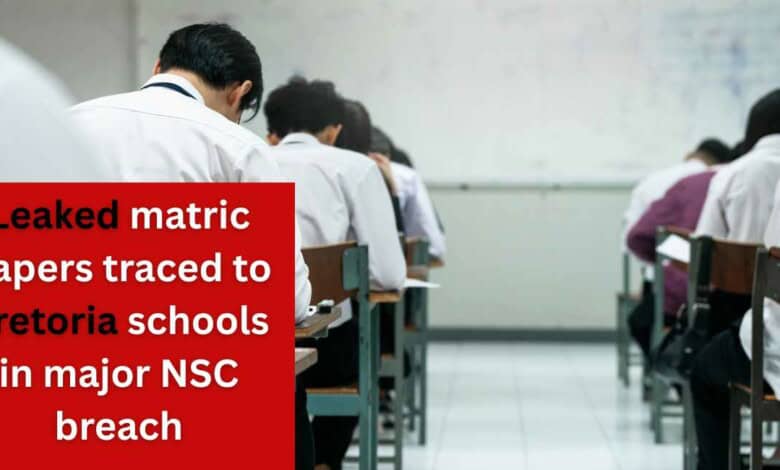
A national investigation is underway after the Department of Basic Education confirmed that several leaked matric exam papers were traced to a cluster of schools in Pretoria.
The breach, which involved English, Mathematics and Physical Sciences papers, was uncovered during the marking process when trained markers detected suspiciously identical responses in a handful of scripts.
Officials have since been suspended, and a specialist task team has been appointed to determine the full extent of the leak and protect the integrity of the 2025 NSC results.
Basic Education Minister Siviwe Gwarube said the NSC examination is one of the largest and most complex national undertakings in the democracy.
“This year, over 900 000 learners sat for the NSC Matric exams. They were invigilated by thousands of invigilators. Their scripts are marked by around 51 000 trained markers, mark capturers and moderators.
“These markers are in 183 marking centres across the country. They work together in a collaborative manner to ensure that candidates’ scripts are marked accurately, fairly and efficiently.”
She furthermore explained that it is through our markers’ diligence that they were able to detect a breach in the exams.
“This morning, I want to inform the country that our systems worked exactly as they were designed to do: to detect, isolate, investigate and address any manipulation of the NSC exams.”
Marking began on 1 December at 183 centres nationwide and is progressing well, with completion expected by 13 December.
The Department highlighted the strength of its multi-layered marking system — which includes expert markers, strict guidelines, standardisation, moderation and multiple accuracy checks — noting that this robust process enabled markers to detect irregularities in six Gauteng scripts.
Their swift escalation of the anomaly underscored the effectiveness of the system and the vital role of markers as the first line of defence.
She said the Gauteng Department of Education officially alerted the national Department of Basic Education last week to an unusual similarity between the answers provided by a candidate with the answer provided in the marking guideline for English Home Language Paper 2.“This raised an immediate red flag and triggered standard protocols, starting with a preliminary investigation, which confirmed that a breach had indeed occurred in respect of a few of the exam scripts.
“Let me be clear: This detection demonstrates the effectiveness of our system.
“The breach did not come to light through rumours. It was not discovered by chance. It was detected because markers, whose training includes investigative marking, are equipped to distinguish between authentic learner responses and content that should only be accessible to markers.
“This skill, plus our robust marking regime, which involves not less than 5 layers of quality assurance, was how we were able to pick up anomalies.”
She said, based on interviews conducted up to this stage, they can confirm the following:
- The breach occurred at the offices of the Department of Basic Education, where question papers are set.
- Of the 162 papers that we had set, only 3 subjects were accessed prior to the examination:
- English Home Language Papers 1, 2 and 3;
- Mathematics Papers 1 and 2; and
- Physical Sciences Papers 1 and 2.
- These papers were shared via a USB storage device.
The spread seems to be confined to identified learners in seven schools in a specific area in Pretoria.
“Our systems are robust. They have allowed us to identify that the suspect involved is an employee of the Department of Basic Education who has a child in Grade 12. Evidence suggests that she received the question paper from another Department of Basic Education employee who works in the examination unit.”
Gwarube said several steps are being taken to ensure the highest level of independence and rigour of the investigation into this leak.
“The Director-General of the Department of Basic Education is establishing a National Investigative Task Team (NITT), which will commence its work within the next 24 hours.”
- an independent chairperson;
- Umalusi;
- Universities South Africa;
- Teacher Unions;
- SAQA;
- DBE officials; and
- A private forensic investigator.
- appointment of an independent forensic investigator;
- investigative marking, which is a technique we utilise where specially trained markers conduct an audit of the scripts looking out for any anomalies in the answers provided by a candidate;
- verification of scripts;
- interviews with learners and invigilators;
- statistical analysis and comparative performance analysis; and
- correlation of exam marks with school-based assessment results.
Gwarube reassured the country that no results have been finalised, no certification processes have begun; and a preliminary report will be provided to the National Examination Irregularities Committee on 29 December 2025, and the final report will be submitted to both the Minister and Umalusi on 31 December 2025.
“The transparency we are ensuring today is not an announcement of system failure. It is a demonstration of the strength of our systems. Even though we mark around 11 million scripts, our systems can detect breaches of the nature outlined here this morning.”
The department has assured parents, learners and teachers in Pretoria that it is directly engaging with the schools involved, and that the staff members suspected of leaking the papers have already been suspended. Implicated learners will be given due process, with each case assessed individually and without presumption of guilt.
The matter has also been handed over to SAPS for criminal investigation, as early findings suggest the deliberate possession of stolen state property.
“We follow a zero-tolerance approach to cheating in the NSC exams and are committed to supporting innocent learners who worked hard and played no part in this breach. Let me state this firmly: Any individual who attempts to manipulate the NSC exam system, whether learner, official, or outsider, will be detected.”
Also read: Pretoria father allegedly shot dead by wife laid to rest today
Do you have more information about the story?
Please send us an email to bennittb@rekord.co.za or phone us on 083 625 4114.
For free breaking and community news, visit Rekord’s websites: Rekord East
For more news and interesting articles, like Rekord on Facebook, follow us on Twitter or Instagram or TikTok or WhatsApp Channel.