Moya declares turnaround in SOCA, opposition disputes financial and service claims
The mayor paints a picture of recovery in the Tshwane metro, but critics say the reality tells a different story.
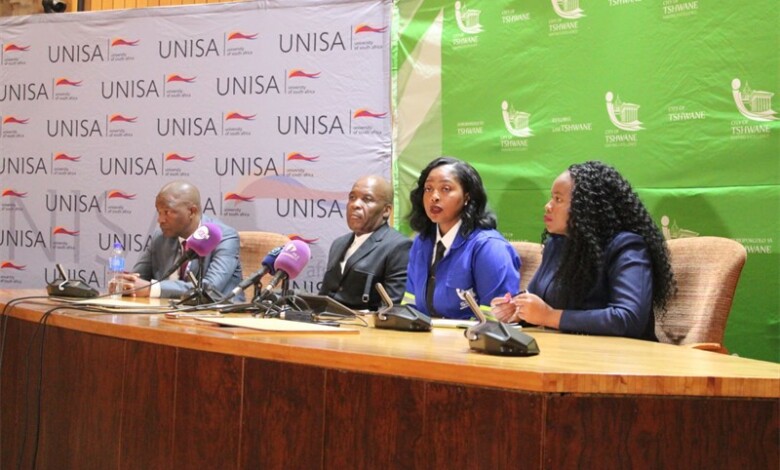
The past 18 months have focused on stabilising the city and laying the groundwork for sustainable growth.
So said Tshwane Mayor Dr Nasiphi Moya in her second State of the Capital Address (SOCA) at Unisa Winnie Madikizela-Mandela Building on April 16.
Moy pointed out that the metro is shifting from crisis management to long-term rebuilding, declaring that the coalition government is now “moving from repair to renewal, from commitment to action, and putting residents first”.
She reflected on an administration that took office amid financial strain, institutional instability and declining service delivery, but now claims measurable progress across six key priorities.
Moya said the coalition inherited a ballooning debt of over R13-billion after the DA-led coalition, weak financial controls and consecutive unfunded budgets.
“Under the current administration, Tshwane delivered its first fully funded budget since 2021, with cash-backed reserves growing from R835-million to over R1.9-billion and projected to reach R2.86-billion,” Moya said.
She said the city has also reduced its Eskom debt from over R6.6-billion to about R4.7-billion, while improving billing accuracy to 90%.
Moya said the city avoided further financial strain through a repayment arrangement with Eskom, saving millions in interest, and it is expected to settle the debt by March 2027.
She said the metro is beginning to reverse a decade of economic decline, with renewed investor confidence.
“The city secured R86-billion in investment pledges through its inaugural investment summit, targeting sectors such as energy, infrastructure, automotive manufacturing and property development.”
She highlighted that global Chery has selected Pretoria as a manufacturing base, reinforcing the metro’s position as an automotive hub.
“The city aims to grow the economy to 3.9% and create at least 80 000 jobs by 2029, supported by initiatives such as the Catalytic Investment Unit and InvestSA One Stop Shop.”
Moya emphasised that infrastructure investment is central to rebuilding the city.
“The capital budget has increased from R2.8-billion to R3.5-billion, with a focus on electricity, water and roads.”
She denied that the city has a water crisis, as there was no water shortage, but rather losses due to ageing infrastructure, water theft and leaks.
“A Water Stabilisation Plan has been introduced to address this, alongside upgrades to reservoirs and pipelines. On electricity, the city is tackling an ageing grid, with more than half of the transformers over 40 years old. Key substations such as Kwagga, Njala and Rosslyn are being stabilised.”
She revealed that since 2021, cable theft has cost the city over R169-million, which remains a major challenge.
Moya said the city is restarting stalled road projects and scaling up new developments to support population growth and economic activity.
She said the Roads and Transport Department, led by MMC Tlangi Mogale, has resurfaced more than 220km of roads across Pretoria.
She added that the city has expanded the sinkhole repair programme in Centurion.
According to her, public transport is also being overhauled through the A Re Yeng Bus Rapid Transit (BRT) network.
“Line 2C along Lynnwood Road is nearing completion, with dedicated lanes, sidewalks and cycle paths. Line 3, linking the Pretoria CBD to Atteridgeville, is about 85% complete. Integration with taxi operators has been formalised through agreements to improve reliability and accessibility.”
She said intermodal transport hubs are also advancing, including the Denneboom Intermodal Facility in Mamelodi, linking rail, bus and taxi services; and the near-complete Wonderboom Intermodal Facility.
“Wonderboom National Airport is being repositioned as a logistics, tourism and regional aviation hub, with routes already connecting to Durban and Cape Town and plans for expanded investment through a precinct development strategy.”
Moya said the city is accelerating the formalisation of informal settlements and improving access to housing. “More than 3 800 households have already been relocated to serviced stands, while nearly 70 000 stands are in planning.”
Over 500 informal settlements have been identified, with a new policy categorising them for development, upgrading or relocation.
She acknowledged that delays in relocation increase costs, as the city continues to provide basic services to over 300 000 households.
She said under MMC for Community Safety, Alderman Hannes Coetzee, the city has intensified law enforcement through multi-agency operations.
“More than 400 businesses have been inspected, with utility disconnections, closures of illegal operations and enforcement against by-law violations.
She added that over 19 000 tons of illegal dumping have been cleared, while response times have improved from 72 to 48 hours.
Moya praised that the indigent support has been expanded, raising the property value threshold to R250 000.
“This provides qualifying households with free basic services, including water, electricity and sanitation.”
She said through the Community and Social Services portfolio led by MMC Palesa Modise, food relief programmes have supported over 2 000 households, while more than 9 000 work opportunities have been created through public employment initiatives.
She said healthcare access has also improved, with extended clinic hours and high patient satisfaction rates. This is due to the leadership of MMC Tshegofatso Mashabela.
Moya acknowledged past governance failures, including adverse and qualified audit outcomes, but said progress is being made.
“Qualification areas have been reduced, investigations into irregular expenditure are ongoing, and disciplinary and criminal actions have been taken.”
She said more than 2 300 staff appointments have been made to strengthen internal capacity, alongside efforts to reduce reliance on external contractors.
Moya concluded that the city is transitioning from stabilisation to sustained progress.
“We have stabilised where there was uncertainty. We have restored where systems were weakening. And we are laying the foundation for a city that works not in theory, but in the daily lives of our residents,” she said.
Deputy Mayor and MMC for Finance Eugene Modise said the new administration was forced to act swiftly on the metro’s financial crisis, revealing that within a week of taking office, they had to urgently engage Eskom to prevent the city’s accounts from being attached.
“We found the municipality in a mess,” Modise said.
He explained that the metro’s debt to Eskom had escalated to more than R6.6-billion, placing the city at risk of severe financial consequences, including legal action.
Modise said the city successfully negotiated a payment arrangement with Eskom, which includes a court-backed agreement running until March 2027.
He said improving internal systems has also been key to stabilising finances.
“We are now sitting at about 90% billing accuracy, which is critical in rebuilding trust and ensuring revenue collection,” he said.
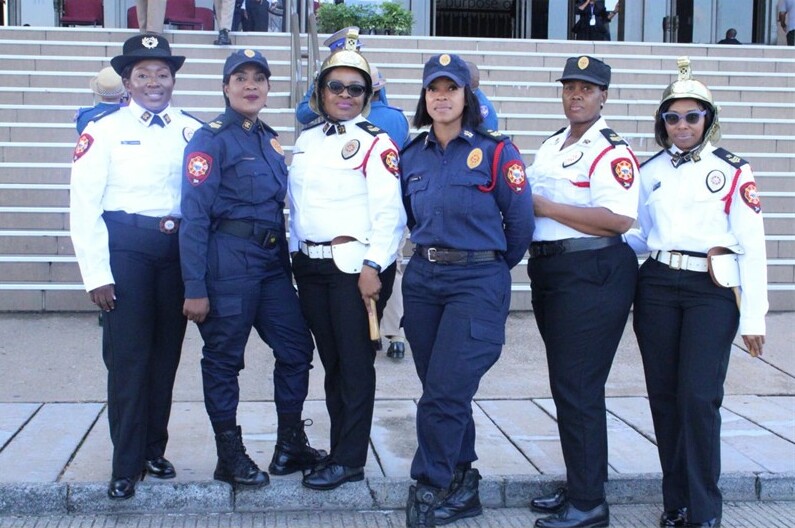
DESCRIPTION: Members of the Tshwane Emergency Services during a drill
Modise further stressed the importance of restoring a culture of payment among residents.
“We need to encourage a culture of payment. We should move away from the culture of scrapping historical debt – if you can afford to pay, you must pay,” he said.
MMC for Human Settlement, Alderman Aaron Maluleka, said the metro has developed a structured plan to address the rapid growth of informal settlements through a combination of relocation, upgrading and formalisation.
Speaking on Plastic View, Maluleka said the metro has already taken steps to secure land for proper housing development.
“The city has written to the Gauteng Provincial Government requesting the purchase of land at Pretorius Park Ext 41. We already have Ext 40, and the intention is to use this land to develop proper housing for Plastic View residents who qualify as South African beneficiaries,” he said.
Maluleka said the current situation in many informal settlements is the result of years of unchecked expansion under the previous administration.
“The DA-led coalition allowed informal settlements to mushroom since taking office in 2021. These settlements have been allowed to connect illegally to water and electricity, which is placing severe strain on infrastructure and negatively affecting the city’s revenue,” he said.
He added that the city is now moving toward implementation, with plans to begin servicing the identified land in the upcoming financial year.
“In the next financial year, the city will submit land planning processes and begin with the installation of bulk infrastructure, including water and sanitation. Thereafter, the Gauteng Provincial Government will take over the construction of top structures,” Maluleka said.
He said this approach aims to restore order, ensure dignified living conditions and reduce the long-term financial and infrastructure pressures caused by unplanned settlements.
DA Tshwane Caucus leader Cilliers Brink has accused Moya of ignoring serious governance failures, particularly around water supply and alleged corruption linked to water tanker contracts.
Brink said Moya’s claim that Pretoria is not facing a water crisis contradicts the lived reality of residents, pointing to rising water losses and worsening outages across the city, including in Hammanskraal.
He criticised the city’s increased spending on water tankers, arguing that funds should instead be directed toward infrastructure upgrades to ensure a reliable water supply.
Brink also raised concerns about the city’s financial position, citing declining revenue collection and questioning the credibility of a ‘funded budget’.
“The reality is that service delivery is deteriorating while residents are left without consistent access to water and electricity,” he said.
He further warned that ongoing power instability is affecting key industrial areas such as Silverton and Waltloo, placing additional pressure on businesses and the local economy.
Brink said the administration has failed to provide clear leadership and transparency on critical projects, including the long-delayed Hammanskraal water intervention.
Freedom Front Plus (FF Plus) Tshwane caucus leader Grandi Theunissen has criticised Moya for hosting the SOCA at Unisa, calling it an unnecessary display of ‘glitz and glamour’ amid the city’s financial strain.
Theunissen said the metro, which he described as ‘technically bankrupt’, cannot justify spending on events that do not improve service delivery, adding that it places further pressure on already overburdened ratepayers.
He rejected Moya’s claims that the city is improving, arguing that service delivery remains poor and pointing to ongoing water challenges in Hammanskraal.
Theunissen also questioned the credibility of the city’s financial position, saying the reported funded budget and surplus do not reflect reality. He cited concerns raised by the Auditor-General, including a lower-than-claimed revenue collection rate and outstanding creditors exceeding R5-billion.
“The so-called surplus is a paper figure that does not translate into real cash flow,” he said.
He said that the city’s low cash coverage means it could only operate for a few days without revenue.
Do you have more information about the story?
Please send us an email to bennittb@rekord.co.za or phone us on 083 625 4114.
For free breaking and community news, visit Rekord’s websites: Rekord East
For more news and interesting articles, like Rekord on Facebook, follow us on Twitter or Instagram or TikTok or WhatsApp Channel