Supreme Court of Appeal ruling to be challenged despite rebuke
A landmark ruling of the Supreme Court of Appeal found the metro unlawfully tried to expropriate private land to avoid its housing obligations. The metro says it will challenge the ruling, even as fresh criticism emerges over the financial implications of new informal settlement projects.
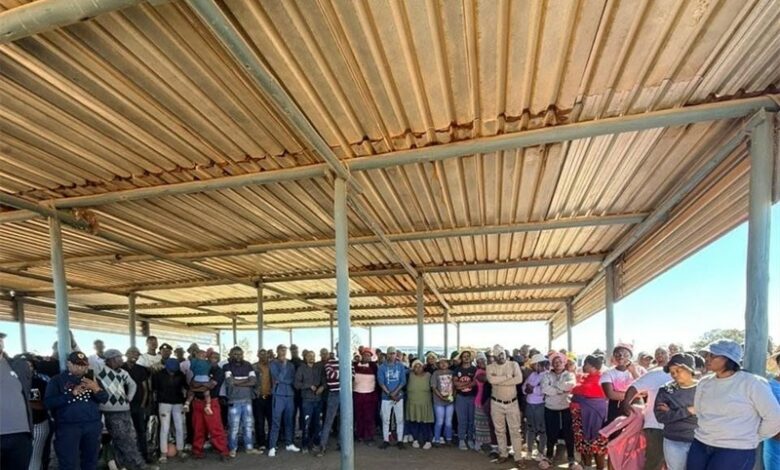
The metro’s decision to challenge a landmark Supreme Court of Appeal judgment has placed its approach to informal settlements under renewed scrutiny.
The legal battle is unfolding as opposition councillors warn that the metro is exposing taxpayers to potentially hundreds of millions of rands in unbudgeted infrastructure costs linked to new settlement projects.
The metro applied in the second last week of June for leave to appeal a Supreme Court of Appeal ruling made public late in May that found its attempt to expropriate privately owned land for the Kanana Village informal settlement near Bronkhorstspruit was unlawful.
The court found that the metro had abused its expropriation powers in an attempt to circumvent an existing eviction order relating to the privately owned land and strongly rebuked the metro for this action.
MMC for Housing, Alderman Aaron Maluleka, explained the judgment to the residents of the settlement on June 13.
According to the judgment, the metro could not use expropriation to avoid its constitutional obligation to provide alternative accommodation for unlawful occupiers before an eviction could take place.
The dispute dates back to a land invasion in 2005.
Court records show the private landowner later obtained an eviction order, but the residents could not be removed until suitable alternative accommodation had been provided.
Instead of complying with that obligation, the metro, over a period of several years and court cases, sought to expropriate the land so that the occupiers could remain permanently.
The Appeal Court ruled in May this year that the metro could not evade its constitutional and legal responsibilities by expropriating private property.
It found that public authorities may exercise their statutory powers only for the purposes for which they were granted and that expropriation cannot be used to avoid compliance with a binding court order.
The judgment also held that while the Constitution protects the right of access to adequate housing, it does not entitle unlawful occupiers to determine where they will be permanently accommodated. Nor does it require private landowners to tolerate indefinite occupation because of the state’s failure to fulfil its housing obligations.
The Appeal Court ordered the metro in late May to provide suitable alternative accommodation to the residents within a year and to pay the legal costs of the appeal.
Responding to questions about the judgment, the metro spokesperson Lindela Mashigo said on June 24: “The city has served and filed its application for leave to appeal this judgment with the Supreme Court of Appeal (SCA) earlier this week. As the matter is now before the courts, it is sub judice and the city is therefore not able to comment further at this stage.”
While the Kanana Village matter concerns a specific dispute over expropriation, the judgment has broader implications for the metro’s management of informal settlements by reaffirming that municipalities must comply with both constitutional housing obligations and legal processes.
That backdrop informed debate at the June council meeting, where opposition councillors questioned the financial planning behind four separate informal settlement formalisation projects.
Freedom Front Plus (FF+) councillor Lenor Janse van Rensburg accused the metro of exposing taxpayers to further unbudgeted financial obligations through possible infrastructural developments for informal settlements.
The party voted against four agenda items relating to developing informal settlements.
It argued that the metro was approving land use applications for the formalisation of the settlements without disclosing the full financial implications.
The four agenda items related to developments in Refilwe in Pretoria east, Zandfontein (also known as Malusi Gomora) in Gardens and Claremont in the Western Moot, Kameeldrift north of East Lynne in the Moot, and Atteridgeville Ext 19.
According to the FF+, the accompanying reports stated that the land use applications would have no negative financial implications for the metro.
Janse van Rensburg rejected that assertion. “The reports on all four items, for the formalisation of existing informal settlements, state that there will be no negative financial implications for the metro. This statement is misleading, as it will unlock a chain of obligations on the infrastructure that could cost the metro hundreds of millions of rands.”
She said the four developments would collectively result in the approval of more than 1 500 new residential stands without any indication of what the infrastructure costs would be.
According to Janse van Rensburg, this constitutes a direct violation of Section 19 of the Municipal Finance Management Act, which provides that a municipality may not commence with a capital project unless funding for it has been budgeted.
The FF+ also raised concerns about the individual projects.
The party said 17 hectares of land in Zandfontein are currently zoned for industrial use and that the report makes no mention of the mandatory environmental impact assessment required for rezoning.
The party further criticised the handling of Atteridgeville Ext 19, saying that despite infrastructure for township development having been installed in 2017, the area has still not been proclaimed nine years later.
Do you have more information about the story?
Please send us an email to bennittb@rekord.co.za or phone us on 083 625 4114.
For free breaking and community news, visit Rekord’s websites: Rekord East
For more news and interesting articles, like Rekord on Facebook, follow us on Twitter or Instagram or TikTok or WhatsApp Channel