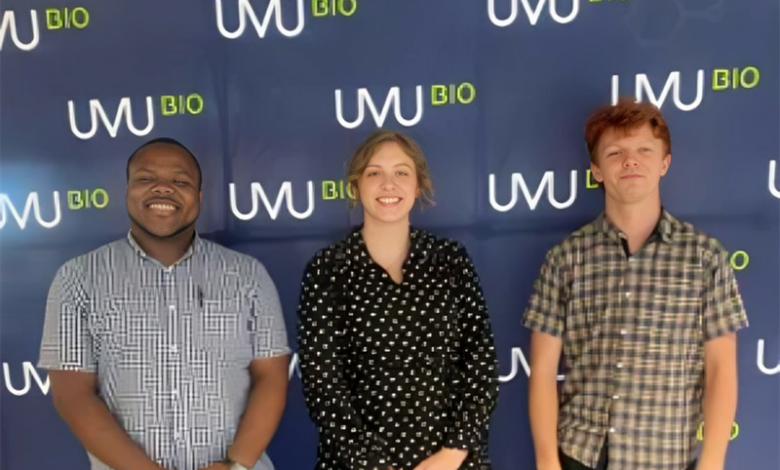
Young researchers at UP are developing an innovative health supplement that could help tackle diabetes, obesity and high cholesterol by turning discarded citrus peel waste into a valuable health product.
The project, known as NutraPectin, is being led by postdoctoral research fellow Dr Kadima Tshiyoyo alongside recent Master of Science in Biochemistry graduates Ryan Bosch and Marni Oberholzer from the Faculty of Natural and Agricultural Sciences.
Using environmentally friendly extraction technology, the team converts citrus processing waste into a pectin-rich nutraceutical – a dietary supplement.
Pectin, when ingested with meals, can decrease cholesterol and blood sugar levels as well as aiding gut health, making it a promising tool for managing conditions such as diabetes, obesity and high cholesterol.
“South Africa’s growing burden of lifestyle diseases and abundance of agricultural waste inspired our work,” said Tshiyoyo.
“NutraPectin uses sustainable green methods to extract bioactive compounds from waste, which are valuable and essential in the management of lifestyle diseases such as diabetes and obesity.”
According to the UP, the students’ research tackles ‘two growing challenges’ facing the country: increasing rates of non-communicable diseases and the environmental impact of agricultural waste.
Citrus peels. they state, are often discarded during food processing, contain valuable pectin and other bioactive compounds that can be recovered and repurposed instead of ending up as waste.
Although NutraPectin is still in its early developmental stages, the researchers hope to produce an affordable, locally manufactured health supplement that will benefit South Africans while creating new value from agricultural waste.
The team is now seeking additional funding and industry partnerships to help bring the product to market.
“It is envisioned that NutraPectin can move from optimisation and scale-up to a market-ready prototype supported by partnerships and collaboration to expand within South Africa,” said Tshiyoyo.
“Our long-term goal is to make the product affordable and accessible while creating sustainable health and commercial impact.”
Bosch said the project began as his honours research under the supervision of Prof Samkelo Malgas in the Department of Biochemistry, Genetics and Microbiology.
“I was drawn to the project as I am passionate about maintaining the environment, and I was excited to investigate how food waste could be converted into useful healing products,” Bosch said.
For Oberholzer, the project demonstrates how student-led research can provide practical solutions to national challenges.
“Sustainability should both underlie and overarch most research if we want to see true economic and social growth,” she said.
“South Africa has so much potential to sustainably improve and empower our agricultural industry by targeting circularity through waste valorisation.”
Malgas said the project highlights the value of university research in driving innovation while equipping students with practical skills in biotechnology and entrepreneurship.
He stated that the extraction of pectin from citrus waste represents a remarkable advancement in enzyme biotechnology.
“The technology promises significant environmental benefits by promoting sustainable waste use and reinforcing the circular economy,” said Malgas.
He added that it has the potential to drive economic growth for South Africa’s citrus industry through the production of high-value pectin.
The project has already attracted recognition.
In 2024, NutraPectin won the Catalyst competition, an early-stage biotechnology start-up pitch event organised by Immobazyme in partnership with UVU Bio, after impressing judges with its potential to improve public health while reducing agricultural waste.
The victory secured laboratory support, industry mentorship, business development training and technical assistance to help move the innovation closer to commercialisation.
The team has also received a Technology Innovation Agency Seed Grant to optimise production methods and prepare for larger-scale manufacturing.
As we mark the end of Youth Month, the researchers say the project reflects the important role young scientists can play in developing innovative solutions that improve health, protect the environment and strengthen South Africa’s economy.
ALSO READ: Pretoria universities climb global sustainability rankings
Do you have more information about the story?
Please send us an email to bennittb@rekord.co.za or phone us on 083 625 4114.
For free breaking and community news, visit Rekord’s websites: Rekord East
For more news and interesting articles, like Rekord on Facebook, follow us on Twitter or Instagram or TikTok or WhatsApp Channel