Borehole registration not required for domestic use, department confirms
Most households using borehole water for reasonable domestic purposes do not need to register under the national water-use process. However, commercial users must still comply with registration requirements, while municipal by-laws, including those in Tshwane Metro, remain applicable.
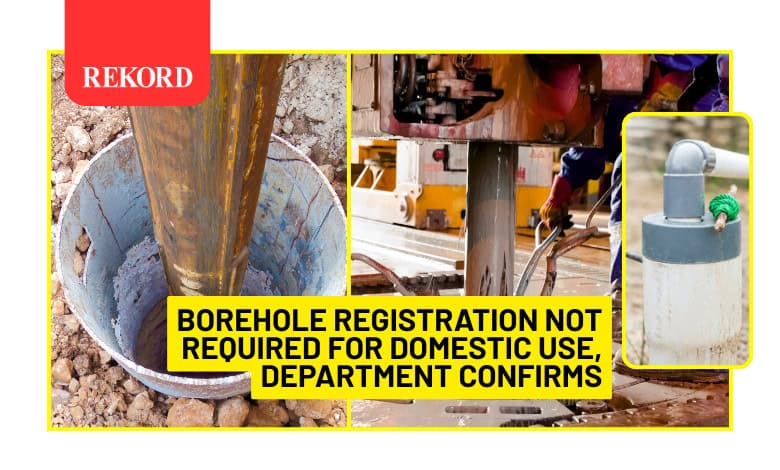
The National Department of Water and Sanitation (DWS) has confirmed that most households using borehole water for reasonable domestic purposes do not have to register under the current national water-use registration process.
The department providing clarity after widespread confusion caused by its recent 90-day registration campaign.
The confirmation comes as the registration deadline for commercial water users and other qualifying groundwater users approaches on July 23.
The clarification follows engagement between the Organisation Undoing Tax Abuse (Outa) and the DWS after Government Notice 54575 and the department’s registration campaign caused confusion.
Many homeowners believed they could face penalties or criminal prosecution if they failed to register their domestic boreholes.
The DWS confirmed in writing to Outa that households using borehole water for reasonable domestic purposes are exempt from registration under Schedule 1 of the National Water Act.
Schedule allows certain low-impact water uses without the need for a water-use licence or formal registration. These include reasonable domestic household use, watering a small non-commercial garden, watering livestock within normal grazing limits, harvesting rainwater, using water during emergencies and certain recreational water uses.
The department further confirmed to Outa that domestic users whose water use falls within Schedule 1 cannot be penalised or prosecuted for failing to register.
The current 90-day registration process applies only to water users who are legally required to register, including licensed, existing lawful and generally authorised water users.
Commercial, agricultural, industrial and other high-volume groundwater users are still legally required to register with the relevant Catchment Management Agency before the deadline.
The DWS also encouraged households to voluntarily submit technical information about their boreholes to assist with groundwater management, although this is separate from the legal registration requirement.
Outa welcomed the clarification, saying it provides long-awaited certainty for homeowners who increasingly rely on boreholes because of deteriorating municipal water services.
“South Africans should not have to fear prosecution simply because they installed a borehole to keep water flowing when municipal systems fail,” said Julius Kleynhans, executive manager at Outa.
“We engaged the DWS on behalf of concerned residents, and we welcome its prompt response in clarifying the legal position for domestic borehole users.”
Kleynhans said the clarification provides legal certainty for ordinary households that have invested significant amounts of money simply to secure access to one of life’s basic necessities following repeated municipal water interruptions.
“It also provides certainty for domestic users living on smallholdings and other properties that are not connected to municipal water services,” he said.
He added that while Outa supports responsible groundwater management, regulation must remain clear, lawful and proportionate.
“Good governance depends on legal certainty,” Kleynhans said.
“People are far more likely to comply with the law when government communicates clearly and consistently. We therefore welcome the DWS’s efforts to clarify the legal position and remove unnecessary uncertainty.”
Outa also noted that the DWS confirmed municipal borehole requirements contained in local by-laws remain separate from the National Water Act registration process.
According to Tshwane metro, in Pretoria homeowners may drill and use boreholes, but they must comply with the municipality’s Water Supply By-laws.
The by-laws require property owners to notify the metro before drilling a new borehole where required and provide information about the proposed installation. In certain circumstances, particularly where environmental risks exist, the metro may also require an environmental impact assessment before drilling commences.
Existing boreholes may also have to be declared to the municipality if requested.
Where borehole water will be used for drinking purposes, municipal approval may be required and conditions may be imposed on its use.
The metro further prohibits any direct connection between borehole water systems and the municipal water reticulation network to prevent contamination of the public water supply.
Do you have more information about the story?
Please send us an email to bennittb@rekord.co.za or phone us on 083 625 4114.
For free breaking and community news, visit Rekord’s websites: Rekord East
For more news and interesting articles, like Rekord on Facebook, follow us on Twitter or Instagram or TikTok or WhatsApp Channel