
Centurion residents demand answers over culling of blesbok in nature area
Community members press the metro for legal authorization and operational details after the final two antelope are killed in Rooihuiskraal.
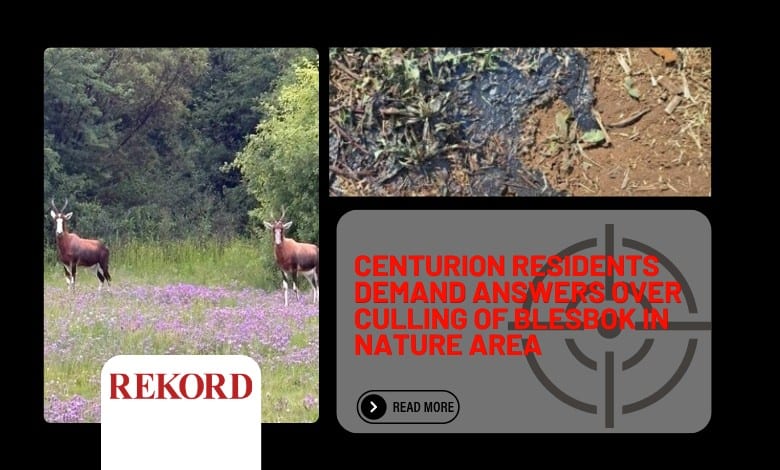
Centurion residents are seeking written authorisation and further details from the Tshwane Metro after the municipality confirmed it culled the last two blesbok at Bishop Bird Nature Area in Rooihuiskraal after unsuccessful attempts to relocate them.
Residents want clarity on the legal basis for the operation, the methods used and why park users were not informed beforehand.
The metro says its Nature Conservation Operations section took the decision after concluding that reasonable and practical relocation alternatives had been exhausted.
”Given the risks of injury and unnecessary stress associated with further attempts, and after exhausting reasonable and practical relocation alternatives, the city took the decision to humanely cull the remaining two animals. [This was done] as a last resort to fulfil its longstanding obligations under a Gauteng Department of Agriculture and Rural Development (GDARD) directive,” said metro spokesperson Lindela Mashigo.
The issue came to light on August 5, when residents discovered substantial pools of blood at two locations in the nature area.
The discovery prompted questions about the fate of the blesbok, which had become a familiar feature of the area as residential development expanded around it.
In response to enquiries, the metro said nine blesbok had been captured and relocated in 2024 with specialised veterinary assistance from the South African National Biodiversity Institute (SANBI).
According to Mashigo, one female repeatedly evaded capture, and further removal attempts were postponed.
”Following the birth of her calf in 2025, the metro postponed further removal attempts to allow the young animal sufficient time to mature, in consideration of animal welfare,” Mashigo said.
He said subsequent relocation efforts were complicated by the unavailability of the SANBI veterinarian who had assisted with the earlier operation. Assessments in 2026 reportedly found that the remaining animals had become extremely wary of human presence, making safe capture and immobilisation increasingly difficult.
Residents demand written authorisation
However, residents say no documentation was provided to them when they enquired about the August incident, which relates to the 2024 capture and relocation operation rather than specifically to the subsequent killing of the two blesbok.
Alison Hadley, a resident who regularly uses the park, said residents had requested documentation relating to the operation but had not received the specific records they sought.
”These include any applicable provincial conservation permits, written authorisation for the operation and documentation identifying the legal basis on which the decision was made. We have not received the requested documentation specifically authorising the killing of the animals,” Hadley said.
Hadley questioned the terminology (‘culled’) used by the metro to describe the operation, noting that the two animals were the last blesbok remaining in the nature area. Their deaths left no blesbok in the area, rather than achieving their removal through relocation.
Details of killing method undisclosed
The metro has not detailed the method used to kill the animals or supplied a specific explanation of the permits and written authorisations requested by residents.
Mashigo confirmed that the carcasses were processed in accordance with the municipality’s established procedures governing game meat.
”The meat was subsequently disposed of through the city’s annual advertised game meat sale process, which is published through the communications department,” he said.
Residents have also raised concerns about communication surrounding the operation.
”We questioned the lack of communication and transparency surrounding the operation. We are seeking clarity on when the decision to kill the animals was made, who authorised it, what procedures were followed and why residents were not informed of the operation,” said Hanlie Roets, a park user.
Environmental practices questioned
Mashigo said the metro recognised the importance of transparency, accountability and constructive engagement with communities surrounding municipal nature areas.
The dispute has also drawn attention to other aspects of the nature area’s management, including residents’ concerns about the removal of indigenous trees and the excavation of trenches intended to manage stormwater runoff close to the road, which is causing erosion.
Responding to questions about these activities, Mashigo said tree removal had been undertaken for ecological management and maintenance purposes. The trenches, he said, were intended to control erosion, manage stormwater runoff and prevent further soil degradation.
He added that the interventions formed part of the municipality’s conservation and maintenance responsibilities and were intended to protect the area’s ecological integrity.
Mashigo further said wildlife management decisions were subject to established municipal oversight processes and should not be attributed solely to an individual official without considering the relevant decision-making structures.
Do you have more information about the story?
Please send us an email to bennittb@rekord.co.za or phone us on 083 625 4114.
For free breaking and community news, visit Rekord’s websites: Rekord East
For more news and interesting articles, like Rekord on Facebook, follow us on Twitter or Instagram or TikTok or WhatsApp Channel


