Tshwane embarks on financial recovery after damning report
The Financial Recovery Plan is part of the national and provincial spheres of governments’ support strategy to ensure that the Tshwane recovers financially.
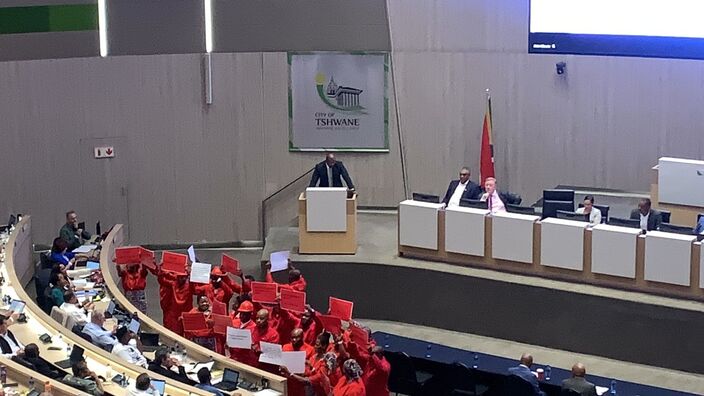
The Tshwane metro will embark on a financial recovery plan following the council discussing an Auditor-General (AG) report.
The report revealed the following irregularities occurred in the metro from July 1, 2021 to June 30, 2022:
– Irregular expenditure of R10-billion
– Unauthorised expenditure of over R600-million
– Fruitless and wasteful expenditure understated by over R1-billion
– Unjustified SCM deviations of over R480-million without reason
– Material misstatement of assets under construction and disclosed as completed, which means they were overstated by R2-billion
– Assets worth over R52-billion were not properly accounted for, not valued properly and the impairment of those assets not properly assessed.
The AG found that the metro misrepresented its financial statements, hence did not accurately reflect its financial performance and health.
The AG indicated that the metro had awarded contracts to service providers that were staff and family members as well as lost electricity worth more than R2-billion.
The AG said the loss comprised R769-million lost in distribution between source of generation and the consumer; and R1-billion lost to administrative and technical errors such as negligence, theft, tampering with meters, illegal connections and faulty meters.
The AG said water worth R866-million was lost in the distribution network and R216-million to meter inaccuracies, consumption estimations, non-metering of water and unauthorised consumption.
Tshwane audit and performance committee chairperson Cameron Ellis said they accepted the AG report.
He admitted that controls in the metro were weak.
“The officials in the City are not bothered and do not fix things before they become problems.”
He said the metro was spending more than it earned.
“Our source of income is electricity and water.”
He said the metro was not run like a business.
Ellis said the metro needed to urgently improve its risk systems.
The committee said that the metro should implement a financial recovery plan (FRP).
“The National Treasury is there to give advice on what to look at in assisting the metro to be able to sustain its financial stability in the long run. The plan also takes cognisance of all other measures put in place to ensure that the metro recovers from its financial challenges while ensuring efficient use of resources available,” said Ellis.
The AG said that maintaining financial viability of the metro was critical to achieve service delivery and its economic objectives.
In the financial year under review, the following service delivery challenges were experienced:
– A decline in revenue collection due to financially stressed residents and other service payers such as government departments, state owned entities and the private sector.
– The inability to reduce water losses attributed to ageing infrastructure led to leaks and burst pipes, which ultimately affected water supply and distribution.
– Cable theft, illegal collections and tampering of meter connections
– Poor infrastructure development and maintenance which pose a threat of causing service breakages and failures.
The committee reported that the metro would have to action the following directives to achieve improved audit outcomes in future financial years:
– Appoint professional external auditors to support the metro’s auditing process
– Appoint additional support from the National Treasury – two former chief financial officers – to support the metro
– Initiate an audit on the City’s performance in the first half of this financial year and every quarter thereafter
– Continue engagements with the AG to systematically address its audit findings in preparation for the next audit and
– Conclude the appointment of top management including chief financial officer, which process has been initiated and will be concluded in the first half of this year.
“All the departments affected are currently in the process of developing appropriate and directive audit action plans in response to the findings raised by the AG. These audit action plans will be monitored and overseen by the municipal continuous audit monitoring committee.”
Do you have more information about the story?
Please send us an email to editorial@rekord.co.za or phone us on 083 625 4114.
For free breaking and community news, visit Rekord’s websites: Rekord East
For more news and interesting articles, like Rekord on Facebook, follow us on Twitter or Instagram