The Orchards resident shares 35-year experiences as teacher in book
As the book 'Towards Advancing Democracy in SA Schools' points out, the principle of democracy in the two countries is not applied in the same way in the schools.
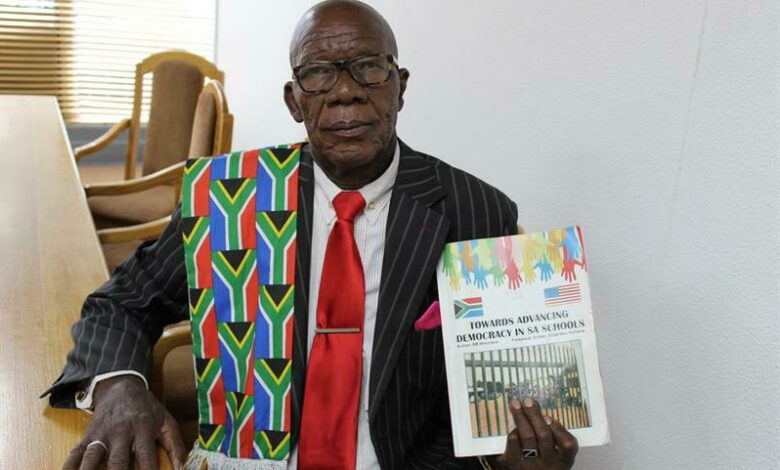
A resident from The Orchards has used his retirement to pen down 25 years of knowledge for a research report on the difference between democracy in South African and American schools.
Simon Ntsimane was born in Rustenburg, where he was taken under the wing of a reverend in the area that offered to pay for his education. In 1977, he completed his junior secondary teacher’s course at Hebron College.
After completing a teacher’s diploma, he began his 34-year journey at the Department of Education as a teacher and 19 years as a principal in secondary schools.
Being exposed to the education system during apartheid and post-apartheid, he can recall being tagged as the first black teacher when he was offered a post at St Alban College in 1989.
It was during his appointment at the college that he noticed that learners from suburban schools performed better than learners from townships and rural schools. The suburban learners were placed in manage-sized classrooms with an abundance of resources for both curriculum and extra curriculum activities.
He compiled information during his visit to America where he was allowed to do research in schools where he noted the differences.
As the book points out, the principle of democracy in the two countries is not applied in the same way in the schools.
The book Towards Advancing Democracy in SA Schools touches on the following concerns in schools:
– Infrastructure: In SA, school buildings are inadequate, dilapidated with pit toilets and a lack of water and electricity whereas in the USA there are adequate school buildings with heathers and air conditioning in the classroom, water and electricity and sufficient resources.
– Racism: Several incidents of racism in schools occurred. In the USA racism is very subtle as learners and teachers are bound by the constitution and do not see each other as black and white.
– Sexual harassment: Various allegations have surfaced continuously about learners experiencing sexual assault.
The book elaborates that girls in South African schools are increasing with videos surfacing, while in America teachers who are labelled as perpetrators would be scrapped from the roll forever.
– Corporal punishment: Allegations of corporal punishment are applied in schools in South Africa with an example of three teachers who took turns beating a 14-year-old after a cellphone went missing. In the USA corporal punishment is not recognised as an effective tool and had been prohibited.
Ntsimane started working on the book after he retired in 2012 and completed the book in June 2022.
“I wrote down all the knowledge that I had accumulated through the years and I hope that those who will be able to access and read this book will adopt good strategies to better their own.”
Do you have more information about the story?
Please send us an email to editorial@rekord.co.za or phone us on 083 625 4114.
For free breaking and community news, visit Rekord’s websites: Rekord East
For more news and interesting articles, like Rekord on Facebook, follow us on Twitter or Instagram