Metro slammed for sitting on cable theft intel for seven months
A whistle-blower’s warning about cable theft in Pretoria east was allegedly ignored for seven months, leaving residents and city infrastructure vulnerable until a fraud suspect was finally arrested.
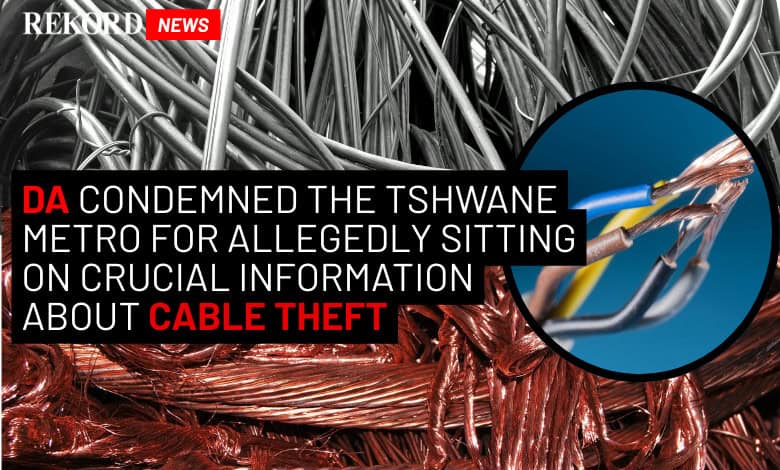
The DA has condemned the Tshwane metro for allegedly sitting on crucial information about cable theft for seven months, leaving residents and city infrastructure at risk.
According to the Ally Makafula, DA Tshwane spokesperson for Community Safety, a whistle-blower alerted the metro as far back as February this year, implicating an individual in both identity fraud and the cable theft that has been plaguing Pretoria east.
Makafula said the metro only acted seven months later, arresting the employee for identity fraud.
He expressed concerned that claims linking the suspect to a cable theft syndicate in the Rietvlei area appear to have been ignored.
“The City of Tshwane must use the opportunity of having a suspect in custody to investigate the allegations pertaining to cable theft and vandalism, and bring an end to cable theft in Rietvlei,” Makafula said.
He described the metro’s handling of the crisis as “nothing short of a disgrace”.
Makafula said Ward 91 (Rietvlei, Grootfontein, and Mooikloof) councillor in the east of Pretoria, Henning Viljoen, has repeatedly raised alarms about relentless cable theft and vandalism in the Rietvlei Nature Reserve.
“Power supply to the Rietvlei boreholes has been vandalised not once, but twice, crippling the city’s ability to pump and sell water, causing millions of rands in lost revenue,” Makafula explained.
He added that the metro allegedly ignored critical intelligence while infrastructure continued to be stripped.
“This delay is not just incompetence, it is negligence. Residents’ water security has been compromised, and the city has lost millions in revenue.”
He said the ANC coalition must explain why they sat on credible information for months while infrastructure was being destroyed under their watch.

Makafula stated that the DA insists that urgent action and accountability are needed to protect residents and stop cable theft, warning that continued delays put both public services and city assets at serious risk.
An alleged fraudster has been arrested, who appears to have been operating within the Tshwane payroll system, and using a fraudulent identity document.
The suspect was impersonating a metro employee at the Rietvlei Water Treatment Plant with fake documents.
The arrest came after a request from the Office of the COO for the Forensic Services Division to probe suspicions of identity fraud.
What investigators found was a man employed under the stolen identity of a person who, as confirmed by Home Affairs, received the genuine ID in 2013.
The ID number had been blocked after the suspect attempted to apply for a smart ID, and fingerprint analysis revealed no match in the Home Affairs database, which raised the possibility of him being a foreign national.
In the early hours of August 15, Forensic Services, together with the TMPD, confronted the suspect at the treatment plant.
Lacking any credible answers regarding the ID mismatch or personal background, the suspect confessed he was not the valid holder of the stolen ID.
The Tshwane metro reaffirmed that matters of alleged criminality, including those linked to identity fraud and cable theft, fall squarely within the Justice, Correctional Services, Police and Security Cluster.
Spokesperson Lindela Mashigo said that once allegations are have been formally lodged and evidence is gathered, they are referred to law enforcement agencies, which conduct investigations guided by due legal processes.
“As a responsible administration, the city cannot compromise these ongoing investigations or prejudice any outcomes by pre-empting the work of the competent authorities.”
Mashigo said it is important to stress that once an employee or individual is suspected of wrongdoing, the city acts within the framework of labour laws, and in alignment with law enforcement directives.
“Where criminal elements are involved, the courts of law remain the ultimate arbiter and, as such, the municipality is obliged to respect their processes and timelines.”
He said while the city understands the frustrations linked to cable theft and service disruptions, the municipality’s interventions must be both legally defensible and procedurally sound to ensure accountability that can stand in a court of law.
“In the interim, the city continues to strengthen its infrastructure protection strategies, including closer collaboration with law enforcement to combat cable theft and vandalism.”
According to Mashigo, the priority remains to safeguard critical water and electricity infrastructure while ensuring the continuity of essential services to residents.
“Once investigations are concluded, and if any employee or external parties are found guilty of wrongdoing, appropriate disciplinary and legal action will be taken, and the outcomes will be communicated in a transparent manner to the public.”
He added that cable theft hurts service delivery as well as business operations within the city, which results in significant economic losses and inconvenience for the communities of Tshwane.
“The Energy and Electricity Business Unit is primarily reliant on static security personnel stationed at various infrastructure points as well as on advanced technological security measures, which are being introduced and managed by the TMPD. [This is] to curb the high rate of theft and/or vandalism at various critical infrastructures within the city.”
Mashigo stated that the infrastructure for the Rietvlei boreholes is difficult to protect, as it requires physical night-time patrols covering an expansive and rough terrain.
“The cable running down Delmas Road, which powers up a few of the boreholes, is also difficult to protect as the cable is in an obscure location and can be accessed by cable thieves out of line of sight. The city is exploring the option of suspending the cable to reduce the risk of its theft once recommissioned.”
He said the boreholes were first vandalised in June 2024.
“Due to the nature of the vandalism, which involved both cable theft and vandalism of the electrical panels, the city has not been able to abstract any groundwater, and the annual calculated revenue loss is in the region of R36-million.”
The cost of replacing stolen cable and damaged electrical panels is in the region of R10.8-million.
The city has signed a Memorandum of Understanding with Rand Water to address water losses in the city and to augment Tshwane’s own resources, inclusive of the resuscitation.
ALSO READ: Tyre depot blaze exposes North fire protection flaws
Do you have more information about the story?
Please send us an email to bennittb@rekord.co.za or phone us on 083 625 4114.
For free breaking and community news, visit Rekord’s websites: Rekord East
For more news and interesting articles, like Rekord on Facebook, follow us on Twitter or Instagram or TikTok