Greenpeace, communities demand urgent action on deadly pollution
Greenpeace Africa and communities protested at the DFFE in Pretoria today, demanding urgent action on deadly air pollution. Wearing gas masks and carrying symbolic tombstones, they called for strict enforcement of clean air laws, a coal phase-out, and community-centered renewable energy.
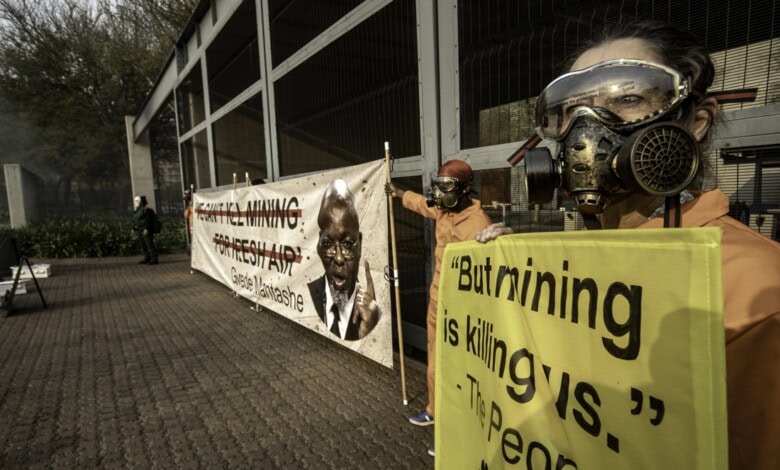
The heart of Pretoria’s administrative district witnessed a dramatic and deeply symbolic protest on August 27, as Greenpeace Africa, together with communities from South Africa’s most polluted regions, staged a powerful demonstration outside the Department of Forestry, Fisheries and the Environment (DFFE) offices in Arcadia.
Their message was simple, but chilling: air pollution is killing thousands of South Africans every year, and government inaction is no longer tolerable.
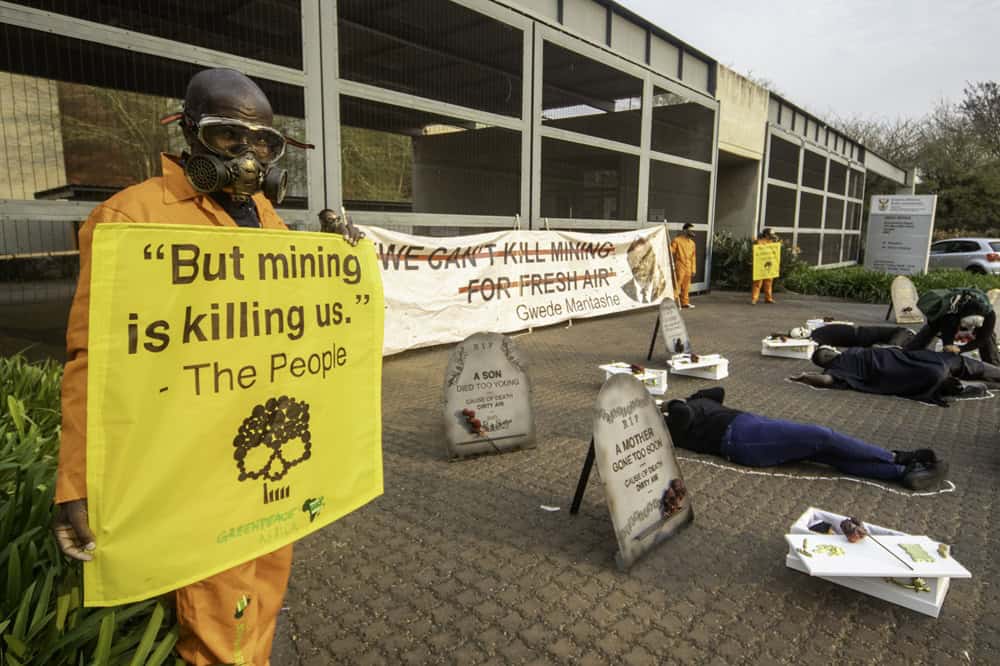
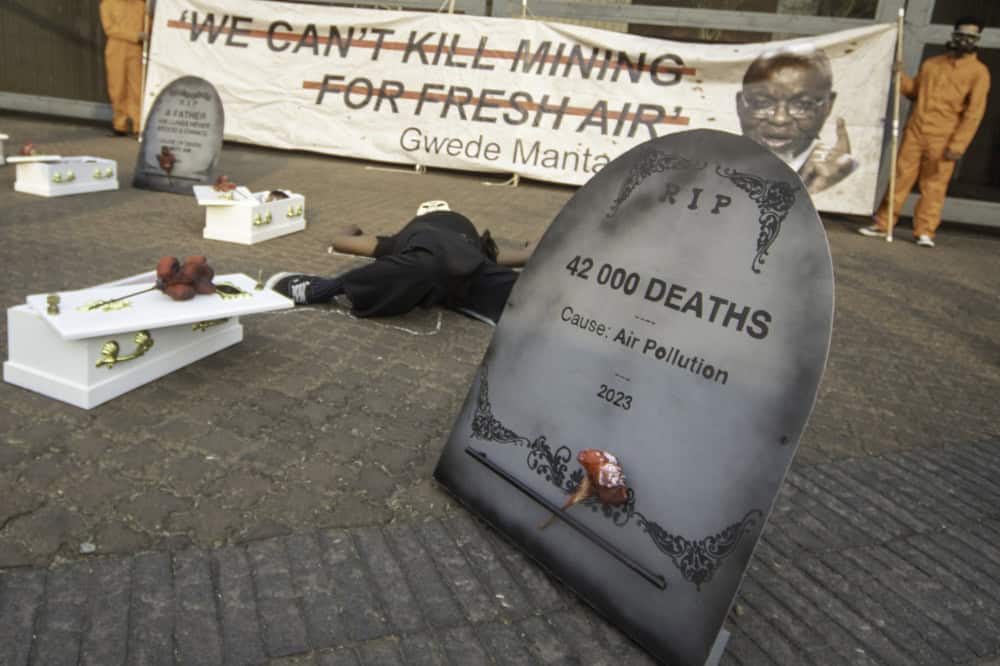
Wearing gas masks and carrying mock tombstones inscribed with real statistics of premature deaths and illnesses linked to pollution, the protesters created a haunting scene that drew the attention of passers-by, government officials, and motorists.
The action was fuelled by recent remarks from Mineral Resources and Energy Minister Gwede Mantashe, who dismissed growing calls for clean air by saying, “We cannot kill mining for fresh air.”
To the protesters, those words epitomised the government’s failure to put people’s health before profit.
At the forefront of the protest were residents from Mpumalanga’s Highveld region and the Vaal Triangle, areas long known as South Africa’s ‘pollution hotspots’.
Here, dense clusters of coal-fired power stations and industrial plants spew toxic emissions daily.
According to a Greenpeace Africa report, six of the world’s ten worst nitrogen oxides (NOX) emission hotspots are located in South Africa, with nine of Africa’s top ten NOX hotspots linked to Eskom-operated power plants.
“Our children are literally choking, our elders die too soon, and yet the government tells us mining profit is more important than our health,” said community activist Khehla Mahlangu from Embalenhle near Secunda in Mpumalanga.
These words echoed the anguish of many who travelled long distances to Pretoria to ensure their voices were heard.
For communities like Mahlangu’s, this was not an abstract debate about energy policy, but a life-and-death struggle.
Residents spoke to Greenpeace Africa researchers about a Greenpeace Africa report on the pollution of constant coughing among school children, high rates of asthma, and loved ones lost to respiratory illness.
According to this report, the estimated total annual economic cost of health impacts caused by fine particle pollution in South Africa is USD52-billion (R960-billion), equivalent to around 14% of the GDP.
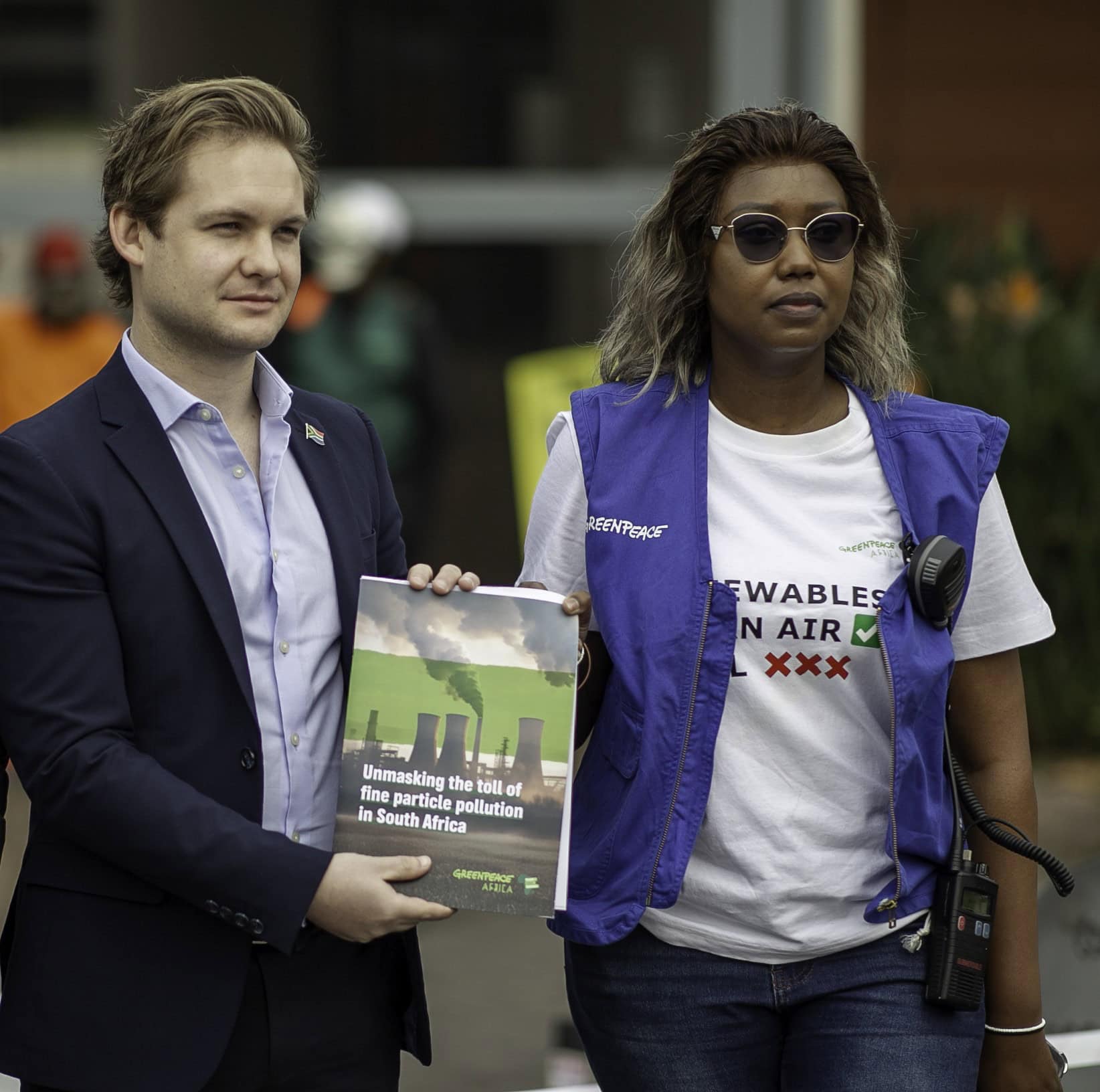
In their memorandum to the DFFE, Greenpeace Africa and the community representatives outlined urgent steps they believe government must take to avert further catastrophe:
– An immediate end to exemptions granted to large polluters from meeting air quality limits
– Strict enforcement of the National Environmental Management: Air Quality Act across all industries
– A bold and just transition away from coal toward renewable energy, ensuring workers and communities benefit from new opportunities
– Full transparency and access to real-time pollution data for the public
– A comprehensive health impact audit in Mpumalanga and the Vaal Triangle, where the crisis is most acute.
During the protest, a delegation formally handed over these demands to officials at the Ministry. This document was received by Shelton Mollentze, the Chief of Staff for the Minister of Forestry, Fisheries and the Enviroment’s.
Protesters insisted that the department not only acknowledge receipt, but also commit to concrete timelines for action.
Cynthia Moyo, climate and energy campaigner at Greenpeace Africa, condemned Mantashe’s remarks in stark terms.
“Every day of delay adds to the body count,” she said.
In their report, Greenpeace Africa points out South Africa’s violations of its National Ambient Air Quality Standards resulted in an estimated 9 300 air pollution-related deaths and USD 12.2-billion (R225-billion) of health-related economic damages.
Moyo argued that the economic case for transition is equally strong as the moral one.
“Air pollution costs South Africa hundreds of billions of rand each year in healthcare, hospital admissions, and lost productivity. Shifting to clean renewable energy will not only save lives but also strengthen our economy and create thousands of decent jobs.”
Her comments struck at the heart of a growing debate in South Africa: whether the country can afford to prioritise mining interests over public health and climate responsibility.
For Greenpeace Africa and its allies, the answer is clear.
One of the most resounding points made during the demonstration was that clean air is not a privilege, but a constitutional right.
Section 24 of the South African Constitution guarantees everyone the right to an environment that is not harmful to their health and well-being.
Protesters argued that continued inaction by government and leniency towards polluting industries represents a direct violation of this right.
Placards reading “Our Constitution Promises Clean Air” were waved alongside the tombstones and gas masks.
Although the protest was entirely peaceful, its imagery was jarring.
Dozens of activists lay on the ground in a “die-in,” symbolising the tens of thousands of premature deaths.
Others raised banners with slogans like “Air Pollution is a Silent Killer” and “Our Lungs Are Not for Sale.”
The use of gas masks added a dystopian touch, reminding onlookers of the future South Africans might face if urgent change does not occur.
Despite the intensity of the message, the atmosphere remained disciplined and focused. Marshals ensured order, and chants of “Clean Air Now!” rose rhythmically against the backdrop of Pretoria’s high-rise government buildings.
As the protest concluded, the memorandum was left in the hands of the DFFE’s representatives.
Activists made it clear they expect a formal response and an opportunity for direct engagement with both the Department and the Minister. They vowed to continue mobilising until their demands are met.
– The DFFE was approached for comment but none has been received by publication.
– Greenpeace’s report on pollution in South Africa can be read on this link: https://drive.google.com/file/d/1_m6S2R25ut7CMvqiWy_VCrsVcQggK9NN/view?usp=drivesdk
Do you have more information about the story?
Please send us an email to bennittb@rekord.co.za or phone us on 083 625 4114.
For free breaking and community news, visit Rekord’s websites: Rekord East
For more news and interesting articles, like Rekord on Facebook, follow us on Twitter or Instagram or TikTok.