Waterkloof Ridge street closure sparks legal, safety debate
Residents and metro officials in Waterkloof Ridge are at odds over a controversial road closure on Grus, Jupiter and Regulus streets with blocked access, delayed emergency response, and conflicting interpretations of municipal by-laws.
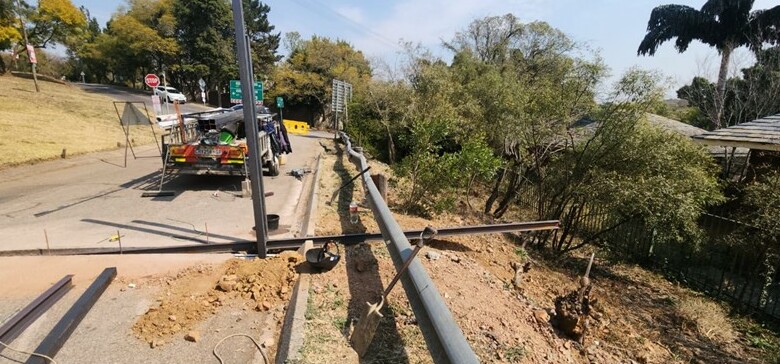
The metro has confirmed that no final decision has yet been taken on the controversial application to restrict access to Grus, Jupiter and Regulus streets in Waterkloof Ridge.
According to Tshwane spokesperson, Lindela Mashigo, the application for restriction of access to public places for security purposes was submitted in October 2022.
He said it received approval for advertisement purposes from the Strategic Land Development Tribunal (SLDT) in November 2023.
“It was formally advertised in April 2024, and a follow-up report is expected to be served before the tribunal in the coming months for a final decision.”
Mashigo stated that under the Rationalisation of Local Government Affairs Act, the metro does not permit the outright closure of public roads.
“The restriction of access legislation does not allow for the closure of public roads, but is intended as a means by which to monitor access for security purposes,” he explained.
“Conditions that the metro imposes make it clear that no person may be prevented from gaining access or denied access to a public road.”
He said all approved applications include specific conditions for fire, ambulance, civil defence, traffic, and police services, ensuring they have full, free, and continuous access.
“Unrestricted access must also be guaranteed for municipal officials and contractors, as well as emergency services at all times,” Mashigo added.
While the metro has emphasised that closures must allow public passage and emergency access, residents say the reality on the ground tells a different story.
Terence Kommal, who owns property on Grus Street, said barricades, road closure signs and even trailers have already been placed across the road, cutting off direct access to his home.
“Because my house is the second one as you enter the street, I now have to drive three and a half kilometres to find another access when my gate is literally 50m from the turn-off,” he said.
Kommal believes the closure contravenes the by-law itself.
“The wayleave is approved subject to the by-law, but there is no separate permit for a complete road closure, which is required,” he explained.
“Municipal policy clearly states that you cannot completely block off public access to a road.”
He also questioned the public participation process, saying he was never consulted or informed, despite writing to the committee last year.
“The only meeting they held was on Zoom, with notice given on a Friday afternoon for a Sunday meeting. That cannot be called meaningful public participation,” he said.
Ward councillor Shane Maas confirmed that the application for “restriction of access to public places for security purposes” covering Grus, Jupiter, and Regulus streets was submitted in 2022.
He said it was advertised in April 2024 after receiving approval for advertisement purposes in late 2023, but the SLDT has not yet made a final decision.
“Despite this, construction has already proceeded.”
Maas said he cannot support the closure in its current form, warning of wider consequences for residents.
“I grew up in this ward, and I’ve watched closures mushroom over the years. They restrict freedom of movement and create enclaves of ‘us and them’ that divide communities.”
He said he can’t walk his dogs or take a run freely anymore because gates force him into narrow routes.
Maas also expressed concern about emergency services.
“We’ve seen fire trucks delayed by 15 to 20 minutes because they couldn’t get through a closed gate.
Ambulances and security companies face the same problem. Some closures even put guards at entrances, interrogating people as to where they’re going.”
According to Maas, these are still public roads, and the closures infringe on the constitutional right to freedom of movement.
He said he supports alternatives such as monitored access with boom gates, which allows identification without blocking access outright.
“I support electric booms where residents swipe, their number plate is recorded, and the boom opens. That’s different from a physical locked gate across a road, which I oppose.”
Maas explained that with Grus, they want to permanently close the road for residents only, with remotes issued to those who pay monthly fees.
He said that excludes others and could trap people in emergencies.
“The so-called toll-free numbers that are supposed to open the gates in emergencies don’t work. Residents have tried calling and [have had] no response,” he said.
However, proponents of the project argue that closures are a necessary measure against rampant crime.
Councillor Siobhan Muller, who supports the Safe Water Club, said police and the metro have failed to protect communities.
“Brooklyn Police Station is one of the worst in the country, plagued by corruption and inefficiency.”
According to Muller, people are tired of waiting for help that never comes.
She said closures or monitored access, as they are now called, are necessary for safety.
“Courts have repeatedly ruled in favour of residents, forcing the metro to finalise applications. We pay taxes for safety, but we aren’t getting it.”
According to Muller, these initiatives are the only way to protect their families.
Consultant Jan Malan, who has been involved in several closures in the area and in the current closure, defended the process.
“Residents will have access through sliding gates controlled by drop calls from their cellphones.”
He said there’s also a toll-free number displayed at every entrance, which connects directly to the control room and the metro police.
According to Malan, claims that the numbers don’t work are simply false.
“This system ensures that emergency services and residents can access the area without delay,” Malan said.
He added that the closures enjoy broad support.
“Over 70% of residents backed the application, and it was approved by all relevant departments in principle.
“The construction only takes a week, and driving through the work area could cause damage, which is why access was temporarily restricted. Residents opposing the project are a small minority.”
According to Maal, after a public participation that was held, residents were given 40 days’ notice to object, however, no objections were brought forward.
ALSO READ: East cemetery prioritised in week-long maintenance
Do you have more information about the story?
Please send us an email to bennittb@rekord.co.za or phone us on 083 625 4114.
For free breaking and community news, visit Rekord’s websites: Rekord East
For more news and interesting articles, like Rekord on Facebook, follow us on Twitter or Instagram or TikTok.