Tshwane coalition reflects on year in office
Mayor Nasiphi Moya says her multiparty coalition inherited a city at the brink of collapse, however they have slowly stabilised the city’s finances, reduced Eskom debt, and rebuilt key services.
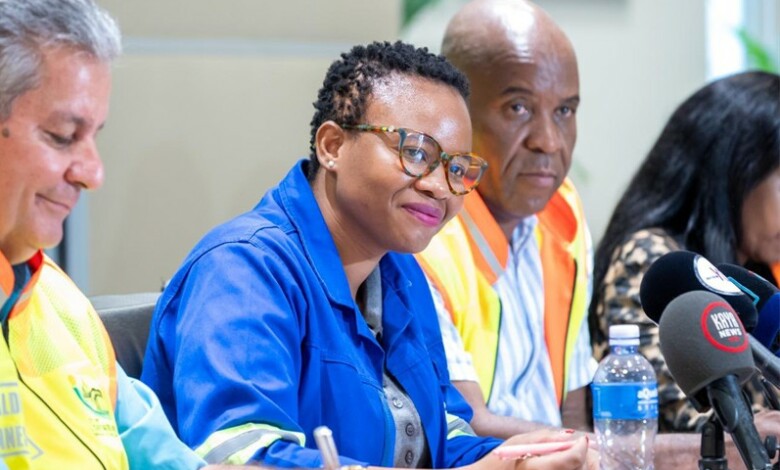
After a year in office, Mayor Nasiphi Moya has reflected on her administration’s first year, describing it as a period of ‘rebuilding from crisis’ and steady progress toward restoring stability.
Speaking at her administration’s first anniversary on October 14, Moya said they inherited ‘a financially strained city’ but have since achieved measurable progress.
She said this is evident through the reduction of Eskom debt, the rebuilding of service delivery capacity and fielding a fully funded budget after years of operating without one.
The current Tshwane coalition is made up of the ANC, EFF, ActionSA, GOOD and smaller parties and took over from the DA-led administration in October last year following the ousting of Cilliers Brink.
“When we took office in October 2024, the City of Tshwane was in a dire financial position. For four consecutive years, it had operated with an unfunded budget, limited cash reserves, and mounting debt to Eskom,” Moya explained.
She added that her administration inherited a city on the brink of collapse, struggling to meet its obligations and serve its residents effectively.
Moya said the coalition government had stabilised the metro’s finances and restored investor confidence.
“For the first time in years, Tshwane tabled a fully funded budget. The city’s Eskom debt has been reduced from R6.7-billion to R5.6-billion. These are not political points, but measurable steps towards recovery,” she said.
She added that Moody’s retained Tshwane’s stable outlook in November 2024, and Global Credit Ratings revised the city’s outlook from negative to positive in April this year. She said these points to better fiscal control, easing liquidity risks, and an operating surplus for the second consecutive year.
“In just 12 months, we have turned what was a collapsing institution into one that is regaining its financial footing.”
Moya said her administration had begun reversing years of neglect by prioritising service delivery and rebuilding key infrastructure.
“Roads are being resurfaced and repaired, even if not yet at the desired pace. Substations and reservoirs are being secured following waves of vandalism and sabotage. The Water and Sanitation Business Unit is leading critical interventions to stabilise supply and address water losses,” she said.
Moya admitted the city still faces challenges related to infrastructure, but said the turnaround was visible.
Some of the coalition’s achievements include a R1.9-billion surplus in the first quarter of the current financial year, and R86-billion pledged in investments at the Tshwane Investment Summit.
R14.4-billion in unauthorised and irregular expenditure is under investigation.
A total of 220km of roads were resurfaced, and 78% of potholes were repaired.
The metro handed 3 368 title deeds over to residents; and 1 850 illegal dumping sites were cleared and 500 litter-picking operations were conducted.
R1.4 billion was earmarked to stabilise the electricity grid.
The metro also offered support for over 1 000 SMMEs and 179 co-operatives.
“We are reclaiming the city, enforcing by-laws, improving collections through Tshwane Ya Tima, and investing in communities that were long neglected. This administration is about results, not rhetoric,” Moya said.
She also accused the previous administration of neglecting poorer areas while focusing resources on affluent suburbs.
“When we assumed office, we promised that we would serve all residents and remember forgotten communities such as Winterveldt, Soshanguve, and Atteridgeville that had been ignored. Every resident has the right to an improved standard of services.”
Moya said water security was fragile, infrastructure had been ignored, and sewer spillages had become a daily reality for many communities, however, the current government is changing that.
“We will modernise how we serve residents by improving our customer relationship management systems and strengthening community engagement channels, following the successful launch of the city’s WhatsApp channels earlier this year.”
She added that the metro would also reinforce financial and administrative controls to ensure consequence management is applied, and audit outcomes improve.
“This work will be supported by ongoing efforts to digitise legal, audit, and contract management systems to ensure efficient, responsive governance.”
Moya insisted that the metro is ‘turning the corner’ after years of mismanagement.
“We have a long road ahead, but the direction has changed. For the first time in years, Tshwane is on a path to recovery, financially stable, administratively stronger, and committed to restoring service delivery across all communities,” she said.
Moya said the decisive action against financial mismanagement demonstrates her administration’s commitment to clean governance and accountability.
“When we took office, Tshwane’s finances were in disarray, R13-billion in irregular and wasteful expenditure,” Moya said.
“Today, we are restoring integrity to the city’s financial management. The fact that over R14-billion worth of cases have been investigated, with billions already processed and recovered, shows that we are serious about ending the culture of impunity.”
She added that the disciplinary and criminal actions taken against officials mark a turning point for Tshwane.
“No one is above the law. We will continue to act firmly and transparently to ensure every cent of public money serves residents, not private interests.”
However, former mayor and DA mayoral candidate Cilliers Brink has dismissed Moya’s claims, saying residents have ‘little to celebrate’ under the coalition’s rule.
“What we have seen over the past year is not recovery – it’s regression. Residents are still battling power cuts, water shortages, and poor service delivery,” Brink said.
He accused the Moya administration of failing to prioritise key infrastructure projects, including the Hammanskraal clean water project, which he said has stalled despite massive expenditure.
“The city’s water tanker costs have ballooned from R170-million to R500-million since the coalition took over. This is despite the fact that the Hammanskraal project should have reduced that expenditure,” Brink said.
“The mayor talks about accountability, yet the same corrupt networks remain untouched. The DA believes the Hammanskraal project can still be completed, but it requires leadership that acts decisively, not politically,” he said.
Our priorities for 2025/26 are clear and targeted:
1. Build stronger cash reserves to cover at least one month of operating costs,
creating real financial resilience.
2. Intensify revenue recovery by cleansing the indigent register, enforcing arrears
collection, and improving… pic.twitter.com/yHgBXeF8YE— Eugene Modise (@eugene_modise) October 14, 2025
ONE YEAR OF SERVICE DELIVERY
Today, we proudly report back to the residents of Tshwane on the progress made over the past 12 months under a multiparty government.
Together, we’ve worked to restore stability, accelerate service delivery, strengthen financial management, and… pic.twitter.com/X8ljNTBsPF
— Eugene Modise (@eugene_modise) October 14, 2025
Do you have more information about the story?
Please send us an email to bennittb@rekord.co.za or phone us on 083 625 4114.
For free breaking and community news, visit Rekord’s websites: Rekord East
For more news and interesting articles, like Rekord on Facebook, follow us on Twitter or Instagram or TikTok.