Poetry: Powerful words that bind us
Through precious spoken and written words, poetry still plays a profound role in today’s society.

People experience poetry as a way of sharing experiences, cultures and common humanity, using it as a means of self-expression, social commentary and activism.
Rekord spoke to a few people to find out what poetry means to them.
Poet Mpumi Morutlua, aka TheeLadyLilo, has been running the Spoken Sessions at Café Barcelona in Colbyn since 2012.
According to her, in this time of social media, the poetry sessions allow people to express themselves in front of like-minded people at a platform where they can get together to share their thoughts and emotions. She says it’s about ‘giving a voice to others and issues,’ helping people realise that they are not alone in their feelings.
She says their sessions are mostly attended by students and the younger working class. Themes that come up are centred around love, relationships, politics, and mental health issues. “People still like to vent their rage about politics and share issues like depression,” she adds, explaining that the attendees get ‘really excited’.
On a personal level, Morutlua explains that she started off writing poetry as a ‘diary to process pain and loss, celebrate God and religious stuff’.
Here is her poem reflecting the metaphorical cutting of the umbilical cord:
Bittersweet Independence
Some nights turn darker than dark,
and pillows pull you down memory lane,
while you trace your lifeline.
Blurry-eyed-eyed eyed you squint through the days,
yet tell no tales of your hollowed heart.
Your troubles packed under your feet,
in hopes that they too will walk away.
Your body aches of tiredness and your mind
trying to stay alive in a body that’s fighting to die.
Invisible tongues scorch your ears,
Until the distorted sound of your dreams hurl
You run outside but there’s no rain to wash your dreams clean,
nor a state of mind to start on a clean slate,
so, you watch the beams of your life glistering in a distance.
Independence greets you with an even colder kiss.
Curled in loneliness, you recollect your mother’s smile,
and travel through time coiling your spine to nest in her embrace,
It is 1989, cuddled in her arms with forehead kisses that never cease,
you cluck onto her breast and
your bones awake to new strength.
You live in a glass house that never breaks,
Your bones glow as though they were laced with granite finishings.
The world wonders why your bones never turn to ash,
but breast milk nourished babies make resilient humans.
So even in the darkest hour when the moon is reluctant to show face,
you strap on your mother’s voice as though it were a cloak.
Disappear in the rhythm of her heartbeat.
And rise as if you were Sun herself.
Her words have watered you and
her love nitpicked the rust off, of your character.
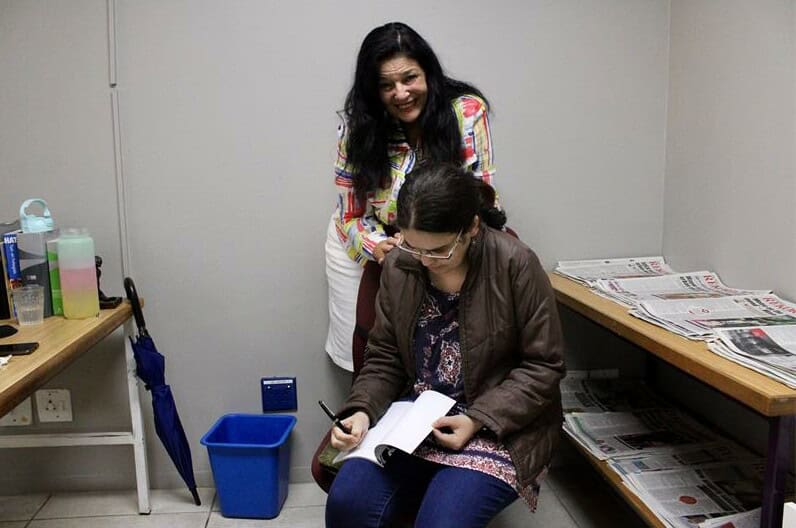
Sulet Linde, who self-published her anthology Dada for Nonsense earlier this year, looks at the world through a different lens. She says when she first started writing poems at school, it was like a bug had bitten her. She thought about her writing as ‘nonsense,’ but in her third year at university, her lecturer suggested it could be Dada.
Dadaism is a rebellious art movement which started during World War I. Artists and writers decided that because of the atrocities of war, the world didn’t make sense, and so their art shouldn’t either, going against social rules and expectations.
“Poetry is a fun way to express yourself and explore who you are as a person. It’s a way to see the world around you from a different perspective,” Linde says. She explains that she started writing nonsense poems and then moved on to Dada, with the two styles converging.
Here is her version of Tristan Tzara’s poem, one of the big Dadaists of that time.
How I write a DADA poem
I take an article,
read it.
Underline the words that pop out.
Cut,
scramble them,
mix them up,
and put them together
again in a new puzzle.
Here’s her poem about war in Ukraine:
War I
Plan of Attack
Bully for Ukraine
Keeping score.
Monster. Master,
You have the right to be forgotten.
An apology would be a start.
Inside job
Killing it softly
Childhood denied.
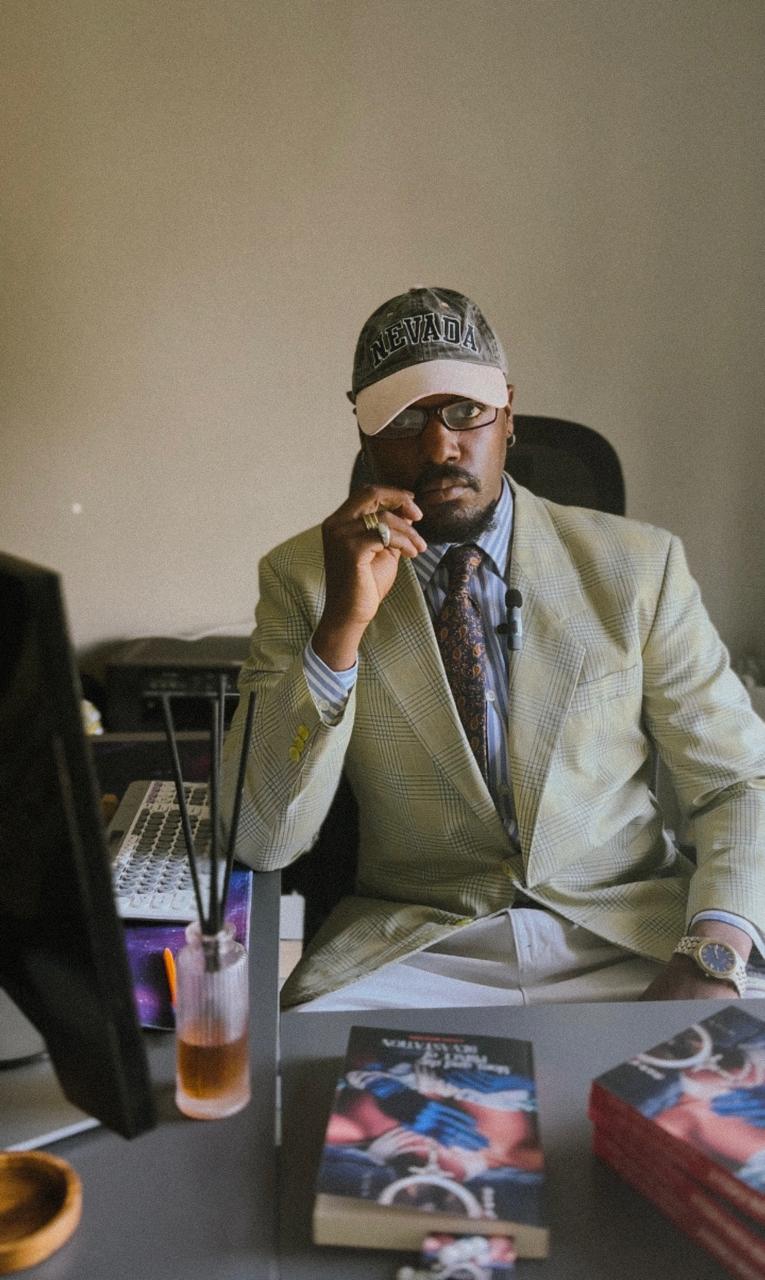
Author of the novel, Mom and the Prince of Devastation, Mlunghisi Manganyi, describes himself as a passionate lover of literature who sees poetry as a way of connecting.
He says that with his mom’s and sister’s books lying around the house when he grew up, he was inspired by poetry from a young age and exposed to classic poets such as Edgar Allan Poe. He also listened to music and appreciated the poetry in it, but as he couldn’t sing, he started sharing his emotions through writing.
“We are living in a very individual time – where everyone is looking out for Number One and we don’t have a community,” he says.
He feels, however, that poetry has the power to bind people and give them the ability to see beauty through words. “It allows us to be a community, it’s a string to attach us. People need a mirror to see themselves – it’s difficult to see yourself if there is no mirror. When I read a poem, I finally find out someone else felt the same way and I’m not crazy.”
Manganyi says he’s ‘into real-life poems speaking of love, lust, and fate’. He’s a fan of American poets Joe Baldwin and Charles Bukowski. Bukowski is his biggest influence, especially his poems from the 70s and 80s: “He doesn’t conform or follow the rules. His poems are about real life in New York, of prostitutes and everyday people”.
Asked which poem comes to mind, he recalls this one by Bukowski:
Find what you love and let it kill you
My dear,
Find what you love and let it kill you.
Let it drain you of your all. Let it cling onto your back and weigh you down into eventual nothingness.
Let it kill you and let it devour your remains.
For all things will kill you, both slowly and fastly, but it’s much better to be killed by a lover.
Media consultant Laiza Maleka recalls that reciting poems at school helped her to come out of her shell when she was young. “In my opinion, it helps you stand up for yourself and express your feelings, to own your words.”
Lamenting the lack of platforms for youth to experience and perform poems at schools these days, she explains that to her, reading and listening to poetry allows one to create a ‘photo in your mind’.
She explains that in her Pedi culture, young initiates also have to learn long ancestral poems within days to recite during their initiation ceremony. The decades-long practice is their way of continuing oral history that also teaches the youth to appreciate their heritage.
Click here to watch a video of initiates and the community of Tjiane, GaMathabatha celebrating their oral heritage:
Do you have more information about the story?
Please send us an email to bennittb@rekord.co.za or phone us on 083 625 4114.
For free breaking and community news, visit Rekord’s websites: Rekord East
For more news and interesting articles, like Rekord on Facebook, follow us on Twitter or Instagram or TikTok or WhatsApp Channel