DA leads Tshwane municipal race as ActionSA gains ground
Coalition talks loom in the capital as provisional local election counts show changing voter dynamics and no outright majority.
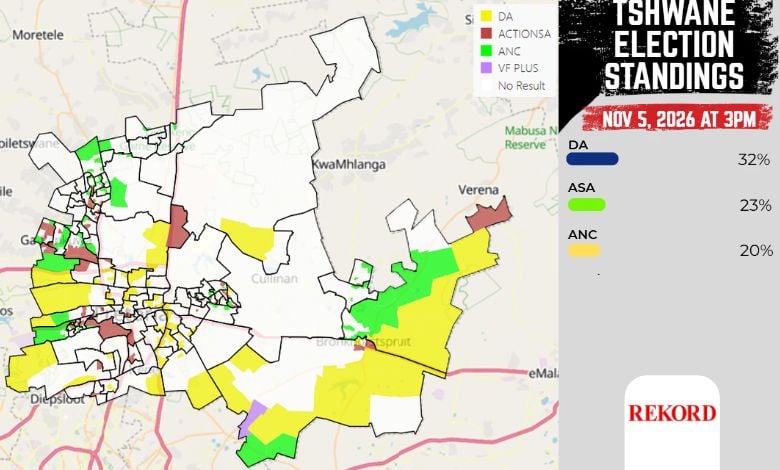
The DA led the City of Tshwane’s local government election race at 15:00 on Thursday, as vote counting continued, with ActionSA remaining a strong contender and setting the stage for coalition negotiations, according to a political analyst.
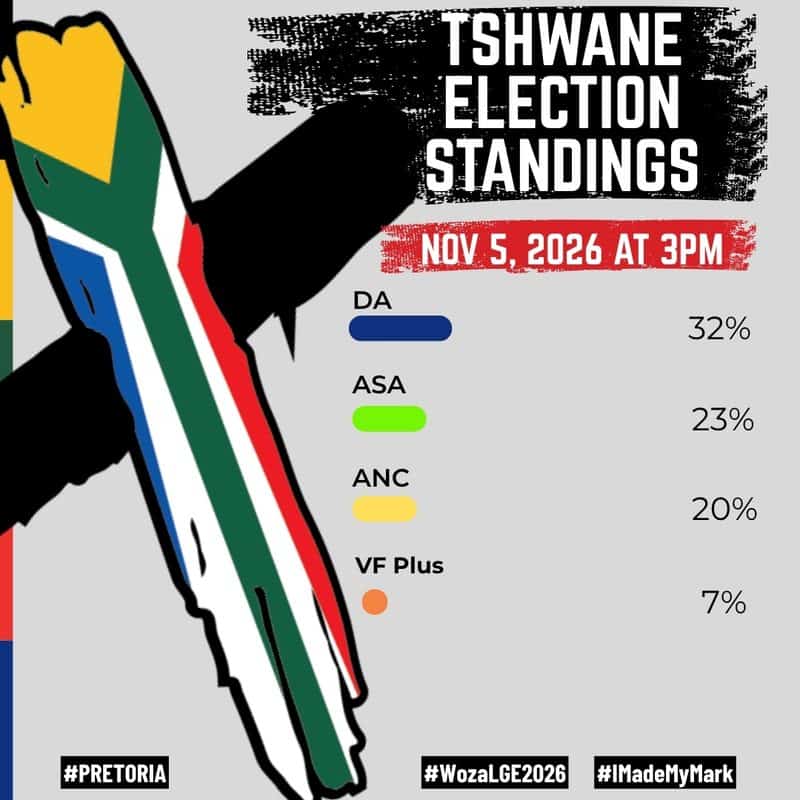
Provisional IEC results showed the DA ahead with 32.29% of the vote, followed by ActionSA on 23.21% and the ANC in third place with 20.34%.
The Freedom Front Plus (VF Plus) ranked fourth with 7.97%, followed by the EFF with 5.92%, according to figures provided by the IEC.
The proportional representation (PR) ballot, which determines each party’s overall share of council seats, also showed the DA leading.
With about 25% of voting districts counted, the DA had secured 32.4% of the PR vote, followed by ActionSA on 24.9% and the ANC on 20.3%.
The results suggest a closely contested race between the DA and ActionSA, with the ANC also retaining a significant share of the vote.
Coalition prospects
Political analyst and University of Stellenbosch lecturer Dr Kuhle Zwakala said the results in Tshwane pointed to an interesting development in voter behaviour, with the Government of National Unity (GNU) framework potentially influencing how voters view political representation and coalition governance.
“It is very interesting to see voters not being influenced any more by big parties with big manifestos but rather by what they think coalitions might achieve on their behalf,” Zwakala said.
He said it would be particularly interesting to see whether ActionSA and the DA could find common ground on policy and establish a principled coalition agreement in Tshwane.
“In Tshwane, it will be interesting to see if ActionSA and the DA can see eye to eye with each other on policies and be partners in an agreement,” he said.
He added that the outcome of coalition arrangements would not be determined by the ballot alone, but also by the negotiations and agreements parties reach after the election.
He said the alignment of parties at national level could increasingly translate into co-operation at local government level.
Seat allocation
Tshwane has 214 council seats, comprising 107 ward seats and 107 proportional representation (PR) seats.
The PR system is intended to ensure that the final composition of the council broadly reflects the overall share of votes received by political parties.
The Independent Electoral Commission of South Africa (IEC) calculates the total number of votes received by each party and uses a seat-allocation formula to determine its overall entitlement to council seats.
Ward victories are then deducted from that entitlement, with the remaining seats allocated through the PR lists.
For example, if a party qualifies for 50 seats based on its overall electoral support and wins 40 wards, it would receive another 10 PR seats.
Smaller parties can therefore secure representation in council even if they fail to win individual wards, provided they receive sufficient PR support.
The final allocation will be important in determining whether the DA can govern Tshwane independently or whether it will need coalition partners to secure a working majority.
The IEC is expected to announce the official national election results on Sunday, November 8, as counting and verification continue.

Do you have more information about the story?
Please send us an email to bennittb@rekord.co.za or phone us on 083 625 4114.
For free breaking and community news, visit Rekord’s websites: Rekord East
For more news and interesting articles, like Rekord on Facebook, follow us on Twitter or Instagram or TikTok or WhatsApp Channel