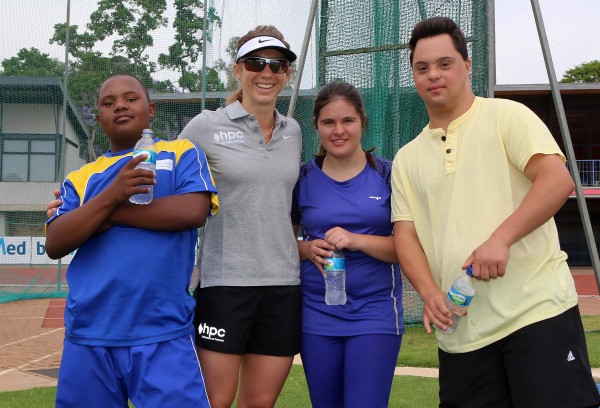
Wenda Nel help disabled athletes on practice field
The 400m hurdles star, Wenda Nel, immediately agreed when she was asked to become involved with a few young athletes with Down Syndrome.
The quest to run ever-faster times in an effort to become one of the best 400-hurdles athletes in the world is not Wenda Nel’s only passion.
To help others is equally important to her. It was not surprising, therefore, that the 400-hurdles finalist at this year’s World Championships in Beijing immediately agreed when she was asked to become involved with a few young athletes with Down Syndrome who are preparing to compete at the SASA-II Open Games in Secunda. This will be one of the last opportunities for these athletes to try to qualify for the World Championships for persons with Down Syndrome that will be presented in Bloemfontein at the end of November.
The Tuks/HPC athlete will help to improve the focus and coordination of these young athletes so that they will be better able to train and compete.
Judging by the reaction of Minette Swart (Pathways), Pieter Starke (Pathways) and Siphure Monama (Via Nova), Nel certainly has the knack to relate to these athletes. Coincidentally, South Africa’s National Down Syndrome day is also celebrated in October.
The athletes were smiling happily while Nel put them through exercises with two balls to help them improve their eye-hand and eye-foot coordination at the LC de Villiers-stadium. To intensify their ability to focus Nel had them do some fine motor activity exercises combined with balance.
To top it off Nel surprised them with a challenge to run a 50 metres dash. As an extra incentive she lined up some gifts on the finishing line.
“With the 50 metre race I wanted the athletes to realize that you don’t necessarily have to win to be considered a champion. Every time you participate in a race and run to the best of your ability you are a winner. That is why each athlete received a prize.”
Asked why she decided to become involved with helping these athletes with Down Syndrome, Nel said that to be involved in sports is a real passion for her.
“As far as I am concerned everybody, no matter who, deserves an opportunity to experience the joy of competing in sports. That is what I am planning to do when I work with these athletes. I must admit that it is a mutual beneficial relationship because they certainly also inspire me.”
Nel, who is qualified dietician, is working out some dietary guidelines for athletes who will be competing at the World Championships.
Tessa van Heerden, marketing and communication manager of the SA Sports Association for the intellectually impaired emphasized the importance of regular exercise for children with Down Syndrome. Because most of them have a low muscle tone they need to move and be active to support their bodies.
“The more they move the more fluent their movements will become. Regular exercise is also an intellectual stimulation and it helps the kids to learn better,” Van Heerden explained.