Wheelchair rugby helped player to maintain self-respect
As one of South Africa's most experienced wheelchair rugby players, Victor Buitendag believes that this sport helps him get rid of his frustrations as a disabled person.
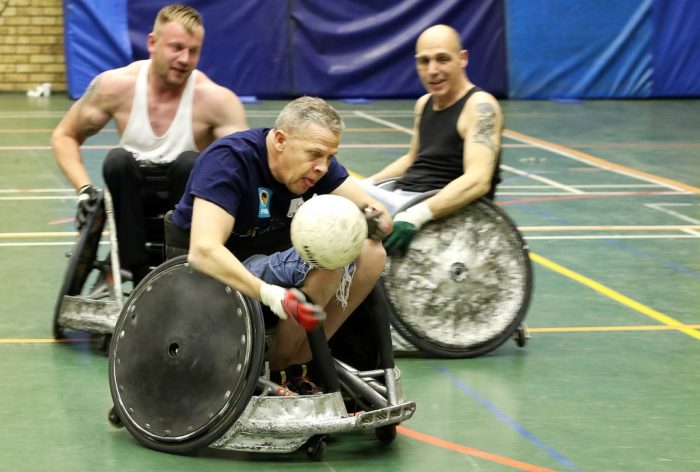
It won’t be wrong to say that playing wheelchair rugby has given Victor Buitendag self-respect.
In 1993 when he was just 23 years old his life changed dramatically forever in a mere few seconds. Buitendag was driving home after completing a military camp when he was involved in a car accident in which he broke his neck leaving him paralysed. He admits to being down and out after the crash.
“I was starting to wither away. Nothing mattered to me. I did not know what to do with myself. However, everything changed when a friend suggested that I should take up wheelchair rugby. Right after my first training session, I realised that the sport is going to change my life for the better. Suddenly I had a purpose. I wanted to the best wheelchair rugby player in the world,” Buitendag explained.
The Tuks player said the biggest challenge facing any person after being paralysed is to realise that the person sitting in the wheelchair is not the person who you really are.
“I will admit the first time you see an image of yourself in a wheelchair that it is quite a shock. You battle to identify with the person in the chair. But you got to realise that a wheelchair is just the means to get from one place to another. It can never define who you are. What defines you is how you cope with each day’s challenges. You got to learn to respect yourself. Only when you are able to so, you will start to earn the respect of others. Playing wheelchair rugby changed my life,” he said.
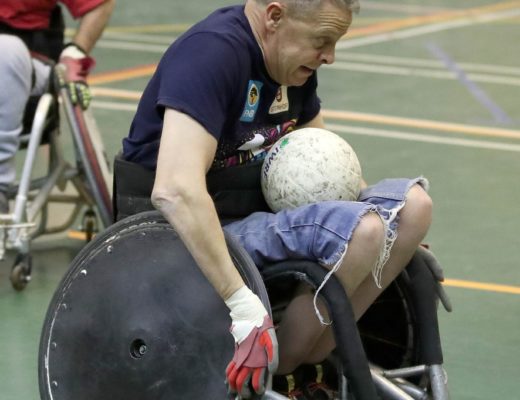
Photo: Reg Caldecott
Buitendag can really claim to be one of the sport’s stalwarts. He played his first game for South Africa in 1998 and his last in 2015. The Tuks player is not sure as to exactly how many international games he played but guesses it could be anything between 60 and 80 games. A definite highlight was playing against New Zealand getting to experience the haka first hand.
There is no stopping the 50-year-old Buitendag. He is still training with the Tuks wheelchair team at least twice a week. What he might lack in physical abilities he makes up with tactical savviness. During training, he regularly ‘sidesteps’ the younger players to go on to score tries.
Getting to execute the ultimate tackle – to hit your opponent with such force that he is flung from his wheelchair – is one of the reasons why Buitendag fell in love with the sport.
According to Buitendag the physical contact of wheelchair rugby is of cardinal importance to the players.
“It is a way to vent our frustration. One of our coaches remarked how he could see a marked change in every player before and after a training session. To him, it seemed as if we all were more content afterwards,” he concluded.
For free breaking and community news, visit Rekord’s websites:
For more news and interesting articles, like Rekord on Facebook, follow us on Twitter or Instagram.