Young players learn from experienced tennis legend
The South African tennis legend, Danie Visser, enjoys working with young players these days while he is also back at home in Pretoria, the city where his remarkable life journey began over six decades ago.

Tennis fans around the world will be glued to their TV sets this week to follow the last Grand Slam tournament of the year.
After South Africa’s only hope, Lloyd Harris, was eliminated last week in the second round of the US Open by the new wunderkind of tennis, Carlos Alcaraz, many people wonder if South Africa will ever again produce top players who can win Grand Slams.
Of course, this scenario was not always the unfortunate reality for South Africa. In the late 1980s and even throughout the following decade, South Africa at times had up to ten players in the top 150 of the world rankings. One of these players was Danie Visser, a Pretoria boy through and through who made the country proud on his day as the winner of three Grand Slam titles.
After his wanderings around the world as a professional tennis player and later also as entrepreneur, during which he lived in America, Visser is back in Pretoria these days, where it all started for him.

Photo: Supplied
“I already started playing tennis at the age of five and although later as a pupil at Laerskool Anton van Wouw in Pretoria I also played rugby and cricket and swam quite well, tennis was always my first love,” he explained during a recent interview with Rekord.
In high school at Afrikaans Hoër Seunskool Pretoria (Affies), he started to focus only on tennis and quickly became one of the country’s top juniors.
Visser wanted to study medicine at Tuks, but decided at the last moment to do his compulsory military service first. However, in the Army he began to excel as a tennis player and when he won the national Army championship in 1981, his future changed drastically.
He decided to start playing professionally and after winning the Johannesburg Challenger tournament with a prize money of $25,000 in April 1982 (big money in those days), he was able to start touring overseas at his own expense.
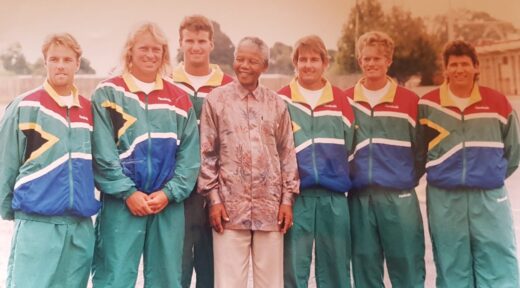
Photo: Supplied
As a singles player, Visser quickly established himself among the top 100 players on the world ranking, which opened many doors for him.
With his keen sense of anticipation and adaptability he was a formidable competitor on the court. By the end of 1984 he was the world’s 59th best singles player and until his career was interrupted by a serious shoulder injury in 1987, he managed to beat future Grand Slam winners such as Michael Chang, André Agassi and Pat Cash.
On his return to the game after the injury was sorted out, Visser decided to specialize as a doubles player.
This was followed by unprecedented success, which included his three doubles Grand Slam titles. 1990 was a big year for him, during which he and fellow South African, Piet Aldrich, won the Australian Open as well as the American Open, while reaching the final at Wimbledon. They were also the world’s top ranked men’s doubles pair for most of 1990.
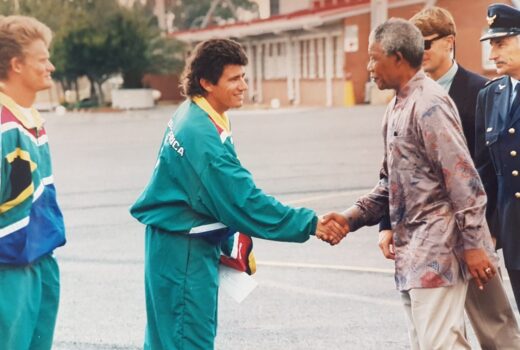
Photo: Supplied
In the same year, he and his mixed doubles partner, the Aussie Nicole Provis, also reached the final of the French Open.
Visser and Aldrich’s success in 1990 even qualified them for a State President’s award, while they were also named South Africa’s sportsmen of the year that year.
In 1993, Visser won his third Grand Slam doubles title (second at the Aussie Open) together with Laurie Warder from Australia, after Aldrich was not available due to injury.
Visser eventually won 17 doubles titles on the pro-tour until he retired as a professional player in 1995. After his normal pro career, he also won a few titles on the seniors tour for players over the age of 35.
He also represented his country as a player in the Davis Cup tournament in 1994 and 1995, while he was the South Africa’s Davis Cup captain between 1996 and 2000. He captained the South African Federation Cup team in 1994 and 1995, while he was involved as a manager/coach with the South African Olympic Team in 1996.
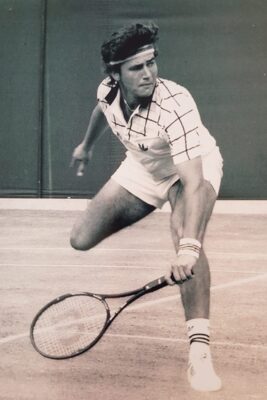
Photo: Supplied
After working first as a financial advisor and later as a stock trader after his tennis career, Visser got involved in tennis again for a short time as tournament director of a few Challenger tournaments in America.
With the arrival of Covid, however, he returned to South Africa, where he is now semi-retired at 62. He is also part of a group of specialist coaches, who work with high performance groups among Gauteng North’s junior tennis players.
“I sometimes help out as a coaching consultant in America, but these days I enjoy being with my family here in South Africa and especially spending time with my 92-year-old father,” he remarked.
Like many other experts, Visser believes that South Africa’s biggest problem now is that there are too few proper Futures and Challenger tournaments in the country. This means young players must spend big money to compete elsewhere in the world, so they can earn points to improve their world ranking places.
Do you have more information about the story?
Please send us an email to editorial@rekord.co.za or phone us on 083 625 4114.
For free breaking and community news, visit Rekord’s websites: Rekord East
For more news and interesting articles, like Rekord on Facebook, follow us on Twitter or Instagram