Coetzé had to dig deep to be the overall men’s winner of the Swim World Cup Series
The international profile of Pretoria’s swimming superstar, Pieter Coetzé, has grown further following his stellar performances during the recent World Cup Series.
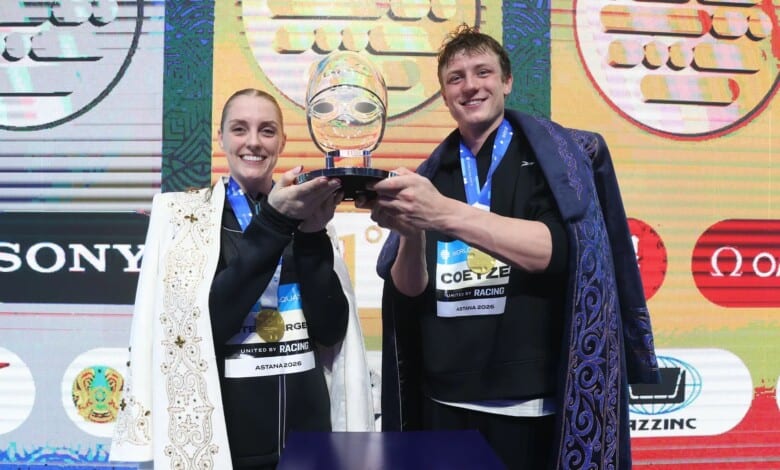
In sport, numbers sometimes tell a better story than words, as evidenced by the achievements of Pretoria’s swimming superstar, Pieter Coetzé, at World Aquatics’ recent World Cup Swimming series.
Simply saying the Tuks swimmer was the men’s overall winner of this series sounds impressive, but it doesn’t tell the whole story.
There is good reason why Coetzé, in an interview with World Aquatics in Kazakhstan on Saturday, remarked after his last race that if he compares it to other races, it’s probably the hardest he ever had to work in the 50m backstroke.
“Therefore, I’ll cherish this one forever, and I’ll always remember this,” he said during the media interview.
The statistics certainly bear out Coetzé’s statement. Between October 1 and October 17, the Tuks swimmer competed in 27 backstroke races (50m, 100m, and 200m). He reached nine finals, won eight, and tied for second in one.
In Uzbekistan and Kazakhstan, Coetzé won all three backstroke events. He set a world record in the 50m backstroke and twice improved the African record in the 100m backstroke.
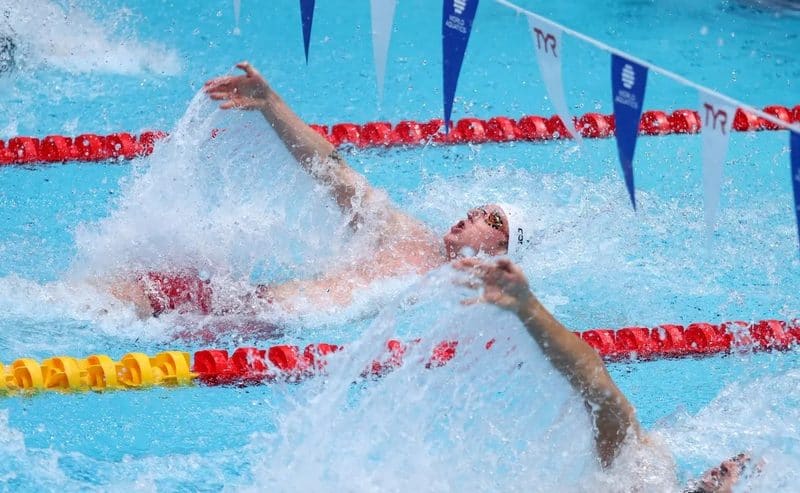
Photo: Supplied
This 22-year-old swimming star is only the fifth South African male swimmer to win the overall Swimming World Cup series. Ryk Neethling, Chad le Clos, Cameron van der Burgh, and Matthew Sates have done so as well. Notably, Van der Burgh was also a Tuks swimmer when he achieved this.
The men’s overall race was tough to call, as it came down to the final race between Coetzé and Russian Egor Kornvev in the 50m backstroke. Kornev’s Triple Crown victory earlier in the 50m Butterfly at 21.82 meant that whoever won the final race would become the overall winner and earn the $100,000 (R1.6 million) top prize.
“I tried not to think about it coming into the 50m backstroke. I just did it like any other race. I had some bicep pain in the warm-up, so that stressed me out a bit. But I tried to switch my mind off and focus on the race, and got the race done, and that led to winning the World Cup,” Coetzé remarked.
The 50m backstroke final was an absolute thriller. After the first 25 meters, the two swimmers were separated by a mere 0.07s. With 15 meters to go, it looked as though the Russian might beat Coetzé. But then again, the Tuks swimmer doesn’t know the meaning of giving up and he won in 22.36s. Kornev’s earlier heroics caught up with him, and he finished third (22.81s). Russia’s Pavel Samusenko was second in 22.49s.
As things stand, the Tuks swimmer is the fastest in the world in all three backstroke events in the 25m pool. His 22.09s 50m is a world record, while his 48.21s 100m backstroke is an African record.
What impressed about Coetzé’s 200m backstroke performances, was how consistently he got faster. In Azerbaijan, he won with a time of 1:49.64. In Uzbekistan, it was 1:49.32, and in Kazakhstan he swam 1:48.08.
Do you have more information about the story?
Please send us an email to bennittb@rekord.co.za or phone us on 083 625 4114.
For free breaking and community news, visit Rekord’s websites: Rekord East
For more news and interesting articles, like Rekord on Facebook, follow us on Twitter or Instagram