Monet Townhouses standoff: What the public should know about such incidents
From staying back to passing on information, the Polokwane CPF vice chairman explains what the public should know and what they should do in armed incidents.
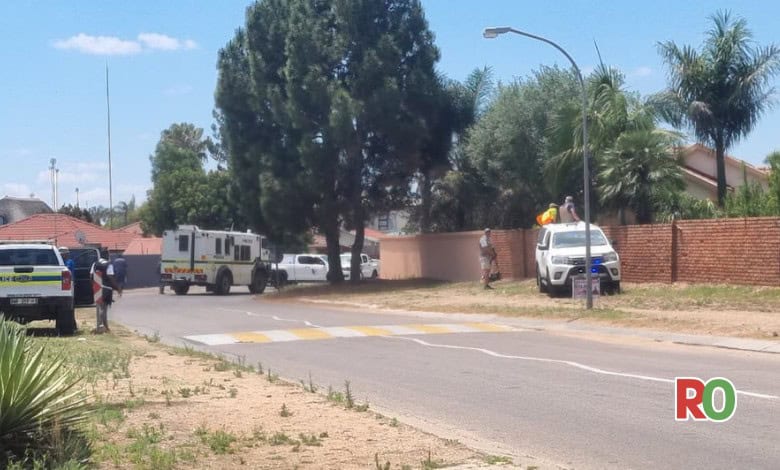
POLOKWANE – When gunfire rang out at Monet Townhouses on Sunday, October 11, Community Policing Forum (CPF) vice chairman Graham Browne was at home when he received a call from a resident reporting what sounded like automatic gunfire.
He immediately contacted provincial police commissioner Lieutenant General Jan Scheepers before joining the police response.
When Browne arrived, the gunfire was still ongoing. Responders did not yet know where the shots were coming from or who was involved, creating risks not only for those directly involved, but also for residents and bystanders nearby.
The incident ended with the armed man surrendering, but it also highlighted the difficult balance between community involvement and allowing emergency responders to manage a volatile scene.
ALSO READ: Monet Townhouses suspect to appear in court
Reflecting on the response, Browne said one of his biggest concerns was protecting members of the public.
“My responsibility is to make sure you’re safe, that you can go back home to your family,” he said.
When helping can create more risks
Browne said he understood why residents might be drawn to an unfolding incident, whether out of concern, curiosity or a desire to help. However, he warned that approaching a scene without understanding the risks could put lives in danger.
He highlighted the potential danger posed by high-velocity ammunition of the type used by the armed man during Sunday’s incident.
“You’re talking a muzzle velocity of 2 000 feet per second. With that type of muzzle velocity and the size of the projectile coming out of the weapon, it can ricochet, or it can go through you and hit the person behind you. People can get killed by it. It’s as simple as that. It will kill you.”
While members of the community offered assistance during the Monet Townhouses incident, Brown said such involvement needs to be coordinated, as it was that day, with the police and community policing structures.
Drone operators should also identify themselves to the relevant authorities at the scene, as they may need to be contacted and any footage they captured could greatly assist the investigation.
“We appreciate the public input, we do. But it’s very important that the public come to us. The residents offered the drones, and I’ve got no issue with that. It gave us information as to what was happening. But others must understand also that something like that could escalate the situation. It could panic the person with the gun, and that person could start firing. So that has to all be done through communication with the SAPS. It’s a very thin line to balance properly.”
During the incident, a drone operator was asked to stop flying because the noise was interfering with Scheepers’ ability to hear the armed man during negotiations.
Browne said the example illustrated how even well-intentioned assistance could complicate an already dangerous situation.
“General Scheepers was in front of that guy, and if he’d felt pressured, it could have endangered the lives of the SAPS members.” The implication is clear: the priority had to be safe management of the scene.
His message was that residents should not take it upon themselves to intervene in an armed incident or attempt to manage it independently. Instead, information and offers of assistance should be passed to the police or CPF, allowing those coordinating the response to determine whether and how they can be used.
What should residents do during an armed incident?
Browne said residents should report their concerns to the police or CPF rather than confront the person themselves.
People should prioritise their own safety, move away from danger and avoid approaching or following an armed individual. If it is safe to do so, they can provide responders with information such as the person’s last known location, direction of travel and a description of what they observed.
When contacting emergency responders, useful details include the exact address, nearest intersection, relevant unit or access point, and a clear explanation of what is happening.
Browne said residents who are uncertain about what they have seen should make that clear when reporting it, allowing authorities to assess the information.
He also warned against aggressive confrontation, vigilantism and attempts by community members to take control of a dangerous situation.
For Browne, community safety depends on cooperation between residents, the CPF and police, rather than individuals acting independently.
“Work within the structures, and the structures will work with you,” he said.
Why the scene must remain undisturbed
The work does not necessarily end when the immediate danger subsides. Once an incident is brought under control, preserving the scene and any potential evidence becomes a priority.
Browne said one of his first concerns after hearing that the man had surrendered was ensuring the scene remained sterile.
“My first responsibility was that the scene must remain safe until forensics are finished. My other concern was for his mother and his grandmother,” he said.
He explained that evidence found at an incident scene needs to be documented and handled appropriately to support any subsequent investigation and court proceedings.
“There was so much ammunition lying around. The Local Crime Record Centre (LCRC), a division of the SAPS, looks after the forensics; the scene gets handed over to them. They put the barrier tape up to preserve the evidence. Then they give it to the forensic science labs. Forensic science labs do all the ballistics on the weapons. They match the weapon to the projectiles. They do all that sort of stuff, and then they give reports. So they are expert witnesses. Without those expert witnesses, things don’t stand up in court. So scene safety is vitally, vitally important.”
YOU MIGHT ALSO LIKE : Lekompo musician ‘Tsaka RSA’ in court on firearm charges
During the Monet Townhouses response, Browne said a resident had found and picked up a projectile.
He warned that unauthorised handling of potential evidence could compromise an investigation, making it more difficult for forensic officials to establish what happened and potentially affect subsequent court proceedings.
His advice was simple: residents should leave anything that could be evidence where it is and allow trained officials to handle it.
Don’t jump to conclusions
As details of a volatile incident emerge, initial information can change as responders establish what has happened.
Browne urged residents to be cautious about accepting or sharing unconfirmed claims, particularly while police are still managing an unfolding situation.
“Don’t jump to conclusions. That’s all,” he said.
He also explained why he favours restricting commentary and the sharing of photographs or footage while an incident is still active. Information circulating publicly, instead of first being shared with authorities, could reach the person involved, while footage, photographs or updates could reveal details that responders need to keep under control.
His position was that members of the public should pass relevant information to the police or CPF and allow those structures to assess it. Community assistance, he stressed, should support the response rather than operate alongside it without coordination.
For those who want to play a more active role in community safety, Browne encouraged joining recognised structures rather than attempting to intervene independently.
“If you want to be a citizen concerned in law enforcement, join a group like the CPF. We are the only recognised unit outside of the SAPS in the Police Act. So it’s very important for people to join the CPF, and then we can manage those people. Even neighbourhood watches fall under us and must register with the CPF.”
The emotional toll of community safety work
Beyond managing the immediate risks, Browne said he hoped to check in on residents affected by the incident afterwards. Although this is not a formal part of his responsibilities, he recognised that an experience of this nature could leave people shaken even after police had left.
Asked how he dealt with the emotional weight of the work, Browne described himself as someone who could be tough while still being deeply affected by what he witnessed.
“I’m an empath. I’m a very hard person and I have boundaries, but I’m an empath at the same time,” he said.
He acknowledged that some of what he encountered in community safety work hurts to see, and that dealing with difficult cases could be painful.
Asked how he managed those experiences, he said, “By the grace of God. Just by the grace of God. All I can say.”
How to join the CPF
For residents interested in becoming involved in community safety, Browne encouraged them to consider joining the CPF.
He said prospective members could contact the CPF to request an application form, which they would need to complete so that their details could be recorded and checked where necessary.
He explained that applicants would be asked to provide their details to allow for a background check.
“We have forms. So phone us, we’ll send you a form, fill it in, so we know who you are. Then you’re a member of the CPF. We’d love to have more members,” he said.
Anyone interested may contact Graham on 082 780 1888.