
EVICTION – Cries for help
By its mere nature the Disteneng eviction process of Tuesday had to it a human element – coupled with politically-motivated blame – that couldn’t be ignored. Cries for help in the winter cold rang louder than the crackling fires devouring the remains which the die-hard occupants of stands couldn’t carry along in the forced removal …
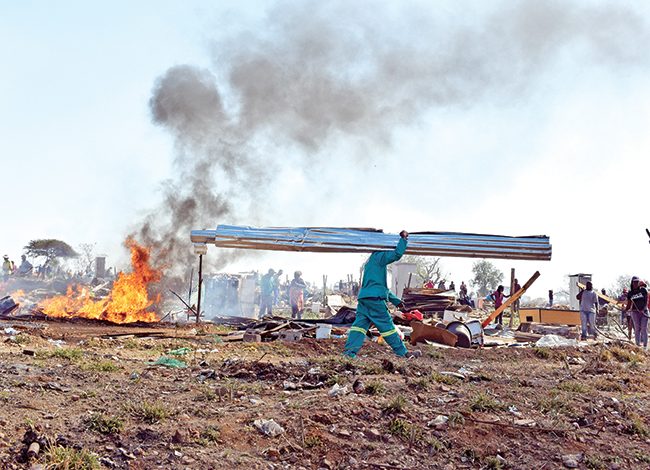
By its mere nature the Disteneng eviction process of Tuesday had to it a human element – coupled with politically-motivated blame – that couldn’t be ignored. Cries for help in the winter cold rang louder than the crackling fires devouring the remains which the die-hard occupants of stands couldn’t carry along in the forced removal of scores considered to be illegal.
Across the landscape duplicate scenes of women and men gathering their meagre belongings, piling up building material, keeping children out of the way of municipal machinery and growing confusion played out. Within close proximity the Police monitored the situation, armoured Nyalas and vans positioned along the outer border.
The removal process conducted at Disteneng sketched the flip side of the eviction coin when scores of newly homeless families and individuals lamented absence of an arrangement for a future abode as Polokwane Municipality forged ahead with plans for a redeveloped township. On their part those die-hards who remained on the land were considered illegal and had to be evicted in terms of an enforced court order early Tuesday morning to make way for the installation of services, as established from Polokwane Municipal spokesperson Matshidiso Mothapo.
Evacuation paves way for development
To earlier questions posed by Polokwane Observer that morning he confirmed that the eviction of illegal occupants was necessary to facilitate the placement of identified legal occupants of the planned redeveloped township. “The new township that will include residential and business stands as well as other facilities such as schools is planned there and some residents are already accommodated on their allocated stands. The illegals are obstructing the redevelopment of the township in accordance with the proposed lay-out and have to be removed to allow for the installation of permanent municipal services to legal occupants,” Mothapo explained. He could, however, not provide a date when the installation of permanent services is due to commence.
Mothapo indicated that the material of the shacks removed had been recorded on an inventory and that the owners might reclaim it from the municipality. He also said that some of the illegal occupants removed their shacks by themselves. To follow-up questions Mothapo emphasised that all the shacks that had to go on Tuesday were illegal. The exact number of shacks removed had yet to be consolidated.
He added that initial resettlement had started in March 2015 after a court order was obtained in 2014, which was re-confirmed in January this year. The municipality had informed dwellers on the court order and explained it accordingly, according to Mothapo. “Unfortunately they have to seek alternative accommodation as they were not part of the resettlement process.”
He concluded saying the municipality understood that there was a demand for housing and a need for people to get closer to the city for economic reasons. “There are identified sites which the municipality will properly service and allocate to qualifying beneficiaries.”
While law enforcers were deployed in their numbers on Tuesday, Nelson Mandela Drive leading from Seshego to town was cordoned off for the duration of the process that was wrapped up in the afternoon. As the proceedings unfolded, Polokwane Observer managed to conduct interviews with departing residents who had no idea what their future held, where they would stay on Tuesday night or being able to give children something to eat upon return from school that afternoon. Some had to ask off time from work to deal with the situation.
Thomas Manganye, who has lived there for 34 years and is self-employed, said he had been living there when they started voting “for Mandela”. He had no idea where he was heading for the night or what his future entailed, had nowhere to go or money for rent elsewhere. He was adamant that they were intending to stay. He claimed that they had not been properly informed about the process and if they had sufficient notice would have made plans in advance. He accompanied Polokwane Observer on a walkabout of the site that resembled something similar to a disaster area, but upon return to the spot where he left his belongings he could not locate it.
Another resident who was witnessed gathering his sparse earthly possessions indicated he was not able to talk due to the stressful nature of the situation.
A woman who opted for anonymity said she was unemployed, hailing from Mphahlele and didn’t have transport money to go home. She was confused not knowing where she was going to sleep that night or any other night. She had been staying in Nkandla section since 2006, she explained. Eventually she excused herself as she was overcome by sorrow.
What about tomorrow?
The attention returned to Solomon Dlamini, family man and father of 4-year-old Oupa and 7-year-old Zazharia, who was in equal despair over their immediate future. He indicated that he had been living there since 1999 and got the required sticker, serving as proof that they were listed for relocation, on their shack. With the intention of asking someone in nearby Extension 78A for a place to stay that night, he said they were temporarily sorted but raised the question what would happen the next day.
Suffering sparks call for help
“We are suffering. We need help,” exclaimed Anna Nkoana, from where she was busy cooking in the open, perched on a mattress. Stressing her dismay over the situation, she said they would have spent the night at that exact spot. Her daughter, Elizabeth Nkoana, exclaimed that government was cruel for kicking them out. Her sentiments were echoed by Tiny Manamela, who added that they had put those who had them removed in power. “They grew fat with big bellies. They are eating healthily. But look at us now.”
A widow who passed stopped to be recorded as she ranted in her vernacular about disappointment in the African National Congress (ANC) government, whom she voted for. “But this is how they repay us,” she said, adding that she experienced a sense of betrayal.
By yesterday morning (Wednesday) a call was received from a despondent resident of the erstwhile Nkandla settlement within Disteneng who claimed that they were awaiting feedback from a councillor who gave the undertaking last week that he would get back to them Tuesday or yesterday, but to no avail. The source said he had hastily returned from Bela-Bela where he was working only to find that his dwelling was gone. At the time of the conversation municipal officials and Disteneng residents were engaged in rows over their belongings, he indicated as whatever remained on the site was being demolished. According to him families have returned to Disteneng in the morning after hiding elsewhere against the excruciating cold the previous night.
Story: Yolande Nel / observer.yolande@gmail.com
Photos: Yolande Nel / Herbert Rachuene
Video: Herbert Rachuene


carries building material past an armoured Nyala.


