Many members of our urban communities are not fully aware of the very practical reasons for planting trees in our towns and cities, especially along the sides of roads. There are sound, realistic and sensible reasons for doing this, and here are four of the most prominent.

- Trees absorb heat, and especially deciduous trees in the summer, which become bare of their leaves in the winter, when we most need the sunlight.
- Trees absorb a certain amount of pollution, something we are very aware of in our very industrialised town environment.
- Trees serve as windbreakers, often helping to prevent serious wind damage to property.
- Trees absorb sound, also an important fact in a noisy urban environment.
Unfortunately, Vanderbijlpark has seen an alarming increase in the destruction of our urban trees and natural environment in general recently. Added to this deprivation, with almost every third property, be it church, business premises or private home being painted in shades of mortuary grey, we have the signs of a gloomy, depressed community psyche. Slowly, so that one does not notice it at first, our trees disappear, a few here, a few there, until…
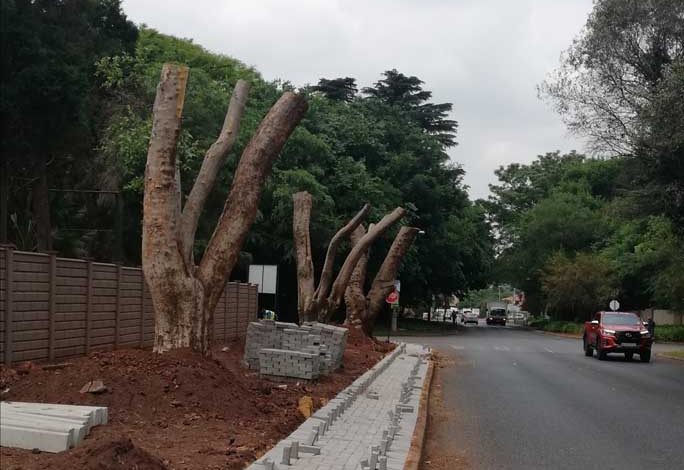
An example of this, but by no means the only one, is Piet Retief Boulevard, where over a few years, from in front of businesses and private homes alike, more than 25 trees have been chopped down, with not a single one being replaced. It’s like looking at a malicious grin, with half the teeth missing.
ALSO READ: Bakkie and taxi collide, leaving seventeen injured
Looking at the above four practical reasons, a lack of trees can add one or two degrees to the daily temperature of an area, especially in summer; our town is notorious for its industrial pollution and trees can help reduce this. (Trees absorb odours and pollutant gases, nitrogen oxides, ammonia, sulphur dioxide and ozone, and filter particulates out of the air by trapping them on their leaves and bark. In one year, an acre of mature trees can provide enough oxygen for 18 people, according to Google Search).
And what about noise pollution? Trees, and other large shrubs, act as sound barriers (sound attenuation), especially of noise from passing vehicles on our streets.
In town planning, when Vanderbijlpark’s streets were laid out, being on a very flat topography, many of our suburban streets are deliberately curved and do not follow a straight line for any distance, such as in the right-angled grid system of many world cities (a Roman invention), and thus prevent the effect of “wind tunnels”.
Add the trees to this, and instead of looking down a long street tunnel to the horizon, one’s eye is met with the fullness of our street trees.
And those trees take up much of the impact of strong winds. In general trees, shrubs and other large plants also help to maintain a high level of moisture in an environment, preventing a drying out effect in the atmosphere.
It was for these several reasons that Dr Hendrik van der Bijl, through his town planners and developers, set out from 1945 onwards, to plant nearly half a million trees in and around Vanderbijlpark to offset the effects of heavy industrialisation on both the human and natural environment.
Their biggest mistake, however, is that many of the trees planted were alien trees. Today we are wiser and we should always, where possible, plant indigenous trees, which means not any South African tree, but those which are indigenous to this Highveld region.
* “Oom Louw Bettrie” is the pseudonym for a well-known Vaal Triangle artist and former academic.
ALSO READ: Nurses deny the sad situation at Bophelong Clinic exists