
VUT launches TV White Space project
The Vaal University of Technology has introduced a TV White Space connectivity project aimed at bridging South Africa’s digital divide by providing cost-effective internet access to underserved communities, starting with local schools.
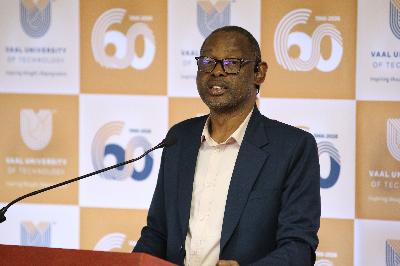
VANDERBIJLPARK – Vaal University of Technology (VUT) has taken a decisive step towards bridging South Africa’s digital divide with the launch of its TV White Space (TVWS) Proof of Concept Project on March 19 at Isak Steyl Stadium.
The initiative seeks to deliver affordable and reliable broadband connectivity to underserved communities by harnessing unused television broadcasting spectrum. Implemented in partnership with industry stakeholders, the project reflects a collaborative effort between academia, government, and the private sector.
Providing an overview of the project, Matshidiso Moloko, Director of Terrestrial-Link, positioned the initiative as a catalyst for social and economic transformation. “Access to the internet is no longer a luxury, but a fundamental tool for education, economic participation, and social development,” she said.
“TV White Space technology enables us to deliver high-speed, cost-effective connectivity over long distances, particularly in areas where traditional infrastructure is either limited or prohibitively expensive.”
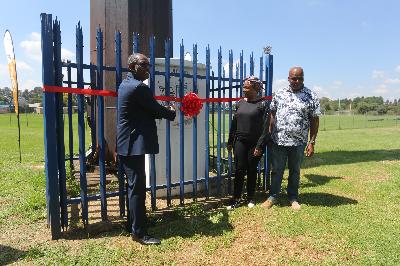
The project will initially focus on connecting schools within the district, beginning with Suncrest High School. It will utilise sustainable, solar-powered infrastructure to ensure reliability and scalability. The long-term vision is to extend the model across districts and provinces, contributing to a more digitally inclusive South Africa.
Welcoming stakeholders, VUT Deputy Vice-Chancellor for Teaching and Learning, Dr Grace Kanakana-Katumba, highlighted the human dimension of the initiative.
“This project is not only about infrastructure, but about people. It speaks to learners seeking knowledge, educators striving to teach effectively, and communities working towards development. Access to connectivity has become essential for meaningful participation in the modern world,” she said.
The initiative was warmly received by community stakeholders. VUT Vice-Chancellor and Principal, Prof Khehla Ndlovu, framed the launch as a defining moment for the University, noting that it signals a deliberate shift in how innovation is applied beyond the institution.
“This is not merely a project launch; it is a statement of intent,” he said, adding that the initiative reflects VUT’s commitment to extending innovation into communities where it is needed most.
He emphasised that the project goes beyond connectivity, positioning it as an enabler of opportunity.
“We are not only providing internet access, but we are unlocking possibilities and expanding pathways for those who have long been excluded.”
Student leadership also expressed strong support for the initiative. SRC Deputy Secretary General, Godfrey Mothibe, emphasised the central role of connectivity in enabling opportunity.
“We are in a digital era where access to information, learning materials, and opportunities depends on connectivity. This initiative ensures that no one is left behind,” he said.