
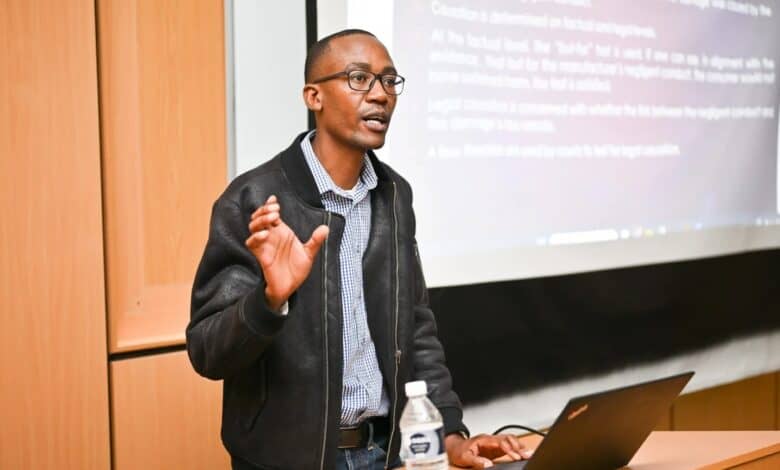
The Vaal University of Technology (VUT) recently hosted a thought-provoking Master’s and Doctorate Staff Research Seminar at Auditorium 100, bringing together academics and staff to engage with a pressing legal question of the digital era: Are South Africa’s product liability laws adequate to protect consumers in the age of Artificial Intelligence (AI)?
The seminar was presented by Stephens Molekwa, a lecturer in the Department of Legal Sciences within the Faculty of Human Sciences.
His research explored the evolving intersection of law, technology and consumer protection as AI technologies become increasingly embedded in everyday life.
Addressing attendees, Molekwa unpacked how South Africa’s legal framework currently approaches product liability through both delictual liability and the Consumer Protection Act (CPA).
“Traditional legal principles were designed to regulate physical products. However, technological developments have introduced AI-driven digital content, autonomous systems, software and algorithmic technologies that can also cause harm to consumers,” explained Molekwa.
During his presentation, he highlighted that under common law delictual liability, consumers are generally required to prove negligence, causation, and damages suffered.
“The principle of res ipsa loquitur, meaning ‘the facts speak for themselves’, allows negligence to be inferred where the circumstances strongly point to manufacturer fault. However, this principle has limitations, particularly where product failures may result from multiple causes beyond the manufacturer’s negligence,” noted Molekwa.
The discussion further examined the role of the Consumer Protection Act, which came into operation on April 1, 2011. Molekwa explained that the Act strengthened consumer protection by introducing a no-fault liability framework under Section 61.
“Under the Consumer Protection Act, consumers do not necessarily have to prove negligence when harmed by defective goods. This represents a significant shift towards greater consumer protection,” he said.
Importantly, the seminar explored how the CPA defines concepts such as harm, defect, product failure and hazard in ways that may increasingly apply to AI-generated content, software systems and autonomous technologies.
“As AI technologies become more integrated into society, questions arise about whether current legal definitions are sufficient to address harms caused by software failures, coding errors, incomplete datasets or autonomous decision-making systems,” observed Molekwa.
He further emphasised that AI technologies can present significant risks if they are not properly tested, regulated and accompanied by adequate instructions or warnings.
“Artificial Intelligence offers tremendous opportunities, but without appropriate safeguards, it may expose consumers to unforeseen risks. The law must evolve alongside technological innovation to ensure adequate protection,” he added.
The presentation sparked meaningful engagement among attendees, who reflected on the need to balance technological innovation with consumer safety.
The seminar demonstrated the critical role of academic research in helping society navigate the legal and ethical challenges emerging from the Fourth Industrial Revolution.
Among those who participated in the discussion was Rethabile Nqhatsetseng, a postgraduate student in Human Resource Management at VUT, who shared her perspective on the topic.
“The discussion highlighted how AI is rapidly becoming part of our daily lives and workplaces. Consumers and future professionals need to understand both the benefits and risks associated with these technologies. Seminars like this help us think critically about how society can remain protected while embracing innovation,” said Nqhatsetseng.